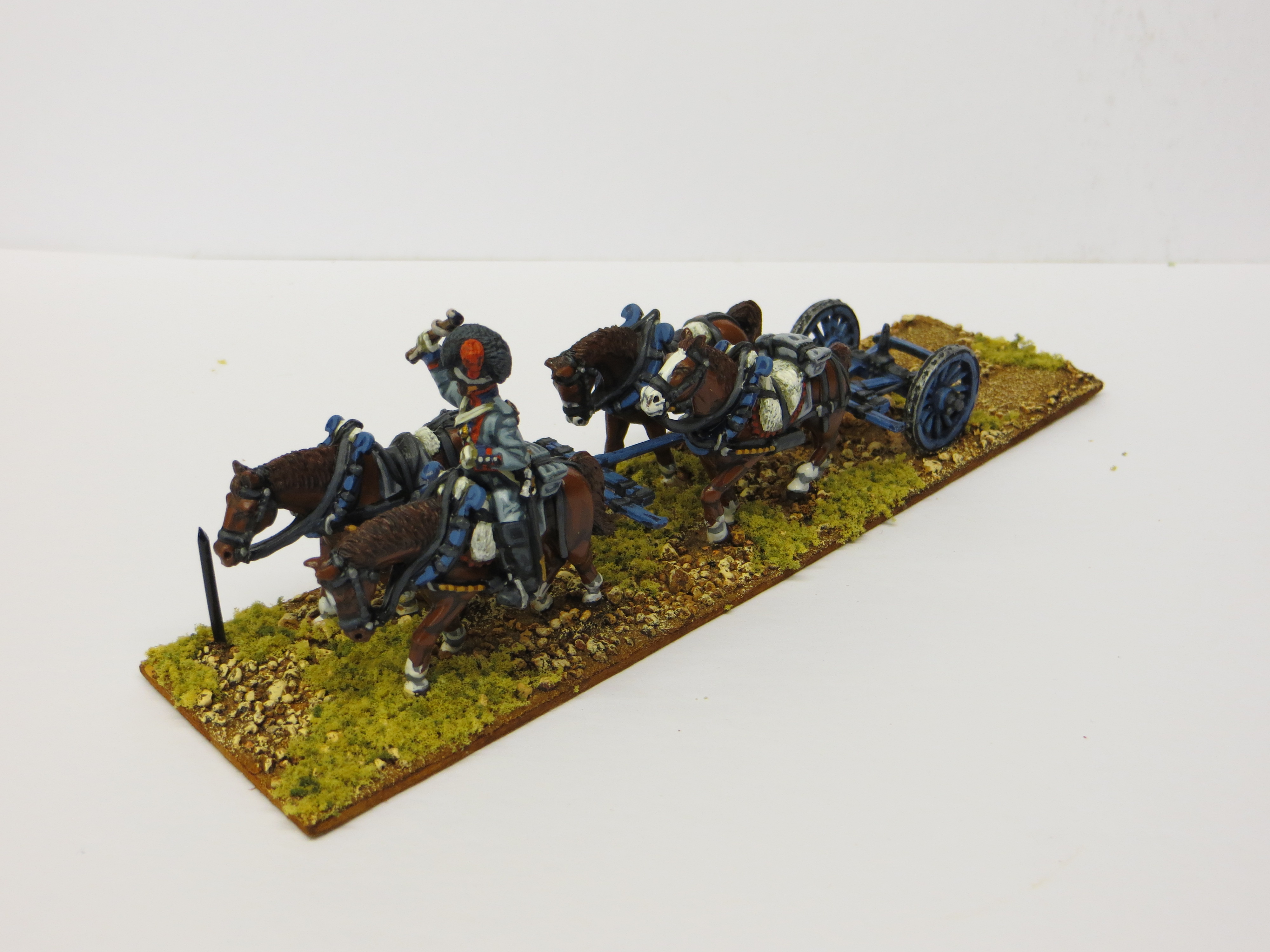
The last of the five orders I placed with Front Rank Miniatures arrived this morning. Everything has been checked and everything seems to be there: 26 units of infantry, 8 units of cavalry, 5 guns, 3 limbers.
Stage 2 of the project chiefly concerns the Spanish (pictured above) but, amongst the lead pile (not shown), I have taken the opportunity to add five more units to the British and French forces.
For the Anglo Portuguese there is a unit Portuguese cavalry (the 10th) that was originally planned for stage 1 (I didn't have enough spare cash at the time), and a unit of British light infantry (51st West Riding) that will enable me to field both Light Division and 7th Division at the same time.
For the French, I've bought another unit of Chasseurs a Cheval (11th) and two more units of Legere (25th).
The former because I think I'm short a unit, the latter to increase my Legere numbers, or enable me to use my Du Midi and Hannovrienne light battalions as line infantry without reducing my numbers of Legere below 8 units - a double bubble purchase for collection flexibility.
These five units are simply 'nice to haves' rather than being 'required'. Another 'nice to have', that I didn't go for, was a couple more units of Portuguese line infantry - you have to stop somewhere! Anyway, I don't think I'm going to paint any of these up straight away - I'm more likely to do them as and when they are required. It's the Spanish army that is my chief concern for the moment.
So, onto the Spanish.
Firstly, after doing some reading, web searching and thinking, I have had second thoughts about my approach. Initially I had planned to do a Spanish army 'for all seasons'. I was going to do the infantry in white coats and bicornes, in coatees with top hats and bell topped shakos, and in the British supplied uniform with stovepipe shakos. However, I've now decided to drop the white coats completely. My reason is pretty simple. By 1809 they had, pretty much, all gone: they had simply worn out, or the units in them had been destroyed or captured during the first year of fighting: For example, Hibernia (actually in light blue coats but, the context is still valid) was fighting in civilian garb by November 1808. It's a crying shame because the white coat uniform is the one uniform there is a lot of definite information about: it's probably why early war Spanish armies are so popular with gamers and manufacturers.
For the mid war years, uniform information - definite uniform information - is quite sparse. Even where contemporary artwork on the subject is available, the caption often reads 'unidentified unit'. Of course, one has to remember that the Spanish central authority and bureaucracy evaporated in 1808 and jurisdiction was maintained by local Juntas not best known for their organisational skills or record keeping. There is plenty of information about the uniforms supplied by Britain and to which regions they were delivered, because the British did keep records but, on arrival in Spain they were given to whatever Spanish authority pertained in the area and the paper trail generally comes to end at disembarkation.
Two things we can be sure of are: Firstly, most 'regular' units from 1810 were uniformed and secondly, an awful lot of uniforms were supplied by Britain. All told, Britain supplied the Spanish with more than 180,000 uniforms, chiefly between 1810 - 13.
Anyone looking into the Spanish of the mid war period soon realises that definite information is sparse, and what there is gets repeated a lot. In the end, I fell back on two sources. I have noted the book used for my uniform decisions. Codes are:
PH: Haythornthwaite and Chappel: Uniforms of the Peninsular Wars 1807 - 1814
O1-3: Osprey Man-at-arms series: Spanish Army of the Napoleonic Wars, volumes 1-3.
All of the infantry units will carry a single flag (except guerillas, with none) as per the regulations of 1806 (from memory) when battalions, previously having two, retired their spare flags into churches for storage. After the French arrived, many newly raised and reconstituted units often took these flags out of churches to use as their own without a thought being given to their regional affiliation or previous owners. Consequently, I'm no longer that bothered by the lack of information on flags. Mostly, I will simply take whatever flags I think are the best fit for my units.
I've sourced my flags from GMB Designs (GMB) and Adolfo Ramos (AR). Little things please little minds, and my mind being little and easily pleased, I've taken to saying Adolfo Ramos, in my best rounding the 'R' Spanish, at every given opportunity. It tickles me pink.
When you read what units I'm doing for this collection you will come to the speedy realisation that I'm not collecting for a specific Spanish army: Units are an eclectic mix of anything in theatre between 1809 and 1813. This is how I did my French, and that seemed to work well enough.
Before I finally get down to brass tacks, there is one last fudge I am going to use and I think it is worth mentioning. Although some units are definite units, most won't be - most will be guesswork. Because of this I will use a very simplified name plate for all units: 6th Malaga will simply read Malaga; Voluntarios de Navarra will simply read Navarra. I don't want anyone, who comes across pictures of these units in the future, to mistakenly think that everything is brilliantly researched because I've given things very specific names, and by using me as source material repeat my blunders. When the situation is confused, it's a good idea to keep the backdoor open.
Note on infantry unit sizes: Unless otherwise stated, all infantry units comprise 24 close order figures plus 4 skirmishers, for a total of 28 figures each. This is slightly more skirmishers than they will often field but I want to make the collection as flexible as I can.
First up, are nine units dressed in the so called 'British uniform' that started to be delivered in 1810 and was the predominant uniform export by 1812.
The coat came in dark blue, or sky blue, with cuffs and collars most commonly red but sometimes other colours, including light blue. One source I've seen on line says that all of the dark uniforms were issued in the north whilst light blue uniforms went to the south (through Cadiz). This is probably not the case, though a majority may have done so.
A distinctive stovepipe shako was supplied with this uniform. Equipment was generally British with white or black belts and trousers were usually supplied in the same colour as the coats, though some pictures I've seen show grey (replacements?).
There were an awful lot of these uniforms kicking about: Britain supplied 80,000 in dark blue alone.
Most sources seem to agree that Cacadores wore the 'British uniform' in sky blue coats with sky blue collar and cuffs. There is some disagreement about company distinctions - some say they were uniformed as per line units, others that they all wore light company distinctions.
Line regiments, could wear either base colour and had grenadier and cacadores companies with red or green fringed padded wings (like those shown opposite) and similarly coloured shako 'ties' and plume distinctions.
Two units of cacadores (each x 24 with 6 skirmishers) will be in sky blue with sky blue collar and cuffs. I've bought all of the rank and file figures with the cacadores distinctions (green fringed padded wings and bugle cap badges, see pic above) - this may be wrong but they will stand out from other units in light blue. They will be Navara and Victoria. The flag for Navara has been sourced (AR), the flag for Victoria will be fudged. (PH. Plate 33)
Two line units will be in dark blue British uniform, faced red. I'm going to use this uniform for some regiments from the Aragon region, with flags of Aragon (AR) and Zaragoza (GMB). I've seen pictures of these specific units, from an older style Osprey that I don't have, on the web. (PH. Plate 35)
Two line units will be in dark blue British uniform, faced light blue. 3000 were delivered for use by regiments serving with Wellington (from 1812). I'm going to go for Leon and Jaen (flags AR). (O3 Plate C)
One line unit in light blue British uniform, faced red. 20,000 uniforms, mostly faced red, were delivered to Cadiz in 1812, so a regiment from Grenada (flagged by AR) seems as likely as any to have got some. (O3 Plate C)
Two line units in light blue British uniform faced black. Definite info here: Two battalions of the Castropol Regiment (1812 - 13) with flags (AR) of Asturias. (O3 Plate B)
Note: All of my units in the British uniform are posed marching with shouldered musket.
I have five units in simple coats and round (top) hats. Three are posed marching, two are posed advancing.
Two units will be dressed in brown coats with yellow collars, cuffs, turnbacks and brown trousers. I'm really not sure what unit names I'll give these troops. Flags and names will be fudged. (O3 Plate A)
Two units will be dressed in blue coats, one with red cuffs and collar, and one with yellow. Turnbacks will be white, trousers dark blue. A shipment of uniforms like this was sent to Andalucia in 1811 for an unnamed corps of Spanish patriots. I'm going to give them to two battalions of Seville (GMB flags). (O2 Plate G)
One unit will be converted into a unit with lapels. Coat will be brown faced red and trousers will be brown. It will be the Almeria Regiment (1808 - 11), even though I'll need to fudge a flag. (O2 Plate B)
I have six units in simple coats and bell topped shako. Four are posed marching, two are posed advancing.
One unit will be converted so that it can be the Toledo Regiment (1811 - 13). The figures will require the addition of tufted shoulder straps and coat lapels. The uniform was a brown coat, yellow lapels, collar, cuffs and turnbacks, and large white shoulder straps tufted white. Trousers were white; and I'm going to have to fudge the trousers because the regiment was actually issued with tight pantaloons. (O2 Plate H) (Flag AR)
Two units will have simple shoulder straps added. The uniform will be brown coats with brown collar and shoulder straps, with red cuffs, turnbacks and piping. Trousers and gaiters will be white. Definite info here, both will be battalions of the 6th Malaga (1810 - 12). (O3 Plate H) (Flags GMB)
Two units will be very simply dressed as per the (20,000) uniforms supplied to northern Spain in 1810 for use by troops in Galicia, and Castille & Leon. The uniform was supplied in two colours, all dark blue coat or all light grey coat. Both uniforms were supplied with grey trousers and black accoutrements. I'm unsure which specific units to dress in this uniform - I'll probably call them Burgos and Castille. (O2 Plate D) (Flags GMB & AR)
The last unit to be dressed in this uniform will a battalion of the Hibernia Regiment dressed in a uniform that was definitely ordered for them in 1809. It comprised a "scarlet jacket, green facings and yellow buttons". Caps would have been shakos. Although there is no evidence that this uniform arrived or was worn, I quite fancy a unit in red coats - that the uniform was ordered is enough for me. I'll do them with grey trousers. (O2 Page 17, description only). (flag AR)
No Spanish army is complete without a few units of guerillas. However, they don't tend to figure very much in field battles so I'm only going to have three small 9 man skirmish units.
(PH Plate 39)So there you have the 23 units of Spanish infantry: Mostly, it has to be said, organised using smoke, mirrors and a huge dollop of fudge.
I'm sorry if you were hoping for more detail and something more solid but, my efforts on that front have been in vain.
The restriction of only using Front Rank figures has also limited my choices a little. I'm sure that if I mixed and matched I'd be able to field one or two more definite units but, I'm not sure I'd have that many more 'sure things'. And I really like Front Rank Miniatures.
Having said this army is a fiction, and I may well cock up with a few names and flags, if I ever take it to a show I very much doubt I'll be hauled up by the button counters. For the most part, even the button counters don't have a clue about most Spanish uniforms: Sad for them, sad for us all, but true. If I ever needed a 'know it all button counter' it was for these boys.
Next up, the cavalry and artillery, and things start to get very interesting.
Thanks to Alec and Angela for giving me permission to use photographs from the Front Rank online catalogue.