Showing posts with label Roll Call!. Show all posts

Friday, 6 December 2024

Beja completed!

This week I have finished the Beja contingent for the Mahdists - I've halved the Mahdist lead pile! It's not the end of painting Mahdists for a while longer as I still have 24 Baggara horsemen (technically part of the Kordofani contingent) to do the Second Battle of El Teb. That amount of cavalry seems a little excessive to me but it seems to be the usual amount for others doing that battle (down to the scenario in Black Powder?), so I'll follow the trend.

Anyway, the last batches of Beja:

Two sword and spear units (#8 and #9), a second captured Krupp, a captured Gatling gun and a command stand. All figures are Perry Miniatures except for the Gatling gun itself, which is an Empress Miniatures piece. The bases are by WarBases. All were painted by yours truly, mostly using enamels; metals colours are mostly acrylic. Bases were washed with diluted acrylic ink and drybrushed with various shades of Dulux household emulsion paint; scrub is Woodland Scenics clumps.
Because all the Beja bases will be mixed up (especially over time) I chose to add a few splashes of colour to the figures in these batches. A few blue, green and yellow waistcoats - I did a few red ones in the early batches. These can be more clearly from the rear: About one in 15 figures isn't dressed in white, off white, beige or dirty orange. 

Note: I still need to texture and paint the base of the command stand - which I decided to add last minute.

I'm rather taken with this Gatling gun from the Empress Miniatures' Sudan range, which I picked up whilst sorting out Peter J's stuff. The gunner is a PM camel rider (left over from doing my Crusades period Saracen baggage train). Indeed, the two units of sword and spear were also largely inherited by me from Peter.
I had no idea what Gatling guns (beyond shape) looked like as I don't think I've ever come across a coloured picture of one before and I do like the amount of brass - it looks great with the gun metal and carriage grey. Note the guy pointing out targets in a fetching yellow waistcoat.
The Beja contingent. At six figures to 100 men (see unit sizes below) the 398 figures represent a force of about 7000 Beja warriors.

The Beja contingent comprises:

A unit of 11 camel mounted scouts (pretending to be 12 strong); three units of 21 riflemen (each pretending to be 24 strong); two Krupps and a Gatling gun; five command stands.
When properly sorted out it runs out to nine units of 33 sword and spear warriors (each pretending to be 36 strong). 

I still need to flag up five units but that must wait for my printer to become operational again - the price of ink!

That's not a bad amount of painting in six or so weeks. I'm in the groove.

Seeing the lead pile diminish by a quarter in so short a time has me worried so, as well as adding a unit of Baggara horse at the Battleground show, I've added some more Korofani troops to bring them back up to the planned eight units of sword and spear, and I've added a few more command figures. Except for another unit of Beja camels which I don't think I need, that just about does it for the Mahdists. Now I'm planning the Egyptian contingent which I'll probably buy over the next few months - my basic OOB is still First Battle of El Teb with a few extra Egyptian/Sudanese units to make up a diminished force for any fictional offensive land operations led by Gordon: I'm certainly not collecting forces for the siege of Khartoum at this figure to man scale because, major period or not, forces of 9,000 Egyptians and 20,000 Mahdists is well beyond scope. I'm still umming and ahing about adding the British Guards Brigade and the Camel Corps.

I've also decided, for definite, that this will be my last major period. After this I'm doing small wars - like the French and Indian War, a few naval bits and pieces, cowboys, etc. Frankly, I'm running out of storage as much as anything.


Thursday, 9 November 2023

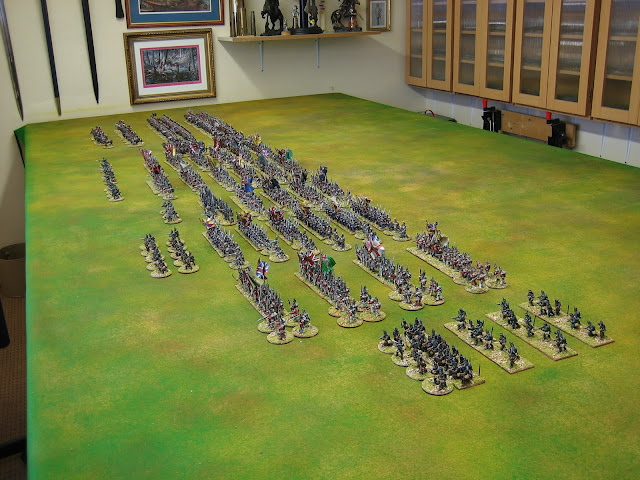
Mid Peninsular War Spanish - Roll Call

 My Spanish army is, for the present, finished. Time for a parade!

This is the army: It only two thirds the size of the British and French armies but, in the years to come I can't see it coming out half as much, and then mostly only in part as a contingent to a British order of battle. It numbers 715 men; 6 guns, 3 limbers and 113 horses.

It is a very colourful army with plenty of uniform variation. All figures are by Front Rank but, I had to do a lot of conversions - mostly minor in nature but lots of them. In the sidebar you'll find a link to individual progress reports with giving unit details, etc. (See: Napoleonic Peninsular War Project - Stage 2 - Mid War Spanish)

It's still not a bad array and is certainly enough to fight a campaign with. Don't be fooled by the proportion of cavalry: I know it is too high overall but, it's always the case that you a lot of units to get the different types you might need and you'll probably never field them all together.

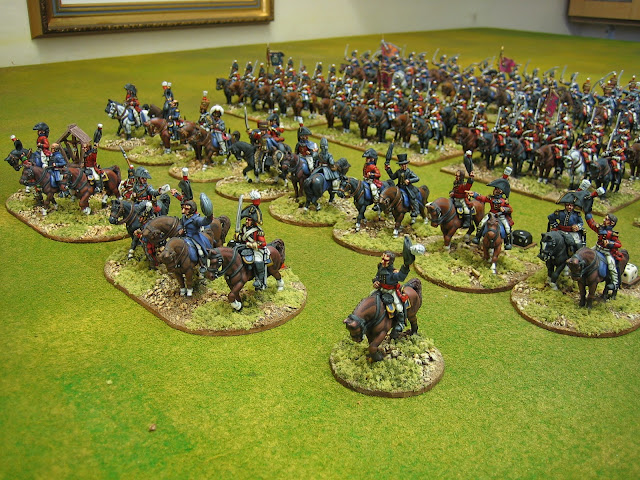
The officers. A C-in-C stand (the best of the three armies) and eight further senior officers stands.
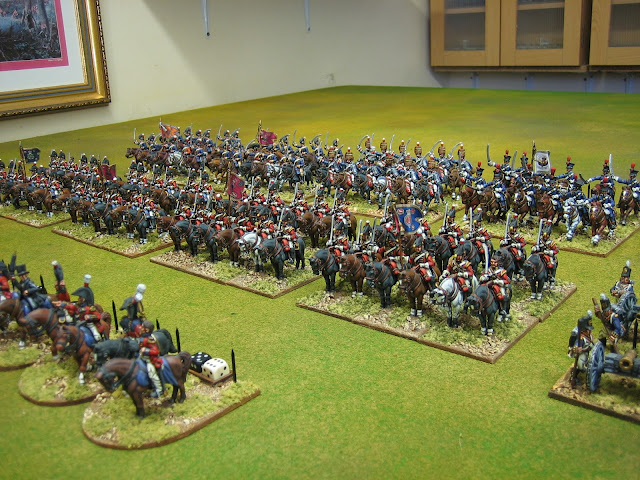
There are seven cavalry units:

Two dragoon units. As well a serving in the guise of Spanish dragoons (best classed as light cavalry), these units can serve as extra units of heavy cavalry when need requires.
Two units of line / heavy cavalry including a new unit: The Coraceros Espanoles. 
Three units of light cavalry. Left to right: Garrochistas (irregular / geurrilla); hussars (another new unit); Cazadores.
The new unit of hussars, previously unphotographed: The Husares Espanoles. These are British bodies with Spanish infantry officer (in bell topped shako) heads.
The Coraceros Espanioles. This unit had one squadron in captured French helmet and cuirass. I've chosen to depict the whole unit with figures from that squadron (to make my life simple). It is simply a unit of heavy cavalry.
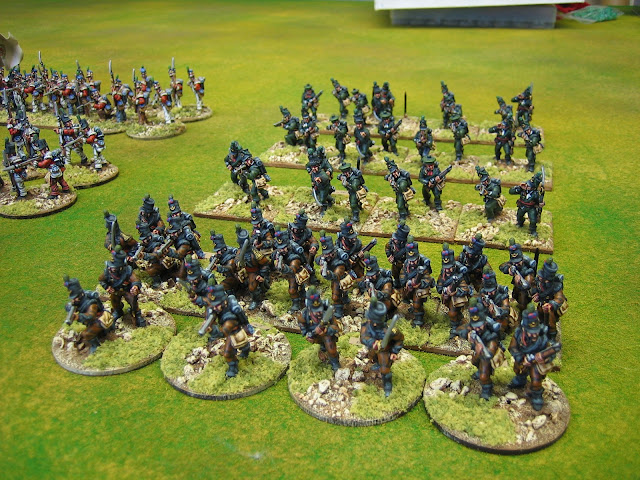
There are fifteen units of line infantry. Five are in bell topped shako. Several units have had minor conversion jobs - I've added popoms, shoulder straps, etc.
Rear view of the same five units from the back. The nearest two are Regimiento Toledo: these have all had tufted shoulder straps and pompoms added.
Three units of line infantry are in round hats.
Rear view of same. I found that I do like units in sky blue.
Seven units of line infantry are in the so called 'English Uniform'. It's boring but, literally tens of thousands of Spanish infantry, from one end of Spain to the other, were kitted out in this horrible thing.
Same from the back. The only interesting thing about it was that lots of the backpacks were made from 'yellow' canvas.
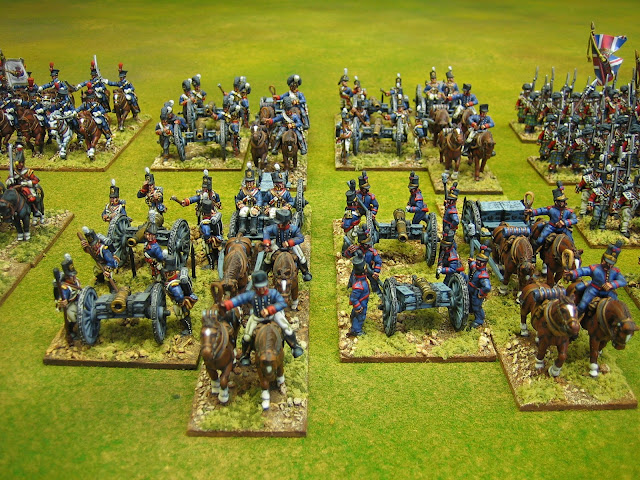
Guerrilla infantry, guns and limbers.
The crew in white uniform are Cadiz artillerymen on duty 'outside the walls'. White was an unusual colour for artillerymen (dirty job?) but, I had to have them. They are mostly Portuguese figures with shoulder wings removed and a round hatted head-swap.
Finally, five units of Spanish Cazadores, Two in 'English uniform (sky blue), two in round hats (brown) and one in bell topped shako (front, in sky blue).
Same from the rear. The two rear units are wearing the 'English Uniform' in sky blue (primarily shipped for cazadore units).

Job done!


Friday, 14 January 2022

Roll Call: My Anglo-Portuguese Army for the Peninsular

As I mentioned in my previous post, since half way through this lot, painting has often seemed more like a chore than a pastime. However, there is always the feeling of satisfaction following the completion of an arduous task and that's pretty much how I feel now. 

"Praise be.... There are no more Brits in the lead pile!"

Enough said.

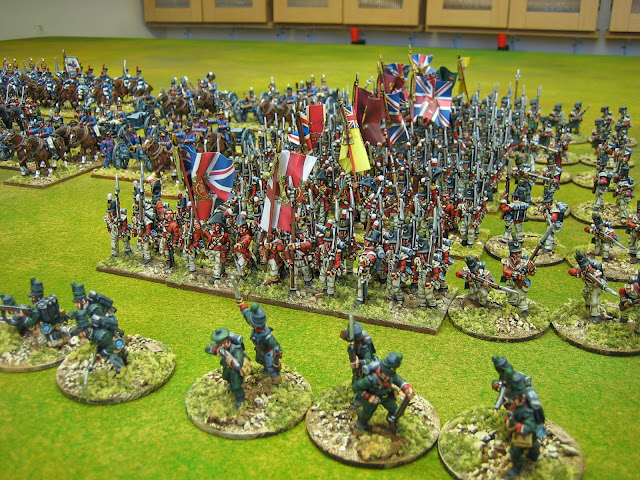
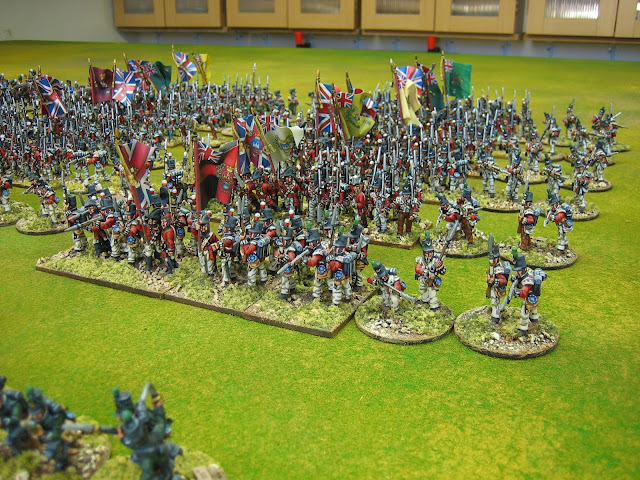
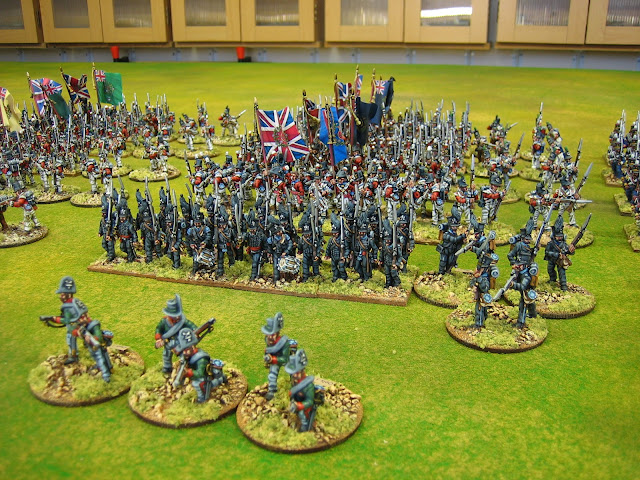
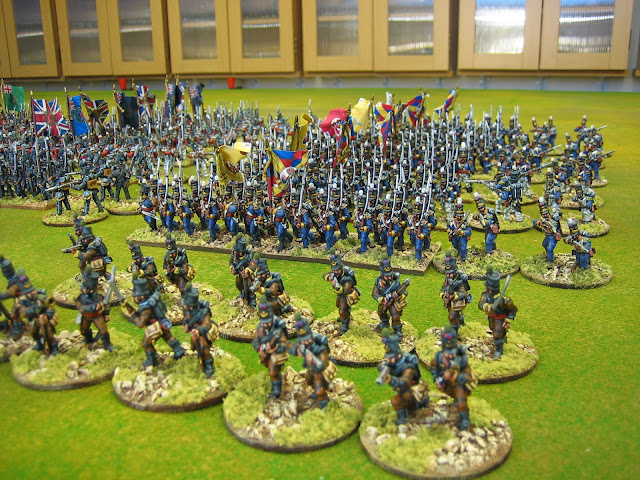
This army comprises twenty eight units of 'formed infantry'; three skirmish units of Riflemen; eight units of cavalry; eight guns and crew, plus four limbers; twenty three extra skirmish stands; ten command stands.

All, except six KGL Light Infantry figures (Warlord) are FRONT RANK MINIATURES.

All were painted by myself using enamels. 

Flags are a pretty even split between GMB Designs and Flags for the Lads. Both are excellent quality; GMB are printed on slightly thicker, shinier paper.

Bases are home cut 2mm MDF (square or officer stands), or War Bases (round for skirmishers). Basing is ink washed and dry brushed sand and grit finished off with foliage by Woodland Scenics (coarse turf: a burnt grass + yellow grass mix). Infantry / cavalry frontage is 45mm per stand.

The British infantry elements were the hardest to settle on because of the 'special troops' required for 1st, 7th and Light Divisions. Consequently, there are rather more special units, such as Highlanders, Guards and Brunswick Oels, than I would have chosen to do otherwise. Indeed, these three divisions grew the army well above the numbers I originally planned and in response the French army grew to match it - a definite case of mission creep.

At first glance the OOB seems incomplete. However, that is because I'm scaling my divisions (my basic command groups) at one unit to a thousand men and, more often than not, this means I need less units than were actually present in the divisions to make the divisions up. Furthermore, table space means collecting more would be practically pointless - I could never physically fit them on my table in any meaningful way.

A classic example of my incomplete OOB is having no 42nd (Black Watch) Highlanders for 1st Division. 1st division usually mustered about 7,500 men which works out at seven or eight units. Looking at the unit composition of 1st Division I decided it should comprise two Guard units, two Highland units (dropping one), one Highland Light unit, two KGL units (dropping two), and possibly one other British line unit (dropping one or two). 

Gentlemen of the League (especially the former and serving officers of the Black Watch), please note that the renowned 42nd were dropped simply because I had flags for the Camerons and the Gordons and no flags for the 42nd - sorry, guys. 

BTW, to the readers who kindly volunteered a donation of their spare flags to this project, thank you again.

The number of Portuguese Line units also seems a little low but, at one unit to one thousand men, there are enough Portuguese Line to furnish three Anglo-Portuguese divisions.

Outside of the afore mentioned divisions, the units I chose to paint had more to do with the flags I had than any specific OOB: They all fought in the Peninsular, and that's enough for me.

With the infantry figures I have, I can field five infantry divisions: 1st Division, Light Division and three other divisions, possibly including 7th Division (The Mongrels) all at the same time. Not bad, at all, and certainly enough for a big game.

A note on skirmishers: The number of skirmish figures attached to a unit does not represent proportionally accurate numbers. The number of stands (each two figures) equates to the unit's basic 'in game' skirmishing factor: A line unit has a skirmish factor of 2, so it gets two stands (four figures) even though this is proportionally too high for the number of figures in the unit; I could have halved the stands, or based less figures individually, but it didn't look as good. The British also have numerous independent skirmish stands that are used to bolster a division's overall skirmish factor - representing attached Rifle coys, Cacadores and such. 

The composition of the cavalry (one unit equates to 500 troopers) is a total fudge because the variation in a cavalry division was quite extreme from one year to the next and I wasn't prepared to cater beyond eight units in this department. However, given that I only use a light or heavy cavalry type classification (with quality adjustments), and one unit can easily substitute for another within that confine, I decided to go for a 50 / 50 split. It remains to be seen if I'm right on this.

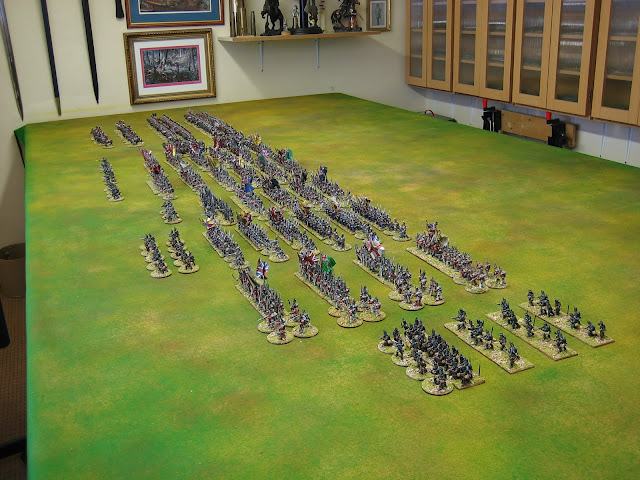
It all makes sense, kind of, to me at least, and here is my 'army'. 

We start with command: Ten command stands plus an engineer.

Two army commanders in Wellington and Beresford; plus an Officer of Engineers (an Officer of Engineers is often useful for scenarios).

Eight division / brigade / command group officer stands including two most definitely for the cavalry. 

Before you all jump down my throat, I know Picton didn't wear the top hat and civilian coat in the Peninsular but, he wouldn't look like Jack Hawkins without it.

The Cavalry: Eight units, each 12 figures strong.

  • 1st and 3rd Dragoons; 1st and 2nd Dragoons KGL.
  • 13th and 14th Light Dragoons.
  • 10th Hussars
  • 10th Portuguese cavalry
Should I have had one less heavy unit and one more light?

The Artillery: Eight guns and four limbers. Each gun has 4 crew figures.

  • Four guns (British Foot Artillery) plus two limbers.
  • Two guns, (British Horse Artillery) plus one limber.
  • Two guns, (Portuguese Artillery) plus one limber.
The Portuguese limber is not available from Front Rank as pictured here. It is a simple conversion - British crew with outer buttons removed, shoulder wings added, sword and sword belt added, and a Portuguese artillery crew head swap. More pics and info here.

The Infantry: Six units each of 24 figures plus 4 skirmishers: 

  • 53rd Foot (Shropshire).
  • 88th Foot (Connaught Rangers).
  • 3rd Foot Guards (Scots Guards).
  • 1st Battalion Coldstream Guards.
  • 79th Foot (Cameron Highlanders).
  • 92nd Foot (Gordon Highlanders).
The Guards, two units, are for 1st Division but could double as other units if the flag position is swapped around. The Union flag is not the King's colour in these units - it's the crimson one.

The Infantry: Six units, each 24 figures plus 4 skirmishers:

  • 50th Foot (West Kent).
  • 27th Foot (The Inniskillings).
  • 5th Foot (Northumberland).
  • 9th Foot (East Norfolk).
  • 11th Foot (Devonshire).
  • 24th Foot (Warwickshire).
The Infantry: Five units, each 24 figures plus 4 skirmishers  (Note: the Brunswick Oels have 6 skirmishers).

  • Brunswick Oels (7th Division).
  • Chasseurs Britannique (7th Division, but can double as something else).
  • 1st Battalion KGL 
  • 2nd Battalion KGL.
  • 97th Foot (Queen's Germans, and with almost identical flags, can easily double as a third KGL unit).
The Infantry: Six Portuguese units, each 24 figures plus 4 skirmishers:

  • 8th; 9th; 12th; 13th; 16th; 21st.
Note the Cacadore skirmisher stands in the foreground. Cacadore units were invariably small, at around 400 actives, so they never quite hit the mark to be fielded as full units. I have chosen to make them additional division assets to be added to the divisional skirmish screens. They are painted as the 6th and the 8th Cacadores. The exception is in Light Division were I field one full unit to represent the multiple units therein (see below).

The Infantry: Four light infantry units each of 24 figures plus 8 skirmishers:

  • 52nd Foot (Oxfordshire) Light Infantry.
  • 51st Foot (2nd West Riding) Light Infantry.
  • 43rd Foot (Monmouthshire) Light Infantry.
  • 71st Foot Highland Light Infantry.
52nd and 43rd are for the Light Division, 71st is for 1st Division and 51st is for 7th Division. 

The Infantry: One unit of 24 figures plus 8 skirmishers; 3 units of 9 Riflemen (Skirmish order):

  • 3rd Cacadores
  • 95th Rifles (skirmish units) x3
All four of these units are for the Light Division.


Finally, extra skirmishers for deployment to the divisional skirmish musters, each stand 2 figures (pictured above, out in front, on round bases):

  • 6th Cacadores (5 stands).
  • 8th Cacadores (5 stands).
  • 95th Rifles (4 stands).
  • 60th Rifles (3 stands).
  • KGL Light Infantry (3 stands).
  • Oels Jagers (3 stands).
Totals: Men 1040; Horses 145; Guns 8; Limbers 4; Ammunition carts 2.

So, am I short? Possibly. If I were to add, and I have no intention to do so, I'd add another unit of cavalry - either light dragoons or Portuguese - and a couple of units of Portuguese line infantry. But, and here's the rub, I don't want to paint any more of them. Nor do I have the storage capacity anyway - see below.

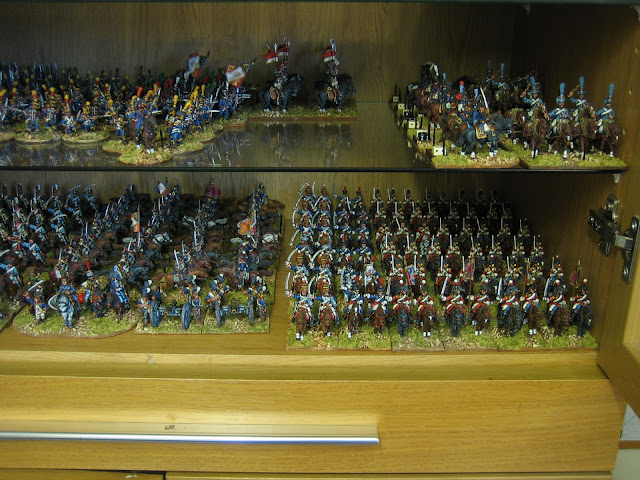
Now, there is one more part to this tale of woe: Don't let me get away without confessing a sin. It's a simple sin and, I think, one not often spoken of but shared by many: When conceiving and planning a collection I have more than history, or even a good game, in mind. In my view, there is no point collecting what you can't possibly store. Consequently, I do buy figures by the yard - there, I've said it.

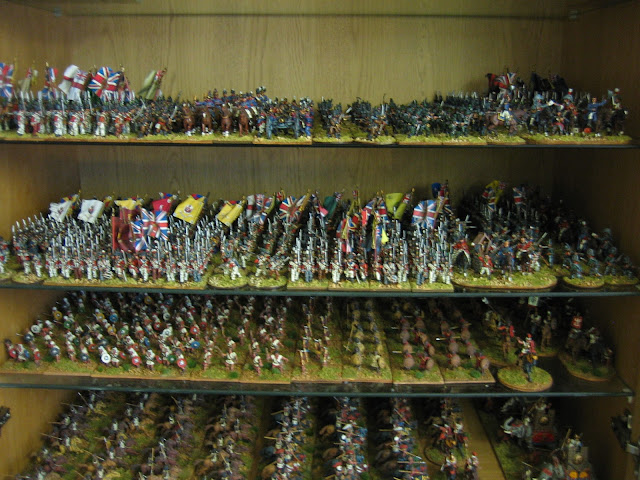
The two pictures above shows just how much that this is the case: Crammed in they are, crammed into a strictly allotted space. 

You will note two large spaces on the first French shelf above the cavalry (there's another completely full French shelf above that). I'm going to fill those spaces next, with two units of Legere, a unit of Chasseurs a Cheval and a second army command stand. That will completely finish the French.

Then I'll start the Spanish. It never ends....

Thursday, 23 December 2021

Roll Call: Parading the Fleet

So that Peter J. can see what I have, so he can use a Squadron Builder site to create his own squadrons, I've decided to parade my X-Wing stuff.
EDIT: Four ships were added as of 31/12/21 and are now included in the totals. Classes with changed numbers have been highlighted yellow.

I'm not exactly sure how I've managed to collect this amount of stuff for a game I've played less than half a dozen times but, there you have it, I'm a collector, obviously. Most of these ships have never fired a shot, sorry laser.

It was Peter who started me off down this road. One Christmas, several twin moons ago, he brought a starter set round to play and I was immediately hooked. It looked perfect, as a 'filler game', to play between larger historical games.

Initially I thought to buy a dozen ships but, it seems X-Wing models are like crack cocaine: Unlike figures, which you need to paint and base before you can use them, X-Wing models provide instant 'ready painted / ready to go' gratification; you can use an X-Wing model immediately after taking it out of its box; for me, this was quite novel and very addictive.

Since splurging on ebay (I probably bought over half the collection in the first year), when you could pick up ships relatively cheaply (66% cost, or less), I've curbed the number of ships I buy: Now I usually only buy ships after Christmas or my Birthday, using up the Amazon vouchers I invariably receive. 

This year I'm adding at least one more ship, a present from my wife for Christmas, an Imperial Raider Corvette: I can't wait for that to arrive. It's the biggy!

However, looking forward, being a collector of version 1 (now outdated), pickings will be slim. Most V1 ships are unobtainable and those that are seem to be quite expensive (K-Wing £25). Long gone, it seems, are the days of reasonable ebay bargains. 

My Christmas present Raider is a case in point, it was bought on ebay in used condition and there wasn't much change from a ton. In my first year of collecting they were coming up regularly for £50 - £70 each. Plus, although I can see a small base for the Advanced Tie Fighter that comes with a complete Raider package I'm not expecting to see one in my ebay purchase - or will I be surprised? Blimey, that would be a cosy bonus because I'm looking for one!

I think X-Wing is a great fun game and the pre-painted models are superb. I really should get it out and play with it more often. Obviously, anyone contemplating getting this game from a standing start should go for the version 2 edition - more ships and readily available. I'd upgrade myself but, the cost would be horrific!

Anyway, enough said, onto the roll call. The following pictures have been added to show just how good these little models are.

A-Wing x2
B-Wing x4
E-Wing x2
K-Wing x2
X-Wing x6
Y- Wing x2 (Note: +1 in Scum faction ships).
Z95 x 1 (Note: +2 in Scum faction ships).
HWK-290 x1 (Note: Can also be a Scum faction ship, I only have one model).
Sheathipede-Class Shuttle x1
Tie Fighter (Captured) x1

Tie Fighter x8
Tie Interceptor x5
Tie Bomber x2
Tie Punisher x2
Tie Defender x3
Tie Reaper x1
Tie Advanced x2
Tie Phantom x2
Tie Aggressor x2
 
M3-A Interceptor x2
Starviper x1
G-1A Starfighter x2
Quadjumper x1
Scurrg H-6 Bomber x1
Kihraxz Fighter x2
Z95 x 2 (Note: +1 in Rebel faction ships).
Y- Wing x1 (Note: +2 in Rebel faction ships).
HWK-290 x1 (Note: Can also be a Rebel faction ship, I only have one model).
B/SF-17 Bomber x2
YT2000 x1
YT1300 (Millennium Falcon) x1 
Lambda-Class Shuttle x1
Upsilon-Class Shuttle x1
VT49 Decimator x1
Firespray 31 x1 (Note: I have cards for this to be either an Imperial or Scum faction ship).
Lancer-class Pursuit Craft x1
Jumpmaster 5000 x1
YV-666 x1
C-ROC Cruiser x1
GR-75 Medium Transport x1
Gozanti-Class Cruiser x1
Raider class Corvette x1

There is also a home made escape pod and an asteroid base, plus some asteroids, space buoys and debris clouds.


Monday, 12 October 2020

Reorganising and rebasing my Crusades collection

Grid based miniatures games are not everyone's cup of tea but, no one can argue that grid based games don't usually have the clearest rules. This is because the ambiguities thrown up by more conventional 'free moving' table-top rules are eradicated by the simple imposition of the grid. Such games also seem to play faster, possibly because measuring distances can be done by just counting squares or hexes, any question regarding 'angles' is always clearly defined, and possibly because a 'board game grid' always feels user friendly (could the reason be that simple). 

On the downside, the strict adherence to the grid can sometimes detract visually. Not because of the grid pattern on the table (which can be made almost invisible by just marking square intersections) but because units can sometimes seem to be facing in an unrealistic direction when carrying out actions. However, the fun that can be had from elegant grid based games, especially those that come with a lot of important decision making opportunities and subtlety, far outweigh this downside and it is soon forgotten. 

Two grid games we regularly play using miniatures are Commands and Colors (which uses a hex based grid), and To The Strongest (which uses a square based grid).

Of the two, To the Strongest (TtS) by Simon Miller is probably the most favoured here - we definitely count as fans. We have used them for all manner of ancient and medieval games, both here and at Graham H's place. Most recently we have used them for battles set during the Crusades. However, my Crusades unit organisation didn't work well for TtS because my four stand units were to big to fit into 20cm grid squares.

A 'To the Strongest' Crusades battle prior to mass reorganisation and rebasing using cobbled together 3 stand units. 
Each terrain tile is divided into nine 20 x 20 cm squares marked only at their intersections - see 'em?


For the last TtS Crusades games we played I had cobbled together three stand units. Following these battles, I  decided to reorganise the collection, and re-base where necessary. Then Covid 19 got in the way and the games stopped - no longer any need for urgent progress with that idea. However, work has continued very slowly, in fits and starts, and half finished jobs. Frankly (no pun intended), it's been a chore but the results have been pleasing.

So, job done, it's time, Roll Call!

First up, The Forces of Islam. This force was built so it can make up an army for the Seljuks of Rum or a Syrian City State. It is quite a small force but it still covers most of the bases for evening long games. I'd like to add half a dozen more units of infantry, including two units of Daylami, to make it a more versatile collection.

The entire force. 
It comprises 277 mounted figures including a single camel rider, and 218 foot figures of all kinds. 
Quite small really - it's the cavalry that give it a footprint.


Twelve units of Turcoman light cavalry horse archers, each 7 figures.

Perry Miniatures.
Three units of Bedouin light cavalry each 7 strong (probably one too many units but the Franks can also use one or two).

Perry Miniatures.
Five units of Seljuk horse archers each 10 figures strong. 

Under TtS these count as 'cavalry' rather than 'light cavalry' which works very well IMHO.

Perry Miniatures.
Five units of Ghulam / Askari lance / bow armed heavy cavalry, each 12 figures strong (one is 13 strong). 

These normally form the bodyguard units of generals. I have decided to mark units as having a general rather than have separate 'command figure' stands. This helps to get the three stand units into the boxes (and the five 3 figure general stands I had helped to fill out the ranks of these cavalry and the Arab cavalry below).

Perry Miniatures.
Five units of Arab / Kurdish lance armed heavy cavalry, each 12 figures strong.

Perry miniatures.


One unit of Mattatawia, 33 figures strong. 

It is a TtS 'deep unit'. I'd like another of these.

Perry miniatures.
Three units of Adhath city militia, each 22 figures strong. I'd like to add one more with glaives instead of spears.

Perry miniatures.
Five units of Arab light infantry archers, each 9 figures strong.

Footsore Miniatures: Armies of the Caliphates range.
Three units of Turkish foot, each 23 figures strong.

Perry miniatures.
Two units of Turkish light infantry archers, each 9 figures strong. I'd like to add one more unit.

Perry miniatures.
A 'carvan' of four stands of pack camels. Each has three camels plus attendants. They don't really have a fixed unit organisation. 

The camels are 'Beja camel warrior' camels (riders not used) with home made Milliput, balsa wood, and bits and pieces baggage loads.

Perry miniatures.
Naffatun fire pot throwers. I generally field these as one stand units. I'd like two stands more so I can field them as two stand units.

Perry miniatures.
The 'band stand'. 

This allows a senior general in the same square (TtS box) to reissue a failed order to a unit / box up to 3 squares away, once per turn (a house rule). 

It reflects the Islamic practice of using musicians to instantly transmit simple orders over long distances. They also used large flags (think semaphore), sometimes from camelback howdahs, to do the same - that would make a good stand too. It counter-balances the effect of the Frankish True Cross / Holy Lance.

Perry miniatures.

The entire Frankish force, plus allies. 
It comprises 116 mounted figures including a single donkey rider, and 408 foot figures of all kinds, plus various animals.

Next up, the Franks and their Allies. This force was built up to represent armies of the First Crusade and early Kingdom of Jerusalem period up to, and including at a pinch, the second Crusade; after that date the knights are all wrong. 

I would like to add a few more units to this force, including three unarmoured 'pilgrim soldiers' / Arriere Ban spearmen only units, plus a few others, mostly Armenians (detailed below).

There are five units of knights, three of 12 figures and two of 11 figures. (Only one pictured).

Perry Miniatures.
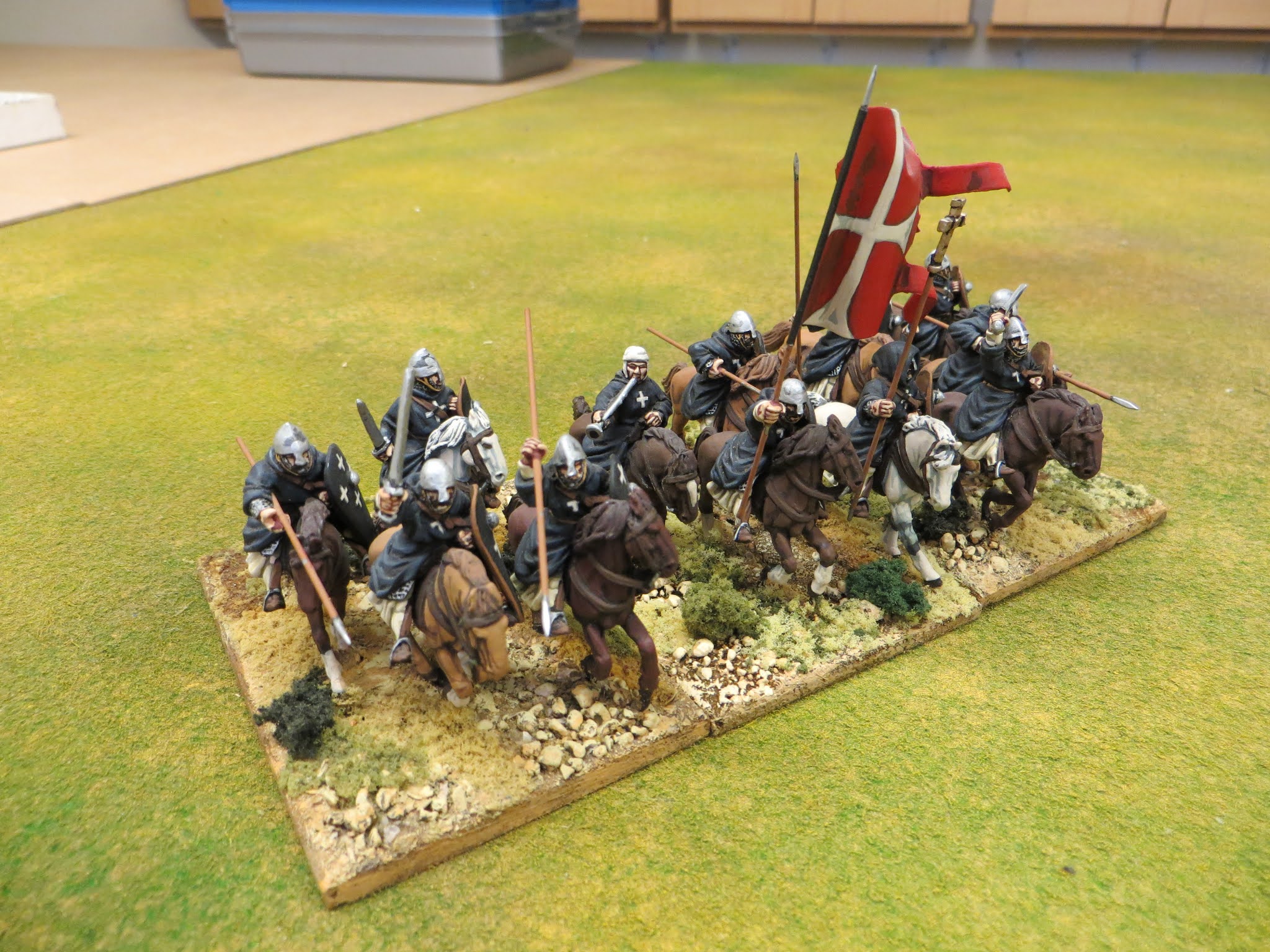
There is a single unit of Hospitaler knights, 12 figures strong.

These are probably more suited to the period immediately after the one I collected for but, knights of a Military Order are so useful for one off scenarios and always add a bit of colour - not to mention highly motivated oomph.

Perry Miniatures.

Three units of Turcopole light cavalry, each seven figures strong. (Only one pictured).

The Franks never seem to have enough of these useful chaps.

Perry Miniatures.
Three units of foot sergeants, armed with simple spears and bows in a mixed unit, each 22 figures strong.

Perry Miniatures.
Five units of foot sergeants, armed with spears and crossbows in a mixed unit, each 21 - 22 figures strong (108 figures total).

For the First Crusade this is proportionally wrong. There were probably far more simple bows in evidence than crossbows. I don't get hung up on this because I only give early crossbows the same range as bows - they are just simple bows with a stock in this period.

Perry Miniatures.
A unit of light infantry archers with bows, 10 figures strong, and a unit of light infantry slingers, 9 figures strong.

I will add another unit of archers to fight with the Arriere Ban I'll eventually purchase.

Perry Miniatures.
Two units of light infantry crossbowmen, each 10 figures strong.

Perry Miniatures.
Three units of pilgrims (all in TtS deep formation), each of 29- 30 figures and animals. 

Note that I based all of these units with 'abled bodied men' at the front so that they don't look completely hapless and helpless. 

Pilgrims are an absolute must for the First Crusade. In fact, you need so many of them that I did baggage stands to mix in (see below) to save a bit of money and painting time (giving a possible five units overall). They have been used in more games than I care to remember so, although of dubious military quality, the gaming value has been well worth the investment.

There is a right old mix of figures here (I threw the sink at them) but, mostly they are Perry and Gripping Beast.
 
Six stands of baggage, to be used as such or to mix in with the pilgrims to build them up to five units. All told the baggage comprises 12 figures, 3 wagons and 16 animals.

Over the years I've come to love baggage elements.

Another hotchpotch of figures. The wagons are built out of Irregular Miniatures bits and pieces - real one offs. The cattle are Foundry. I can't remember who makes the pack animals.

Two stands of artillery and a True Cross stand.

True Cross by Perry Miniatures. Artillery by Gripping Beast.
Two units of Maronite Christians (from Mount Lebanon?), 23 figures strong.

This is a very versatile unit for the Franks, it could also be used for representing a contingent of Assassins.

Footsore Miniatures: Armies of the Caliphates range.
Two units of Armenian infantry, each 21 figures strong. (Only one pictured).

I will add another unit of these.

Armenians are very versatile figures because they can fight for both sides. They were employed by the Franks, the Seljuks of Rum and the Islamic states of northern Syria.

Perry Miniatures. Note that I've changed the arm position on a lot of the Armenians from above shoulder to below shoulder - they look quite static otherwise. Normally, I would say that Perry are the best figures out there but, the one pose spearmen in the Armenian spearmen packs (armoured & unarmoured) are weak in comparison to the rest of the range.
Two units of Armenian light infantry archers, each 9 figures strong. (Only one pictured).

I will add another unit of these.

 Perry Miniatures.
A unit of Armenian 'knights', 14 figures strong, and a unit of Armenian light cavalry, 7 figures strong.

I will add another unit of knights. 

 Perry Miniatures.

So that's it. That's the collection in a nutshell, and a note of the additional units I'd like to add to complete it. 

Total (on the shelf) collection is: 393 mounted figures, 626 foot figures and a bunch of pack animals, wagons and so forth. 

Although this is my smallest collection, it is one of my favourites. Sometimes, medieval games can seem a bit of a slog but, I assure you the Crusades are a period apart. The Crusades are different because they offer forces that fight using totally different tactical styles. Also the armies are not as 'fixed' by religion as one would first believe; there is at least one case of two Christian armies, both with Muslim allies, having a ding-dong. It's the clash of military cultures that sets these games apart, and I just love them. 

One day, when suitable metal figures become available (mainly Sudanese ghulam foot archers, Abyssinian swordsmen, etc.), I plan to add Fatimids to the mix. That will enable me to not only to fight Fatimids Vs Franks but, Seljuk Sunnis Vs Egyptian Shiites, the latter again using forces with different tactical styles - massed foot bows Vs massed horse archers, both with heavy cavalry to pack their punch. I can't wait!

21/06/24 EDIT: Since this was posted I've added the following units:

Turcopoles x1; Dismounted knights (small units of 11 figs on one 90x60 stand) x2; Armenian spearmen x2; Armenian archers x2; Armenian knights x1; Adhath glaivemen x2; Turcoman horse archers x2; Muttatawia x1. Lastly I've rethought the Naffatun and done them as small units of 4 figs on one 90x60 stand, I have x3.