Showing posts with label To The Strongest - Punic Wars. Show all posts

Thursday, 5 July 2018

Ilipa 206 BC - Battle Report

On Wednesday evening, the Ilkley Lads game night, we took are first crack at Ilipa 206 BC using To the Strongest! rules. The battle was good fun and went to the wire. 

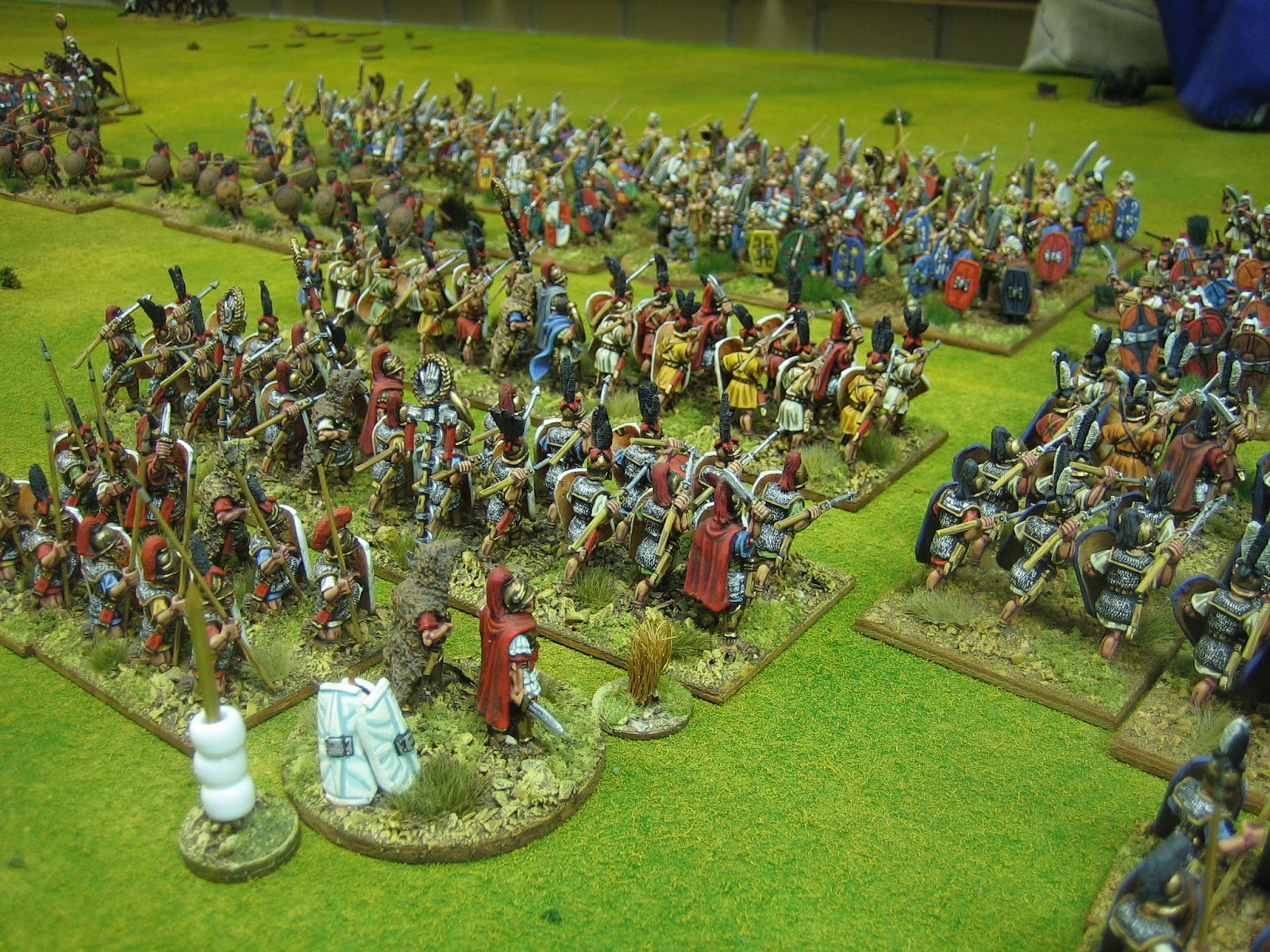
Accompanying this post are some photos of the game in progress.
Peter, having drawn lots of good chits is looking very happy with himself - this might have been the point at which Mark said "Give him a dice."
Last night's set up worked O.K. but it could be improved upon. To that effect, I have edited the Ilipa 206 BC scenario I posted on Tuesday with all of the changes. I'll quickly point them out here.
Peter's troops on the attack!
I've decided to use the rule for triplex acies exactly as written in the 3rd edition of the Punic Wars army lists. This has extended the Roman line to conform with the length of the Carthaginian line and should give the Romans a little more flexibility and oomph on the flanks. Having read this rule again I think it will work extremely well for this battle; it puts the cavalry in a better position to carry out it's flanking moves; the army number ratios are not substantially changed (the Roman army is just 2 VPs stronger). 
It's all about to get messy in the centre.
Initially I had thought to give the Roman cavalry a save on 6+. Just prior to last night's battle I changed this to a save on 7+ with a +1 bonus when in melee with Carthaginian cavalry. This worked better, and it better reflected the morale ascendancy the Roman cavalry had over its Carthaginian counterparts.

I cocked up the ammunition for Spanish scutarii - they should only have one ammunition chit for ranged melee weapon (Soliferrum / Spanish - Saunion). There is a change I'm going to make to the basic rules regarding shock missiles (see advanced rules). In my Punic Wars games, I will play that where two units oppose each other with shock missiles, Roman legionaries and Alae legionaries will always throw first. My reasoning is this: the risk of being disordered when charging will dampen a Roman player's willingness to be 'aggressively Roman', and Roman legions and their alae legions are 'trained regulars'.
In you go, boys! Note the Spanish with the wrong kind of ammunition chit markers. The beads should be red and in the singular. I don't allow ranged melee weapons (pilum, siliferrum, etc.) to be used in a 'general missilery' role.
I am fully aware of the limitations of pachyderms in war and I think Simon Miller must be too. Personally though, I like elephants to be a little more useful than they probably were historically - purely on the grounds that they look too cool to be that bad. To liven them up, my elephants will be able to make a double attack twice. I'm also going to allow for a save on 7+ versus rampage - historically, when an elephant went berserk its mahout dealt with it by hammering a chisel into its skull, and mahouts were all so equipped for just that purpose - and if the save is made no rampage will take place. I will maintain my own house rule on square occupation for elephants as my squares are large enough to accommodate them and it doesn't really effect game play. Otherwise they are unchanged.

I have changed the effect of Scipio's element surprise. The change is minor, but I thought that the Carthaginians got off the blocks a little to easily last night.

Some rules for To The Strongest! are not in the rule book. These can be downloaded from the To The Strongest site as the free download "Even Stronger". We used at least two of the rules last night. The first is that for command group moves, the second is the replacement rule for command group demoralisation. I have to say that the latter rule is very much better than the rule it replaces and I'm using it from now on.
The Romans, about to lose two units in quick succession - game over!
As it was, the Carthaginians took the laurels with some flukey saves and hits right at the end - in the penultimate Carthaginian turn I made six consecutive saves and in the last Carthaginian turn Peter made several consecutive hits, virtually none of which were saved. The game finished with the Carthaginians having just 5 VPs left, it could so easily have gone the other way.

Next week we will re-fight it again, swapping sides, with the Romans under Peter J. and myself and the Carthaginians under Graham H. and Mark D. We will also swap over the table opponents.

Tuesday, 3 July 2018

The Battle of Ilipa 206 BC, using To The Strongest rules

Following a run through of this battle this post has been updated with several text edits and new photographs.

This week, at Peter J's request, I've set up a battle from the 2nd Punic War. Our first thought was to do a game using Hail Caesar but, because I don't have the army lists done, because I don't really know the rules (it would be a first battle using Hail Caesar), because I only have the PDF of the rules (which Warlord were offering for free a while ago), and because Mark D. wants to try a game of To The Strongest (rules the rest of us are familiar with), I've decided to set up the Battle of Ilipa 206 BC on the T.T.S. grid.

I haven't done this battle before, I can't think why, so it's probably worth me writing up the following blurb for the players as a pre-game briefing. 
Note that this picture shows the table with the drop leaf extension (foreground) down. On game night it will be raised for two extra flank squares.
I have edited the text for the following picture but the other photos were taken before this change was made. Given the Romans should (will !) attack I think giving more room behind the Carthaginian line will work much better.
A much better deployment providing the Romans attack - I'm planning this to be a demo game this year where they will!
Historical Background

In 211 BC the Romans in Spain suffered a crushing defeat at the hands of Hasdrubal Barca, Mago and Gisgo. The disaster was compounded by the deaths of two of the Roman commanders, Cnaeus and Publius Scipio. 

The remnants of the Roman army, under it's soldier elected leader Marcius Lucius managed to cling onto a small enclave north of the Ebro until reinforced by fresh troops, and a new commanding officer named Nero, that sailed in from Italy. 

Nero did much to improve the situation and by the Spring of 210 BC he was aggressively expanding Roman territory south of the Ebro.
Crusader Miniatures elephants. These have had some significant alterations to what comes in the post. Extra 'neck' has been added to raise the elephants head, padding has been added to the bottom of the howdahs, and various chains, tassles, shields and other adornments have been modelled onto them. The howdah crew are Renegade Miniatures.
At the end 210 BC Nero returned to Rome. He was replaced by one of the most gifted generals of antiquity - Publius Cornelius Scipio, later called Scipio Africanus - who arrived in Spain with further reinforcements. He was the nephew of the former commander, killed in Spain in 211 BC.

In 209 BC Scipio took the Barca's Spanish capital of New Carthage, and followed this major achievement by defeating Hasdrubal Barca at the Battle of Baecula in 208 BC. 

This victory cemented Scipio's reputation with his soldiers - they were well trained veterans, well led and confident.

207 BC saw the Romans under Scipio consolidating their gains, especially over the rich silver mines in the Baecula region. The Carthaginian counterattack under Hasdrubal Barca fizzled out before it achieved anything and the Carthaginian army went onto the defensive by dispersing into surrounding cities. 


Spanish and Numidian cavalry. The Spanish are Renegade. The Numidians are a mixture of Crusader (front) and  another manufacturer (rear).
In 206 BC the Carthaginians decided to make a major effort against Scipio; they concentrated a large army under a new commander in chief called Hasdrubal Gisgo; this army would swamp and crush the lucky, until now, Roman. 

The army is variously described as somewhere between 50,000 and 70, 000 foot, between 4,000 and 4,500 horse and thirty-two elephants. (Polybius gives smaller numbers than Livy).

Hasdrubal established his camp on top of a ridge near a town called Ilipa (probably in the modern region of Seville) from where he could taunt the Romans into action.

Scipio called in his various detachments and newly won Spanish allies. His army, roughly half Italian and half Spanish, amounted to 45,000 foot and 3,000 horse. He marched towards Ilipa and his willing enemy. Here, on a ridge on the opposite side of a wide flat bottomed valley, Scipio established his camp. 


Romani and Latini equites backed by velites.
Following a clash of cavalry as Scipio's army approached, which the Romans got the better of, things calmed down to a daily routine. 

Each morning, both armies would march out of their camp and form up in the plain between the ridges. Both sides formed up in a conventional fashion. 

The Carthaginians formed up with their African infantry in the centre flanked by Spanish troops supported by elephants, with wings of cavalry. The Romans deployed with their legions and alae in the centre flanked by their Spanish allies with cavalry on the wings. 

Neither side would attack, and after the usual taunts and challenges that accompanied such displays of force, both armies marched back to their respective camps for the night. Every day the routine was the same until.....
Rome's Spanish allies with attached Spanish general.
Scipio decided to wrong foot his enemy, and following a council of war where his orders for the upcoming battle were given and explained to his subordinates, the Roman army marched out of camp. 

The Carthaginians formed up as usual. The Romans formed up differently. 

On this morning, Scipio deployed his Spanish infantry in the centre flanked by a legion with its alae of Latins, whilst on the wings the cavalry deployed supported by the army's velites.
Roman and Allied triplex acies formations - more anon.
Scipio's plan of attack was sophisticated. His Spanish troops would advance and pin the Carthaginian centre in place without coming to hand strokes. The Romans and Italians would attack the Carthaginian's Spanish troops and cavalry whilst the Roman cavalry and velites manoeuvred around the enemy flanks. 

Scipio hoped that, having thrown the Carthaginian battle plan into confusion by his novel deployment, his troops might get into their final attack positions before the enemy could respond effectively. His judgement was correct and his victory was an emphatic one.

The Game

The game has been set up on a 16 x 7 grid. No man's land is three squares. 


Because my units are quite large I decided to have my table marked up with 10 inch squares; this means my six feet wide table is only seven squares deep, not the prescribed eight; according to Simon Miller a three square deep no man's land, rather than four square deep no man's land, is quite sufficient for 'infantry' battles and I tend to agree.

The grid has been marked with green dots. They are easily seen when looking for them but they are unnoticeable when you aren't. A grid of bold lines is not required.

The Romans
The Roman battle line.
The army has four 'heroes' and four spare ammunition chits. The army's breaking point is 14 VPs. The C-in-C, Publius Cornelius Scipio, is a senior brilliant general; he can be deployed anywhere in or behind the Roman battle line prior to battle.

The Romans are deployed with a first square front line and two clear squares to either flank. From left to right, they are deployed in the following order of battle (colours denote separate commands). 

  • Romani / Latini equites backed by velites, + general.
  • Romani / Latini equites backed by velites.
  • Alae triplex acies Hastati / Principes unit backed by a small triarii unit.
  • Roman triplex acies Hastati / Principes unit backed by a small triarii unit, + heroic general.
  • Spanish scutarii (deep unit).
  • Spanish scutarii (deep unit), + attached general.
  • Spanish scutarii (deep unit).
  • Spanish scutarii (deep unit).
  • Roman triplex acies Hastati / Principes unit backed by triarii, + heroic general.
  • Alae triplex acies Hastati / Principes unit backed by triarii.
  • Romani / Latini equites backed by velites.
  • Romani / Latini equites backed by velites, + general.
Publius Cornelius Scipio (senior and brilliant).
Rather than use individual figures to represent heroes, I use spare shields mounted on two penny pieces.
The yellow beads are reserve ammunition chits. The poker chips are army break point VP chits.

Scipio (senior and brilliant) can be deployed anywhere in the Roman battle line. The army has four heroes and four spare ammunition chits. The army's breaking point is 14 VPs.

Rather than use individual figures to represent heroes, I use spare shields mounted on two penny pieces.

The Carthaginians
The Carthaginian battle line.
The army has three heroes and six spare ammunition chits. The army's breaking point is 18 VPs. The C-in-C, Hasdrubal Gisgo, is a senior heroic general; he can be deployed anywhere in or behind the Carthaginian battle line prior to battle.

The Carthaginians are deployed, with a third square front line and two clear squares to either flank, from left to right, in the following order of battle. 

  • Numidian cavalry backed by Numidian cavalry.
  • Spanish cavalry backed by Spanish cavalry, + general.
  • Escorted African elephants backed by Spanish scutarii (deep unit).
  • Escorted African elephants backed by Spanish scutarii (deep unit), + attached general.
  • Spanish catrati backed by African spearmen (deep unit).
  • Balearic slingers backed by African spearmen (deep unit).
  • Balearic slingers backed by African spearmen (deep unit), + attached general.
  • Spanish catrati backed by African spearmen (deep unit).
  • Escorted African elephants backed by a Spanish scutarii (deep unit).
  • Escorted African elephants backed by a Spanish scutarii (deep unit), + attached general.
  • Spanish cavalry backed by Spanish cavalry, + heroic general (Massinissa).
  • Numidian cavalry backed by Numidian cavalry.

Hasdrubal  Gisgo (senior and heroic). 
In the game, ammunition chits are displayed with black pony beads on a 'spike'. Spare ammunition chits are yellow. This is so I don't confuse my piles of spare and spent - everyone else doesn't seem to have a problem with beads of the same colour but I do, and I usually end up with more spare chits than I started with; hopefully this simple two colour approach will help.
Notes on Troops

  I will use the standard rules, with one exception (see elephants), but I'll play around with the definitions for some troops.

  • All equites save on 7+ and have 1 ammunition chit. Due to their morale ascendancy over the Carthaginian cavalry, gained when the armies first met, in melee they get a +1 save Vs Carthaginian horse.
  • Velites save on 7+ and have 3 ammunition chits.
  • Hastati / Principes save on 6+ / 5+ (see special rules below) and have one ranged melee ammunition chit; they are drilled legionaries.
  • Triarii save on 5+; they are drilled legionaries.
  • All Spanish scutarii are deep shock javelimen units, save on 7+ and have one ranged melee ammunition chit.
  • Spanish cavalry save on 7+ and have 1 ammunition chit.
  • Numidian cavalry save on 7+ and have 3 ammunition chits. 
  • All Carthaginian skirmishers save on 7+ and have 3 ammunition chits.
  • African spearmen are deep units and they save on 6+. 
  • Escorted elephants save on 7+ and have 3 ammunition chits (see special rules below). 
Special Rules
Nothing ever changes. African spearsmen, tharsand's of  'em.
Scipio's surprise tactics: 
Scipio's surprise deployment threw the Carthaginians off balance and they were unable to respond to Scipio's plan. To allow Scipio an advantage in the early stages of the battle, the Carthaginians require five better than normal to activate in turn one and three better than normal to activate in turn two. This penalty only effects activation for movement, including cavalry charges into a second square; it has no effect on activation to shoot, or to charge into adjacent squares. On turn three all Carthaginian troops activate as normal. The Romans initiated the battle, so they go first.


Roman Triplex acies formation. Note that the front two 'units' count as one regular sized unit. This allows three units in one square - nice!
Triplex Acies:
We will use the TtS rule as per the 3rd edition of the Polybian Roman army list which I quote, word for word, here: 

"Roman line relief. 

The successive lines of the Polybian legion had a unique (but unknown) mechanism which permitted them to fall back through or past the unit behind them. I have therefore combined pairs of hastati and principes small units to form a single regular-sized unit with some special properties, which usually shares a box with a small triarii unit positioned behind it.
This legionary special unit is best represented by two single lines of hastati and principes with a gap in between them or, alternatively, with a pair of small units of hastati and principes. In either case the hastati start in front.
This unit has a save of 6+ whilst the hastati are in front.  Once per unit per game, when the unit is disordered, a player can conduct a "line exchange" representing the legion's hastati retiring though its principes. This special rally activation replaces the unit's pila (if already expended), improves its save from 6+ to 5+ and, if the unit is disordered, permits a rally save without the penalties for enemy units capable of charging it. Note that it is entirely possible for the rally activation to be successful, putting the principes in front with their improved save, but the subsequent rally save to fail, leaving the unit disordered. The line exchange is represented by moving the principes minis in front of the hastati minis, whence they will remain for the rest of the battle.
The legionaries special unit can also use a normal move activation to exchange places with a unit of triarii unit in the same box when within an enemy zone of control (line exchange within a ZOC isn't otherwise permitted)."
Carthaginian elephants. The one on the right is an adamant elephant - for those into their early 80's pseudo punk rock stars.
Elephants:
Escorted elephants count as deep (2 hit) units but they can share a square with one other unit of any size; they must otherwise follow all the rules for deep units (my very deep squares allow me to do this and it keeps the battle lines tidier). They will gain a the +2 save bonus versus Roman cavalry. Twice in the game, elephants can make can make two melee attacks instead of one; they can do this following activation to charge, or when striking back. 

Sources

From my Punic Wars books I used the following books as the main sources for reconstructing this battle.

The Fall of Carthage - Adrian Goldsworthy. ISBN 0-304-36642-0 
Scipio Africanus, Romes Greatest General - Richard A. Gabriel. ISBN 978-1-59797-205-5

Friday, 25 November 2016

TTS Trebbia (2nd game)

Well, I must admit, the changes that Simon has made with regards the Polybian Romans work a treat. 

In our latest game the Romans, even though fatigued (everything was difficult for activation), performed well.
The new rules definitely give an edge to the Roman player, so those wishing to do the earlier stuff might well wish to downgrade most of the Roman troops.
The result of this battle was a draw. The Romans succeeded in breaking through the centre before succumbing to a general army paralysis.

I think Graham knew a draw was on the cards quite early on because most of his attention seemed to be taken up with nocturnal central heating arrangements. Usually, he divides his attention in an attempt to score in all of his matches.
As said, the Romans did succeed in breaking through with their centre and, much against the odds, their cavalry held out on the flanks long enough to enable it.
I must tell you that I now have a particular fondness for TTS when it comes to the Punic Wars. 

I think the rules have the balance pretty much spot on. 

I'm still of a mind to allow the auto-change of principes and hastati on a disorder result, and I think that the 6/5 save should be downgraded in most circumstances for the bulk of Roman / Allied infantry for the pre-Scipio Punic Wars but, on the whole, the new rules are much better than the old ones.

At all points, this game was a good one. Penalising the Romans with the automatic difficulty to activate was a good way to represent Roman fatigue in the battle - it worked brilliantly. Sometimes you can try to be too clever, as in my previous attempt at this battle using TSS, when a very simple 'historical modifier' can be applied using just the basic rule mechanics.

Next week there is no game here, as I'm playing a WW1 game at Graham's, so I'm going to go quiet for a week. However, last weekend, I was at a League of Gentlemen Wargamers bash in Scotland and came away enthused. You can't beat a scenario devised by Charles S Grant and I came home with a beauty. If I can get permission from the 'Old Man' (I can hear him cursing - "If any of you sons of bitches calls me grandpa, I'll kill you." ) I will have a real treat for you with the next scenario game here. If he gives permission (and I think he might - "What are you a fucking weatherman now?"), you'll see it Olicana-ised for the Seven Years War here soon.

Here's hoping, because it's a proper, proper  belter.

EDIT: The game I played was a wonderfully designed scenario for the retreat from Moscow 1812 by Charlie Grant - that would be CSG Jnr (the 2nd, possibly 3rd, 4th, 5th) - who lifted it from grandpa. 

Heads down, incoming!

Tuesday, 8 November 2016

The Battle of Trebbia 218 BC using To The Strongest [Edit]

Following an email from Simon Miller, pointing out that there is a new army list for Polybian Romans, I have edited this post with new photos and a slightly different set up. I have also added a few scenario notes, making this short post a little fuller.

I have been pondering marking my main table cloth with squares for To the Strongest rules for some considerable time. I have also been pondering what size of squares I would use, considering my unit footprints, because my unit footprints wouldn't allow the full eight squares cross table that the rules recommend. However, after a brief exchange of emails with Simon (author of TTS) he confided that seven squares across would be perfectly fine for all but battles involving two cavalry armies. Indeed, he admitted that many early stage play test battles were successfully fought on tables only six squares across - that swung it and I went for seven 25cm (10 inch) squares across table. My infantry unit footprints are based on four 6 cm stands, so when lined up, units will form an almost contiguous front.

I have marked the squares at the intersections (corners) with dots in dark green acrylic ink. They are easily visible, they are 2 mm - 3 mm diameter, but only when you are looking for them - for some reason the eye doesn't pick them up when scanning the armies. The dots, in the pictures below, are not the bits of 'scrub'.

The Ilkley Lads have played a lot of To The Strongest in Graham's wargame room, so we are now very familiar with the rules. They are incredibly fast play, so a I'm fairly confident that a battle this size can be easily fought out in an evening (2-3 hours). There are quite a few figures, but not that many units - both units are deployed in the confines of a thirteen squares wide by two squares deep deployment zones, separated by two squares. 

It is interesting to note that if the table was eight squares across the Romans would be deployed one square further forward and the back row would feature the Trebbia river.

We will play a couple of special scenario rules, effecting the Romans, to give this battle a little more historic feel . This will make winning the battle difficult for the Romans so the game victory condition is for them to break through the Carthaginian line, and get off the Carthaginian table edge, with more than eight units of heavy infantry. 


The set up from behind the Roman right.


I have used the Osprey book The Roman Army of the Punic Wars 264 - 146 BC by Nic Fields for the basic orbats and deployments. The battle was fought on a treeless plain, so it's pretty easy to set up.

The Roman Army deployed as though it has made one move towards the Carthaginians - historically they attacked, and this deployment creates a clear row of squares behind the Roman army. The Carthaginians will get the first move in the game proper.
The Carthaginian horde.

Trebbia has elephants! Trebbia is the only 2nd Punic War pitched battle in Italy where elephants were present. All but one of the elephants Hannibal brought over the Alps died  in the days following the battle - they died of the cold. He was resupplied with a few elephants at some point - they were used at Capua - but for something so famous, they were very little used (in Italy).
Trebbia was fought on a treeless plain. Nevertheless Hannibal found a steeply banked watercourse, overgrown with brambles, somewhat behind the Roman lines in which to hide an ambush party. It consisted of his best Spanish and Numidian troops (veteran status). It was led by his brother Mago, who later timed his attack into the Roman rear to perfection. Consequently, from turn 3 Mago and his troops can arrive anywhere on the Roman baseline, drawing an activation chip to do so - note they will arrive on an Ace but the activation will immediately end.

Hannibal rides before his battleline - he will be Heroic and Brilliant. Spanish and Gauls in deep units - these are 72-ish figures strong.

I will do a brief report on the game later in the week.