Showing posts with label Visiting figures and games. Show all posts

Thursday, 20 July 2023

Little ships and Nimitz

EDIT

On Wednesday evening, as scheduled, Peter J. brought his WW2 ships along. I hadn't seen them before and I've got to say, for something that small, they looked good to me. They are 1:6000 vessels by Hallmark. Having been to the Magister Militum site today I found models of this Myoko class heavy cruiser were just £9.50 for a pack of four. 


Here are the two fleets that Peter brought along for the evening's game. Basically a mix of cruisers and destroyers: You can just about buy the lot for £40. A single unit of twelve 28mm cavalry from Front Rank cost more than that: 


Now, I've only ever played one game of WW2 naval before and that was years ago. It was a game put on by Brian Hicks (of Leeds Wargame club 'Hicks Centre' fame) using some of his shallow seas stuff. It was okay but, it was a bit complex and it certainly didn't enthuse me to go out and make WW2 naval a thing - on the contrary, in fact. 

In consequence, to be honest, I wasn't expecting much of the planned game. So it came as a nice surprise when the game proved to be both simple to pick up, exciting and fun: The rules used were Nimitz by Sam Mustafa.

We all decided to get stuck in from the start - which is usually the best way to pick up new rules (none of us had played, only Peter had read). Not knowing what ships could do what (beyond move rate and weapon range) there wasn't much tactical thought in evidence. Indeed, before move three was out pretty much everything had drawn up at close quarters and then all hell broke loose - this move to close range was lucky for the Americans because the Japanese would prove to be much better at long range than them.

This photo was taken at the same time as the other shot but, I thought I'd add a pencil to show the scale of these little beauties. The ship size means a big table isn't needed - I doubt we got out of a 5' x 3' all night. Shortly after this shot the formations dispersed a little, and the game got a little (being generous) more tactical. 

The rules were sorted within a couple of turns and the game ticked over very nicely. The firing mechanism was especially sweet because, unlike that other WW2 naval game I've played, it was very simple. Firing is split into three stages: Ships fire secondary armament (cruisers had some, the destroyers didn't), followed by all firing main armament, followed by torpedoes: Basically gunnery was half a dozen modifiers to give you a difficulty factor (0-5), cross referenced with tubes firing on a to hit table to find the number required to hit, then roll d6 - you hit, or you don't; if you hit roll D6 for damage cross referenced with gun penetration at close or long range, minus target armour for effect (tick off damage boxes); then roll a bonus 2D6 for a critical hit. Each fire takes literally seconds to resolve. The effects of damage were also very easy to follow; general movement rules were even simpler.

There is a bit of book keeping to be done on the individual ship roster / damage / gun factor sheet but, this was so easy it is hardly worth going into, except to say that, as with everything by Sam Mustafa, it's all incredibly clear once you've identified the symbols - he's a very 'visual' guy: Once identified and understood they do stick in the mind. 
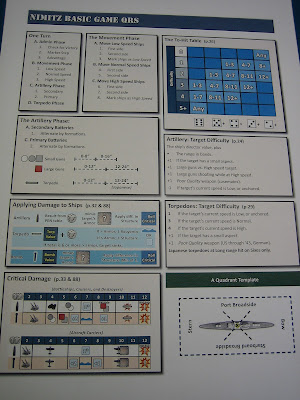
The whole game, with virtually no looking at the rules, was carried out using this one sided QRS in about two hours. Pretty good for a first game with four players.

The game was a draw with both sides getting quite badly mauled. The Japanese cruisers were better off than the American ones at the end but were much worse off for destroyers.

Will I be going out to buy WW2 naval. Well no, but only because Peter has already done so. Otherwise, I'd be sorely tempted. 

Word to the wise about Sam Mustafa's rules: If you think you will get round to this as a period one day, and you like hard copy versions of rules, buy your copy of Nimitz now! They will sell out pretty quickly (they always do) and there never seems to be a re-print so second copies go for twice the price!

RECOMENDED!

We liked it so much we are playing it again next week.


Tuesday, 2 July 2019

Some pics of a recent LOGW game - Dresden 1813

It's that time of year again. The League of Gentlemen Wargamers meet three times a year to play a two day game. It's the only time I get to play in a serious multi-player game (typically 12 - 15 players plus an umpire) and I can't tell you, given the game length, what a difference that dynamic makes. This game was organised by Dale S. and his organisation and umpiring was, to say the least, very clever.

This was not the only big Napoleonic game going on in Scotland this particular weekend. In Glasgow a hundred player 22,000 figure Waterloo game was being played to break a world record. We only managed 12 players with 12,000 figures (apparently). I provided only 300 French infantry, but I was on the train.

I'm not going to tell you that I won the day on this occasion, as my table fellow Corps commander was the ever lucky Charlie Grant. We broke the allied left and swept round behind their centre. We did it with gusto and a fair amount of bluster - much to the chagrin of my host Steve R. who was kind enough to put me up again. It says a lot when you can kick the living whatever out of a man on one day and see him cooking you bacon for breakfast the next!

Anyway, the original game frontage was 48 feet (three 16 x 6 tables), with a reserve 16 foot table (which, guess who got to fight on) used to represent the allied centre rear. So, without much explanation, the pics.

Here we see the French centre and right tables. The far table is the French right. The line of buildings on the centre table is Dresden.

The Young Guard, thousands of 'em. The allies don't stand a chance. It's a wonder they last as long as they do - fighting up to the call of play.

The Old Man 'CS Napoleon' sticks a tape measure up his nose whilst my host examines some paint jobs.

Charlie Grant, the wonder boy, examining his logistics support. Later, he'll throw it away because he can feast on his dead.

I'm on the left. My reserves arrive on turn two. Steve is buggered.

Overwhelmed.


The second table. 


Peter N. surveys his ever shrinking perimeter. He and Kev C. were facing the Yound Guard - thousands of 'em.


At the end of the last Sunday session the Reserve Guard Cavalry Corps starts to arrive (Four regiments of sixteen, each 24 figures strong, arrive by the end of play and the game is called - for the French!). The allied reserve cavalry rides to meet them but, they are about to be swamped. 

And the French won.

I'm a very lucky boy to get to play games like these with the LOGW.

Monday, 24 September 2018

A Few Good Men - and Yarkshire Gamer


When I started this project I made the conscious decision to do the command stands quickly, to get a game on the table, by making them one figure strong. My future plan was to make the command stands two or more figures strong. This would involve re-basing, but hey ho............. 

Seeing a heap of painting to do if I delayed the upgrade any longer the future arrived very quickly. I've added twelve new command figures to the stack and I've rebased all but one of my command figures; the latter is the British officer of engineers - a 'command special' - and I'm sure there will be one or two more of these 'scenario officers' for each side in the future. 

From now on I'll do command figures as their 'brigades' and 'divisions' come on line. I'm still considering the make up of the C-in-C stands - food for though, indeed.

The command elements available now look like this.


Talking of a few good men, Ken, the Yarkshire gamer came over on Friday for a thoroughly enjoyable Italian Wars game. 

For rules, we used my home grown version of FoB  (Hell Broke Loose) for the Italian Wars and, of course, they threw up one of those situations that only Piquet style games can.

Ken's Swiss pike came up to contact with the Spanish foot and he desperately sought a Melee Resolution card. I was desperately worried because Swiss are virtually unstoppable after contact. But, before it came up I drew, back to back, four Missile Reload cards for my Spanish colunelas. Under a hail of lead previously unseen in my games, the three Swiss pike squares were forced to withdraw each having taken their maximum 7 Unit Intregrity loss before pikes crossed. Such is life.

To his credit, Ken kept going. He brought his cavalry, having been victorious on his right, into the fray to restore the balance but at zero morale, the Army Morale card took its inevitable toll. 

A victory to me, courtesy of one of those card runs you can usually dream of.

I hope the encounter encourages Ken to paint up more Italian Wars stuff of his own. I hope that he tries Hell Broke Loose rules again. He's certainly welcome to come back again, and lose here, anytime.


Tuesday, 20 March 2018

A Very British Civil War - LOGW weekend

Belgians, Morris Dancers and the Grenadier Guards rush past Hemingway to face another crisis in Newcastle - you can tell it was cold - they are all wearing coats.

I've returned from yet another thoroughly entertaining game with The League of Gentlemen Wargamers up in the colder reaches of the U.K. The game was a multi-table 'campaign game', the whole representing the north of England up to Berwick and various players were either Scots, Anglican League, Communists, Albertines or British Union of Fascists - I was one of the four players playing the latter and never a game was so well lost! In fact, the BUF were the target of everyone, and who can blame them for that.


Evening all! Communist cavalry, about to get  stuffed by the constabulary. Very pretty unit that, Chris. 

Virtuallyly non of the photos I took came out, so here is a link to Tim's blog, or Bills blog, where they did. 

Tim's blog

Bill's blog

I had a great deal of fun in this game. Except for a brief foray to the east to fight some Albertines (Bill G.) at the start of the two day game, I spent much of my time defending the city of Newcastle. Single-handedly I fought off an Anglican League faction (Angus K.) and Hartlepool Communists (Chris H.) for the rest of the game until Newcastle fell to the Bishop of Durham in the very final turn of the weekend. 


That church in the background is the base of my two faced, conniving, untrustworthy, backstabbing enemy the Bishop of Durham (Angus K.). That jumper belongs to my two faced, conniving, untrustworthy, backstabbing enemy the Hartlepool Communists (Chris H.). That plane is mine and it's about to 'hang another monkey'.
My Grenadier Guards, with support from the constabulary, Morris dancers and Belgians (amongst others) fought to the last man, last bullet, last throw of the dice. I took down the enemy in their droves; at the last count, including the Albertines on day one, I killed 16 units for the loss of only 7. This was largely due to the sterling work done by the Royal Victoria Infirmary which kept depleted units up to strength with troops returning from their sick beds - this was especially true of the Guards who, to a man, must have each been wounded at least three times during the campaign - Angus was definitely hunting bear(skins). 


BUF volunteers, brave but stupid, await the call from Edward VIII. He was unable to make the call because his trip to Balmoral was rudely interrupted by a band of Celtic supporters (Dale S.). 

Mrs. Simpson didn't seem too bothered, she was busy 'doing things' to the Bishop of York (Kieron P.), the eventual winner who, with all the Royals having been killed, and with the death of the Archbishop of Canterbury (machine gunned from the air), would soon find himself crowned King.
Thanks to Colin J. for organising the game, Bill G. for his knowledge of the rules and answering constant questions with such good grace, and Steve R. (of course) for kindly putting me up for the weekend.

Next up, for the LOGW, it will be an old school SYW game organised by Charles G. using rules from The War Game. I think it's planned to be a pan European, multi-table, campaign affair. Should be good......

Wednesday, 21 June 2017

LOGW ACW: I love an acronym.

Last weekend I spent a thoroughly enjoyable two days gaming in Scotland with the LOGW (League of Gentlemen Wargamers). The game was an ACW (American Civil War) mini-campaign with front lines, cavalry raids into rear areas, and a naval element, and it ended with attacks on Washington and Richmond: Attacks which saw both burn. I had a brilliant time in good company.

The game was organised by Kevin Calder and he also provided the rules, Bonnie Blue Flag, which we've used on several occasions, and which are soon to be published by Partizan Press. If ACW is your game, you should look at these when they come out. They are very good fun.

Gaming highlights for me were: 

  1. Somehow losing a naval game to maintain the blockade of Richmond, even though I had two ships afloat (but running away) and I'd sunk one enemy ship, run another ground, and left one under construction in sinking condition. Great fun, with ships and rules from Bill G's collection (he also took the naval photo below showing my fancy sailing techniques). All of that ancient naval gaming came in useful - the Rebels were rammers. 
  2. Fending off a cavalry raid before it had got started, much to Charlie's chagrin. I also fought Charlie in the naval game, which he won, though he was left contemplating his naval as to how.
  3. Charlie got his revenge in the final game. Fortunately my only picture of my woeful performance in this instalment of the weekend is the shot of the cavalry action. At that point my battery packed up. Charlie went on to take and burn Washington. When he's not pillaging supply wagons he really likes burning stuff; during the naval encounter I half expected to be rushed, deck to deck, by fire brand waving men yellin' Dixie.

I also had a very interesting pre-game Friday night / morning whilst being kindly put up at Steve R's place, though that is an entirely different story. 

Anyway, a few pictures of the game and crew on what was a memorable trip all round. 


The next LOGW weekend, in November, will be down to me. We'll be doing a multi-state Great Italian Wars mini-campaign set around 1503. 

The table will be the Alps to Naples. I'll post a plan of the set up soon but, at present, the table (without walkway gaps) is 20' wide and 28' long and covers an area of 432 square feet. 

I've only ever played one game with a bigger table than that, a giant Kingmaker organised by Steve R, and that was the best multi-player game I've ever played in - if they players like my game half as much as that I'll consider it 'job done'. 

Saturday, 26 November 2016

The Raid - A scenario for any period, originally designed by C S Grant

I have recently returned from another meeting of the League of Gentlemen Wargamers in Scotland. This meeting's games were themed on the French retreat from Moscow in 1812. The weekend's games comprised a series of one on one scenarios on Saturday, where each player played three of the six games on offer, followed by a big multi-player game on the Sunday.

Sunday's LOGW game. This scenario involved getting pontoons and bridging equipment to the river and building a bridge over which Napoleon could escape to safety. Napoleon started at the far end of the table. Between there and the river, various French and Russian forces battled for control of the route Napoleon and the bridging equipment would pass. Napoleon escaped and the French achieved a worthy victory. I (one of the six Russians) got trounced.

Napoleon (foreground), in his sledge, at the start of the game, about to go like a bat out of hell for the river over 20 feet up table.
The scenario that follows, even though I got trounced playing it, really took my fancy. It was originally devised by C. S. Grant, appearing as a Table-top Teaser Special and in an early edition of Battlegames. It was tailored for 1812 by Charlie Grant (pictured above, on the right), who devised all the games for the weekend. The rules used, BTW, were written by Kev Calder (pictured above, in the centre).

My version of the scenario is posted here by the kind permission of both of the Grants. I have tweaked the scenario for the SYW, adding one or two ideas of my own. The scenario is a raid into enemy territory. This version of the scenario was written for use with my amended Piquet rules.


The Raid


The Russians have decided to winter in the current area of operations but have insufficient supplies to do so. Consequently, they are undertaking raids in order to stock their magazines. 


Russian Force:

Aim: Steal supplies from settlements (numbered 1 - 6 on the map) west of the wide river, burn what cannot be carried away and escape off the western table edge before the Prussians can stop you.

Forces: One command group comprising:
1 Leader ranked as Skilled
1 unit of Dragoons (Ready)
2 units of Don Cossacks (Ready)
1 unit of Grenadiers (Eager)
3 units of Line Infantry (1 Eager, 2 Ready)
1 battery of light howitzers (Eager)
3 Wagons.

Initial Deployment: All troops enter the area of operations marching in column of route using one (not both) of the western roads marked with a red arrow.


Capturing supplies: Each settlement has three points of supplies. Each wagon can carry three points of supplies. Each cavalry unit can carry one point of supplies. Any type of unit can load supplies. To load supplies a unit must enter the settlement, have a wagon adjacent or be cavalry loading their mounts, and declare their intention to loot on Officer Check. It takes one activation, on a Pillage and Loot card (x3 in sequence deck), to load one point of supplies onto a wagon or onto cavalry mounts. Each point of supplies successfully escaping via the western table edge earns one victory point. 

Burning Settlements: A unit must be in a settlement and declare its intention to commence burning on Officer CheckIt takes three activations on Pillage and Loot cards to completely fire a settlement. Each burning activation on Pillage and Loot cards earns one victory point. A settlement cannot be looted and burnt at the same time, or be looted after burning has commenced. 

Note: Whilst looting and burning, units count as disordered and they cannot shoot or initiate a melee. If attacked, looters and burners can be automatically rallied into fighting trim on Officer Check cards. Likewise, troops can be ordered to recommence looting and burning on Officer Check cards.

Note: Cavalry loaded with supplies deduct 4" from their move rate.

Note: Wagons are captured or destroyed immediately they have a melee initiated against them on a Melee Resolution card. They cannot be destroyed by small arms fire but can be destroyed by artillery fire - they count as a single '3 hit stand'. Wagons move on Artillery Move cards at a rate of 12", adding 25% if moving on a road, but deducting 2" per point of supplies being transported.

Note: We play movement into and out of buildings on Move in Difficult Terrain cards rather than on Deploy cards (because there tends to be only one Deploy card in the sequence decks for SYW armies).


Prussian Force:

Aim: Prevent the Russians stealing supplies and denuding the territory under your protection. 

Sentry Force: One command group comprising:
1 Leader ranked as Average
1 unit of Dragoons (Ready)
2 units of Line Infantry (Ready)
1 battery of field artillery (Ready)

Initial Deployment: Two of the sentry units are billeted in the town east of the wide river (buildings marked 'G'). One unit (infantry or cavalry) is on patrol outside a random (Roll D6) settlement west of the wide river, marching in column of route. The artillery is deployed in a redoubt sited to defend the bridges and ford on the wide river; the redoubt allows a 360 degree arc of fire but because the guns are primarily sited to defend the bridges and the ford fire at other targets will be at Down 1; fire Vs targets on the bridges or ford is Up 1; the guns cannot be moved.


Sentries have alerted you to the presence of the enemy and you have called for reinforcements. 

Reserve Force (off table): One command group comprising:
1 Leader ranked as Skilled
1 unit of Dragoons (Eager)
2 units of Line Infantry (Ready)
1 unit of Grenadiers (Ready)

Initial Depolyment: The Reserve Force begins the game off table and is marching as fast as it can towards the area of operations. It will not arrive before turn 4. From turn 4, whenever the Special 'A' card (x2 in sequence deck) is turned. test for arrival by rolling D8 Vs D8. If the test is successful the Reserve force will begin to arrive in column of route on the next Infantry Move in the Open card. The force will arrive using one of the road exits marked with a blue arrow. If the test was successful on an even roll, the force arrives at the town; if odd, the force arrives using the northern route.

Victory Conditions: For the Russians to win they must successfully steal or burn 22 points worth of property. Any other result is a Prussian win.

Terrain Notes:

  • High ground is type I terrain, stop at contact full rate thereafter, and blocks LOS. 
  • The wide river is passable only at the bridges and the ford. Artillery can only cross at the bridges. 
  • The narrow river is passable with difficulty (Type IV terrain, requiring a standard difficulty check) to infantry and cavalry. Wagons and artillery can only cross it at the bridges. 
  • Buildings are type III terrain and they block LOS. 
  • Woods are type III terrain and they block LOS. 
  • Roads add 25% to movement rate for troops in column of route.
  • Fields are scenic only. 


Army Characterisation Deck Draw: Each side will draw 3 cards from the ACD. Any Stratagem cards involving reinforcements, ambushes and flank marches should be ignored. Each side should have a minimum of ten morale points.