Showing posts with label Peninsular War Campaign 2023. Show all posts

Wednesday, 15 November 2023

Campaign Report: The Allies go on the rampage


In the campaign moves that followed the French scrambled to respond to Wellington's surprise moves and victory at Madrid.

Wellington and his Allies were too quick for them. Whilst Blake bottled up nearly French 50 UI of Soult's army at Badajoz. Wellington backtracked to confront Soult at Cacares. 

The tracker sheet. This has the victory points tack (the Allies are definitely winning I'm definitely coming in last), turn clock and holding boxes.

Note the French blood (my blood), from a savage pin wound, in Siege box 1. Who said wargaming was a bloodless sport?
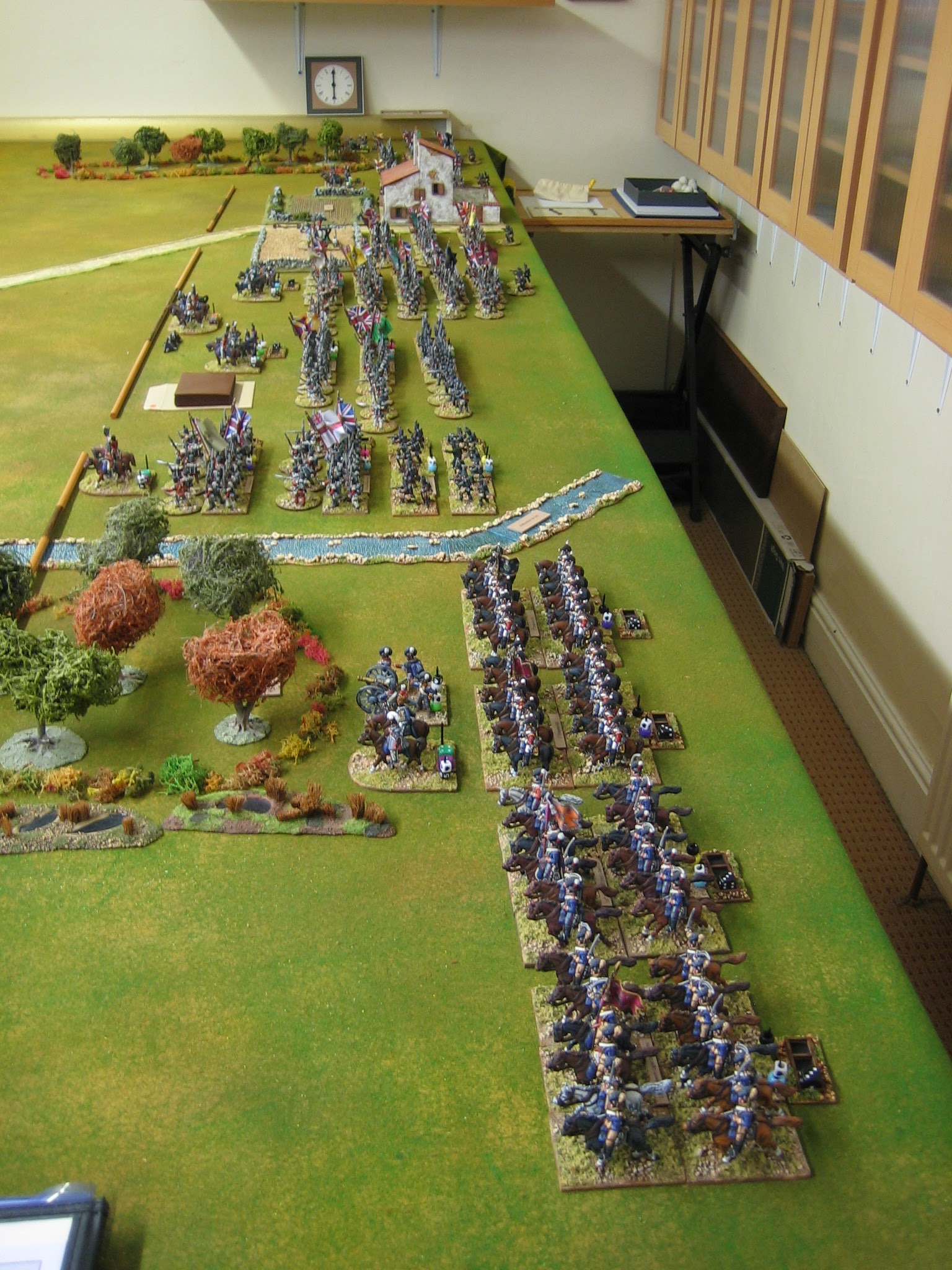
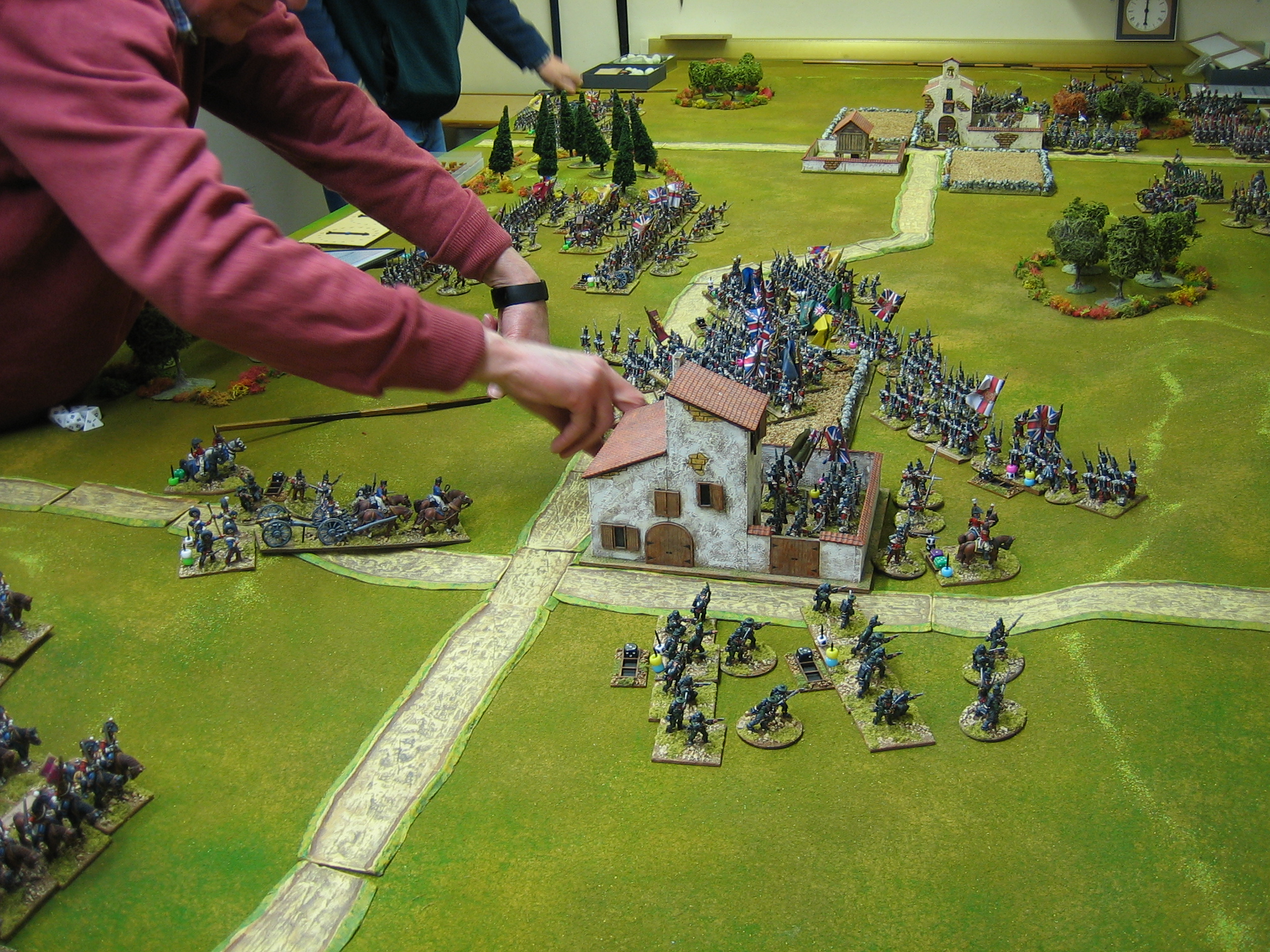
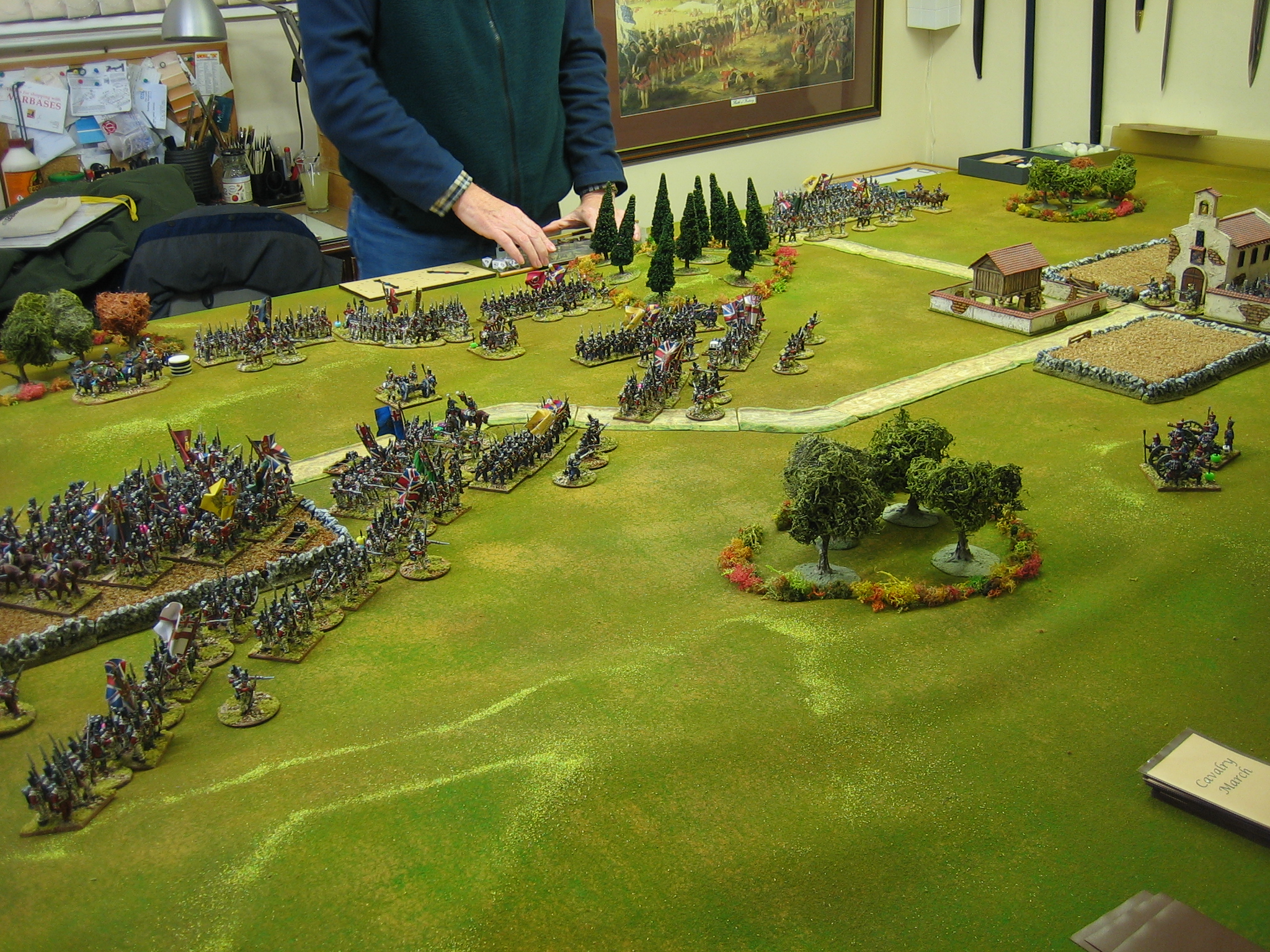
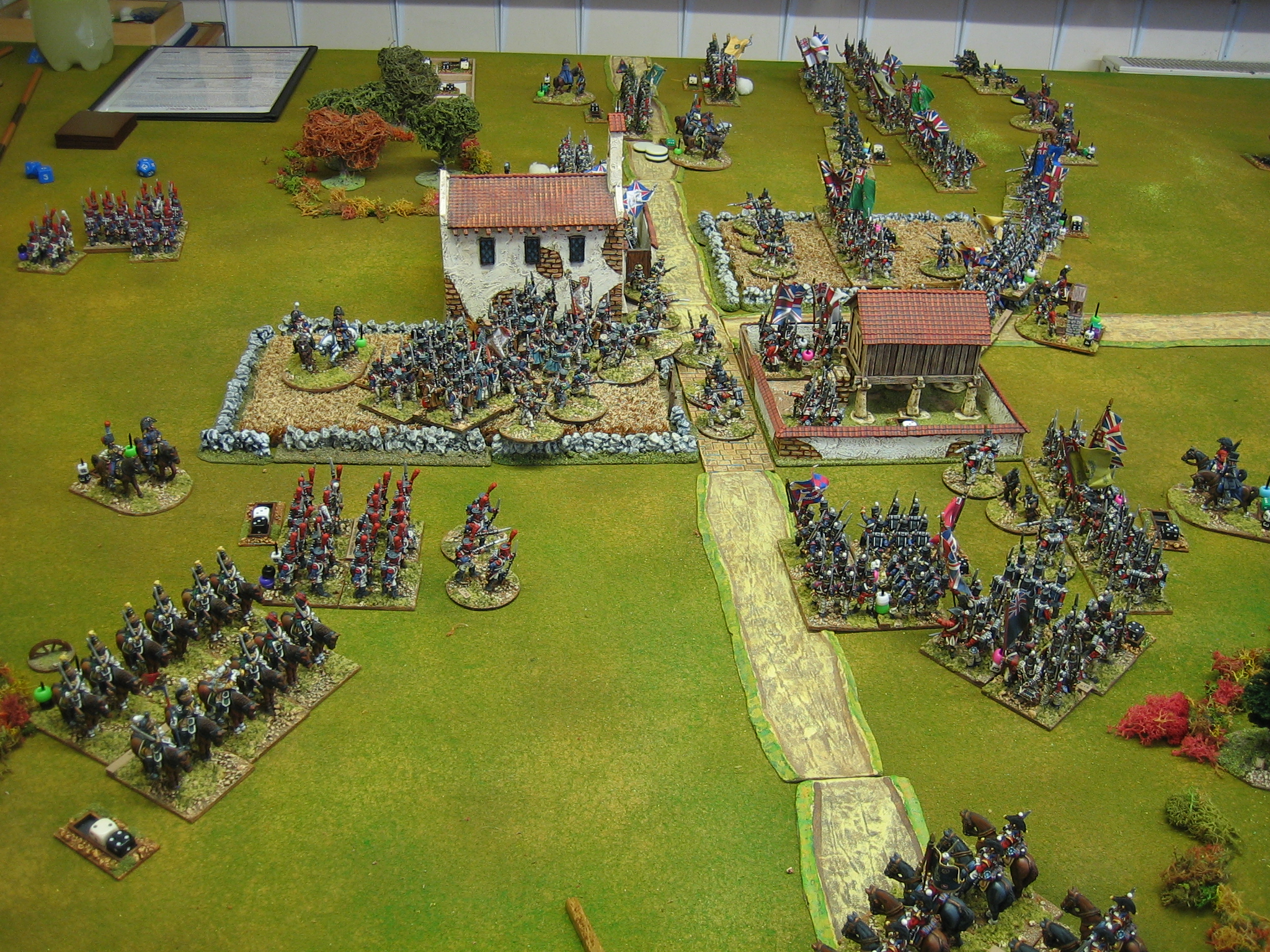
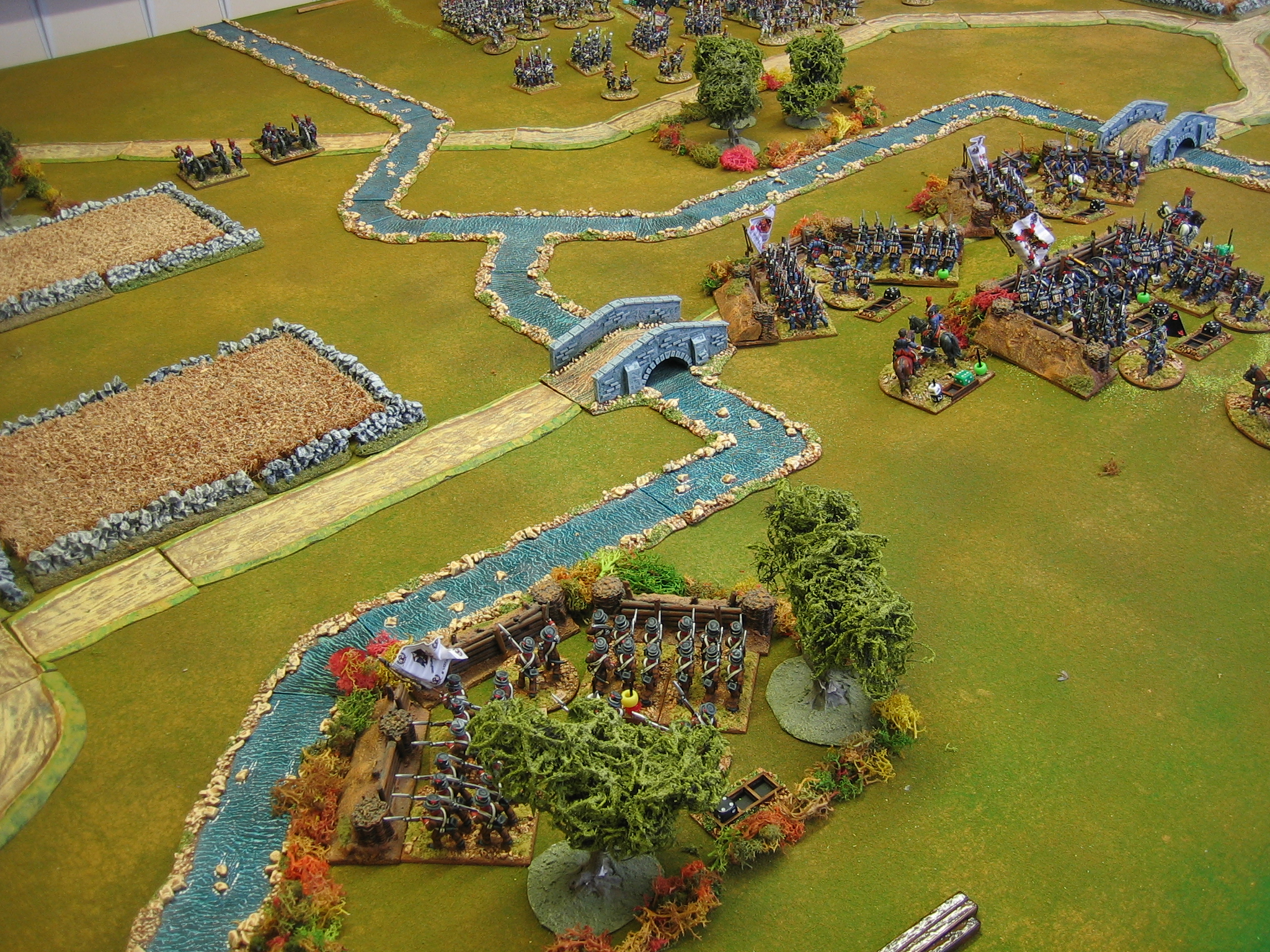
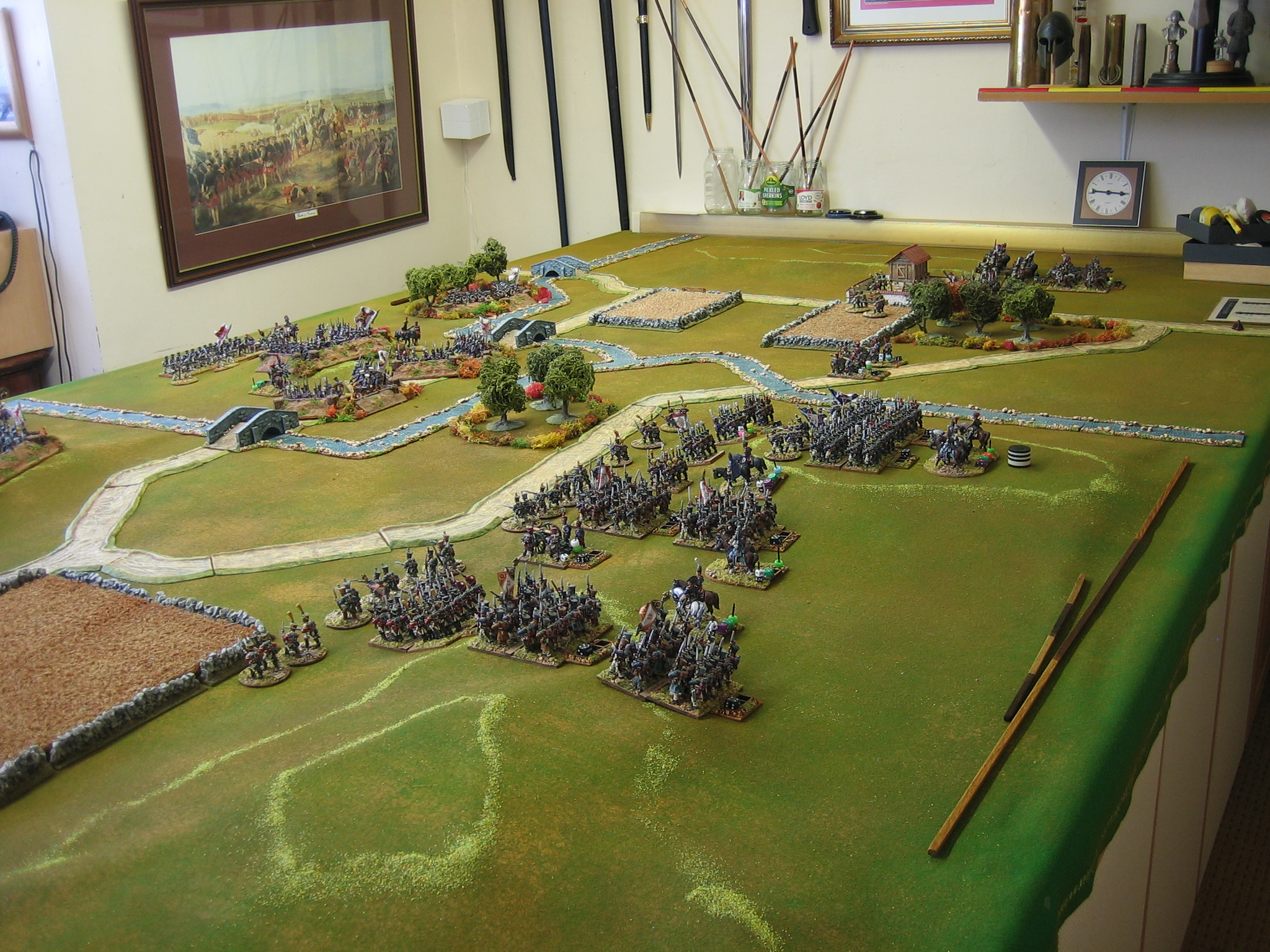
The Battle of Cacares. Map 3 was rolled up, the French will choose table edge.
The table terrain. The French will deploy on the left. The French will deploy first.
The British, all laid out ready to be deployed. As attacker they can deploy anywhere along, and up to 24" in from, their table edge.
The French, all aid out ready to be deployed. As defender they can deploy up to 24" in from their table edge and 18" in from the table ends.


Campaign Report: Wellington takes Madrid

 Wellington had caught Joseph by surprise. Joseph's only hope was to shift position and trade ground for time in the hope that nightfall would allow him to slip away. This hope was dashed on the first night's play when turn one was extended twice by early 'same domino' sequence deck re-shuffles; French discomfiture was exaggerated by their lack of ability to draw a domino with many spots on it - they drew a 0:1 domino three times in succession and failed to beat a low double at least twice: It was brutal.

The British begin their advance.
The French start to reposition to their right, trying to shift the axis of their line through 90 degrees.
As the British advance, Wellington orders Hill's 2nd Division (in reserve) forward. It arrives on the British left, potentially flanking the new position chosen by the French. 
The British press home on their right, the attack being led the Light and 7th Division. The 7th suffers heavily from artillery fire coming from the hill on the French left. 

The French launch a counterattack against Hill on the opposite flank with the Guard and Cavalry Divisions. It stalls under artillery and small arm's fire. 

And turn one is still in progress!
The second night's play goes better for the French. 

Hill's 2nd Division is almost shattered but French Guards Division are spent - only being saved by the play of a Campaign Battle card "Undaunted".
But, the French are finished. They lose their last Army Morale Points with the loss of the cavalry division. Joseph's army retreats to Zaragoza; Madrid falls into British hands.


Thursday, 5 October 2023

Campaign Report: The Assault on Terragona

So the campaign continued with map moves and it wasn't long before the End of Turn card reappeared. However, this time we had gone through about 60% of the cards before it did. The campaign activation deck was shuffled and we moved into turn 6. This released lots of UI from hospitals.

MacDonald activated. He moved from Barcelona to threaten O'Donnel in Terragona. O'Donnel retreated into the fortress and MacDonald moved to besiege him there. To show a siege is in progress we moved their pins into the siege holding box #1 and moved the siege pin #1 onto the map.

Extreme Weather (extremely hot) came into effect in Aragon.

Freire activated, showed his heals to Suchet (departing Sarrion on a forced march card) to reach Tortosa in an attempt to relieve O'Donnel, at Teragona. He made the distance (4 nodes) but failed to initiate a battle.

The British failed to draw an event card.

Soult / MacDonald drew an event card - an important one.

Spanish Drafts: This was the card Peter probably most wanted and he recruited new drafts (in some numbers) to three of his armies, including O'Donnel.

Beresford activated but refused to move from the environs of Elvas.

MacDonald activated, again! He played his newly drawn event card: Siege Artillery. He ordered an assault on Terragona: No external reinforcements by concentration allowed. It would be 44 French infantry UI versus 28 Spanish infantry UI, both with their consequent supporting assets.

Because of the way the game ended last week (with insufficient time to do a new set of campaign map moves) it was agreed that I would pre-set a terrain for the next battle: Not knowing who would fight on it or where, this seemed fair enough - the exact terrain effect definitions could be sorted out after discovering which type of terrain (open, mountain, or wooded/cultivated) would be appropriate for the battle - I set up something that could cover all of the bases.

We spent the next hour or so working out the exact OOBs and Peter's fortifications (which he gets for defending in a siege assault game), then we deployed - Spanish first. With perhaps an hour of the evening still to go we decided to call the session over so people could get an early night. We are set for a full evening of table-gaming next week. This shot shows the Spanish deployment looking from the right, with a redoubt on high ground holding that flank of the position.

On the Spanish left Cazadores hold a Fleche in a wood.
The strongly held centre. Two fleches supported by a redoubt on high ground immediately behind.
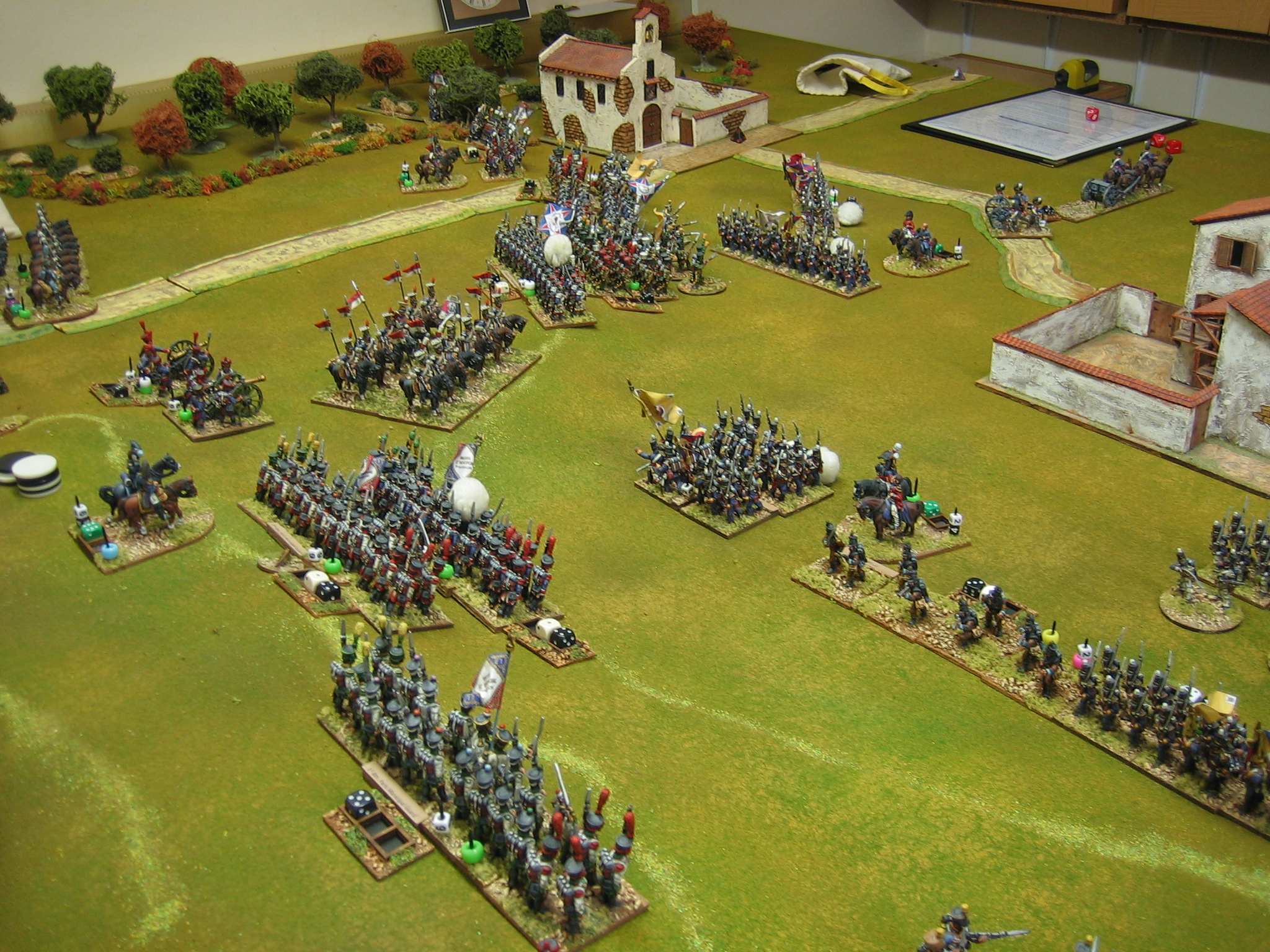
The French deployed for the assault on Terragona. A strong left and centre with a possible flanking force in position on the extreme right.

Two batteries cited for maximum field of fire and within range of all the defences of the Spanish centre and left wing.
The French right - a mixed force of infantry and cavalry.

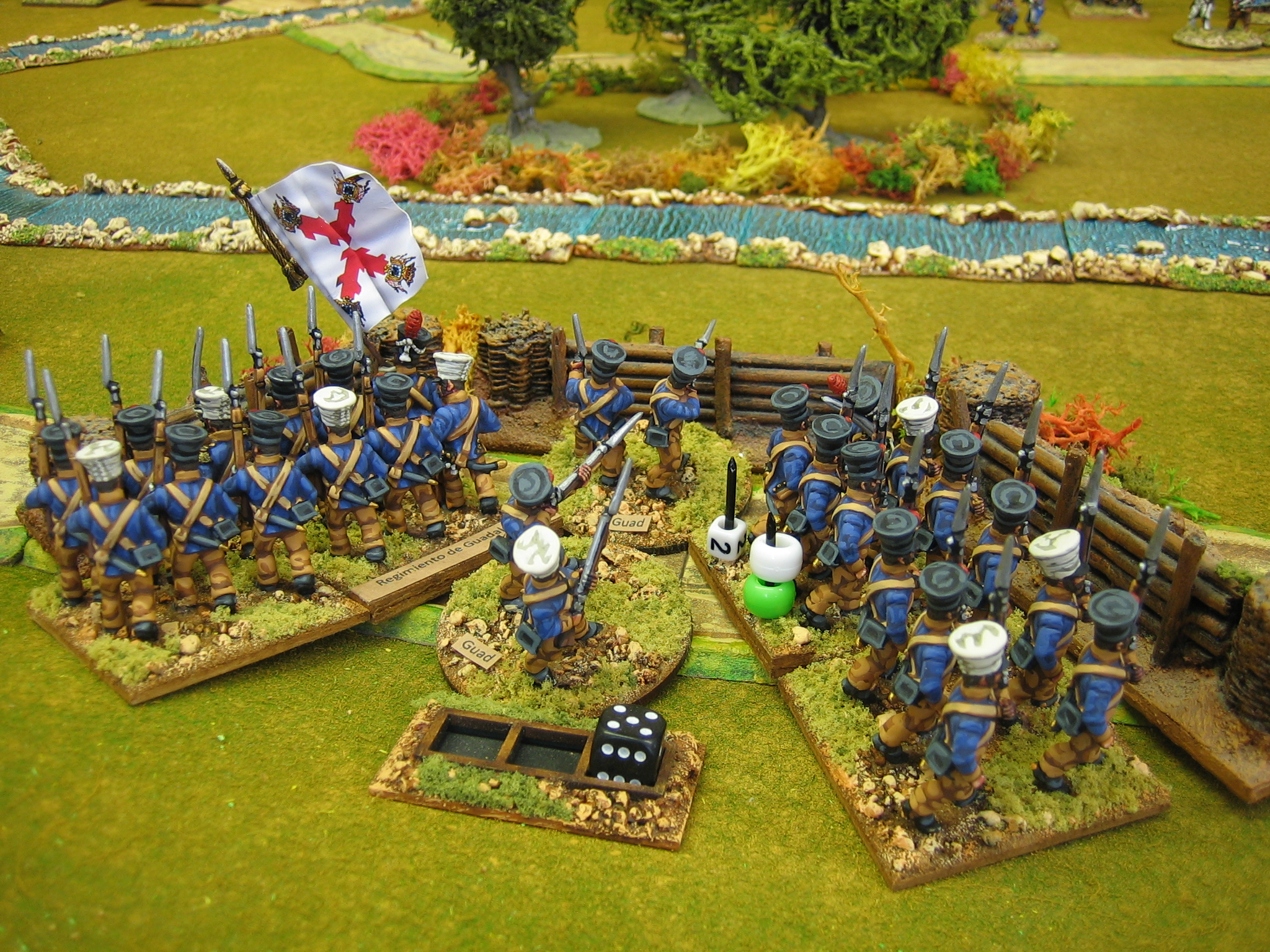
Two previously unseen units will take part in this action. These boys are Regiemento de Guadalajara. The ones in covered shako are all head swaps. The heads are from mistakenly ordered Nassau infantry. The buff facings, accoutrements and pantaloons, with bell topped shakos, are described for the grenadier companies sent to Cadiz, and I assume the rest of the regiment were similarly uniformed.

Secondly, I give you the Voluntarios de Navarra. I have these wearing the so called 'English Uniform'. They were wearing something similar late in the war (possibly with red lapels?); the grenadiers may have carried swords very similar to those carried by their French counterparts, mine don't. However, as the last infantry unit in the Napoleonic lead pile, these are close enough. 

Which leads me on to announce that stage two of my Peninsular War project is finished! It has taken me years, far longer than anticipated. It is my biggest collection to date: There are 2,683 men plus guns, horses, limbers, etc. (it beats my SYW collection by 43 figures). I'm not sure there is going to be a stage three - I have other plans.

Finally, the fortifications are not as Peter left them: I admit to having tweaked them in his absence. I don't really have rules for field fortifications (usually making them up as required) and, having thought on it overnight, decided to classify and rule on some set types. In the diagrams below, the brown lines show the shape of each type of stylised fortification I will allow in the campaign. The defending units stand below/inside them, and the shaded area shows the arc of fire that the fortification shape provides: N.B. Range is measured from the centre of the nearest face. NC stands for no change. SK stands for integral skirmishers (SK provide some limited fire potential and give an Up 1 versus a firepower morale challenge - the SK are placed within the fortification) and are included to give defences a bit of an upgrade within the general format of the game without adding lots of new rules (in a similar manner, they are always out and never withdraw when troops enter town sections).


Wednesday, 4 October 2023

Campaign Report: Road to Badajoz (part 2)


The second session of this game was very frustrating for all concerned. We decided that the severe rainfall in Extremadura was probably the cause. The simple fact was, no one could cause any damage because either the attack dice was too low or the defence dice was too high, in equal measure - it was all down to the mud and wet powder.
By the end of turn three (two non-turns having ended early), divisional morale dice were also too low for either side to press any attack with conviction.
The British had been pressed but, every time they suffered a reverse they successfully rallied. To frustrate the French further, attacks in column were being stopped, with minimum casualties, by British firepower morale challenges at the crucial moment.
With the rain falling heavily on everyone's parade, the French offered the British a draw - allowing them to withdraw back to Elvas (Estramoz). 
The Road to Badajoz - more like a Road to Nowhere.

And, Soult had failed to arrive.

Casualties were assessed - and they were very low considering the amount of dice rolled. The Anglo-Portuguese had lost 3UI killed and 8 UI hospitalised; the French had lost 3 UI killed and 10 UI hospitalised.

The campaign continues....


Monday, 25 September 2023

Campaign Battle Report: The Road To Badajoz.

 With everyone present we got going ASAP.

The British set up first: A line with their left echeloned back, cavalry in reserve.
It looked like the villages would be something of a hindrance to Bereford.
Then the French deployed. They decided to hold their centre and left in strength. Their extreme right was covered, some way off, by cavalry
The left and centre.
The centre right.
The Anglo-Portuguese, bless their cotton socks, attacked from the off. The French artillery began to tell immediately. This did not have the look of half measures.

With the allied advance the French cavalry holding the right advanced into uncontested ground to threaten their left flank.
In the centre left the action was hotting up quickly as the skirmishers of both sides became emmeshed. 

Note: On the extreme French left, Mark has begun to counterattack. 

Note: In the foreground the allied Cavalry is moving to counter the early French movement here. This will result in one French unit of cavalry destroyed by British Guard Dragoons and the Portuguese cavalry being forced back shaken. 

The allies had taking the brunt of it coming in but, they were not doing badly. The lines were forming up at musketry range: A firefight, then; a duel of cards and initiative (with the odds slightly favouring the allies). Shortly after this shot was taken the sides withdrew skirmishers and the volley fire began in earnest.

On the French left, the French pressed home a counterattack. This attack will cause the outnumbered Portuguese division to flinch, losing an infantry unit. However, they do hold.
Almost the last action on the night: On the extreme allied right, Portuguese Cacadores came out of the village onto the flank of French light infantry moving through the woods in extended line: They fired, they charged. The French Legere were sent packing: A classic ambush.

Importantly, this was just the end of turn one (four turns to go) and the French have turned two Stratagem (reinforcement) cards. Soult may well arrive early!

To be continued....

Friday, 15 September 2023

Campaign Battle Report: Manresa and beyond.


Turn four proved decisive. The French stole away with a run of initiative and swamped the Spanish on the mountain before they could make any real defence - to be fair, the position was pretty hopeless. Only on the extreme left and right flanks did the Spanish escape relatively unscathed - every unit on the mountain was put to flight or cut down. However, the French had been given a bloody nose for their efforts and were down to just 3 Army Morale Points at the end - the Spanish hit zero and that ended the battle there and then: Routing units were considered gone with no chance to rally, etc.

The unit picked out for honours was the Spanish unit in pale blue, centre left, green and yellow beads (the Voluntarios de Leon). This unit led the Spanish counter attack that caused the French so much heartache (not to mention casualties). It fought gallantly to the end, only breaking under the constant pressure of vastly superior numbers. It will be an effort long remembered.

The butchers bill was significant for both sides but the Spanish had by far the worse. The Army of Catalonia (MacDonald; French) started the campaign with 51 Unit Integrity (UI) points but now, two actions later, had 44 UI of which 13 are in 'hospital': An effective strength of 31 UI. The 2nd Army (O'Donnel; Spanish) had started the campaign with 59 UI but in fighting MacDonald every step of the way through the Pyrenees had paid a very stiff price; 2nd Army now has a total strength of just 38 UI of which 18 are in hospital: Effective strength 20 UI. This is the kind of casualty rate I was looking for at the end of two significant actions: 2nd Army is, for the time being at least, pretty much spent. 

Hospitalised UI isn't to be taken too literally: As stated in the author notes for the rules used in this campaign, it includes everything from actual wounded to temporary loss of morale, fatigue and expenditure of supplies. This method of doing things saves having to change unit quality every time something happens; the army simply fights with less UI for two turns after hospitalisation; after two campaign turns the hospitalised UI go back to their divisions. Hospitalised UI still count for attrition purposes because they do exist and need to be fed, etc.

Post battle, the presence of two French units of pursuit capable light cavalry really put the boot in: They caused 4 permanent UI losses for simply being present on the field in sufficient numbers (they each had 2 or more UI). A campaign setting is where the value light cavalry over their heavy counterparts really shows - so many wargame myths are created by rule writers trying to give some form of advantage to light cavalry in 'table-top terms' to balance their comparative lack of combat effectiveness [Vs the heavies]. Historically, it's off table, before and after battle, that their value was really felt. I'm thinking of tweaking the 'deployment roll' rule for this campaign: +1 more light cavalry?

After the action compulsory retreat moves forced 2nd Army into southern Catalonia. Unfortunately for the French, bad exploitation dice didn't allow any significant gains to be made; at least in the immediate aftermath.

The game had taken an hour to resolve to a full conclusion. Fine by me. A space was created at the end of the table and down went the campaign map. No time to be wasted. To keep a campaign going the whip must be cracked.

Campaign turn four ended relatively soon after the battle of Manresa [the End of Turn card appeared] but not before MacDonald had marched into Barcelona. Also, on the activations that followed, O'Donnel marched the force directly under his command into the fortress of Terragona (and safety?) 

Freire's 3rd Army and Suchet's Army of Aragon continued to shadow each other (or, to put it another way, nothing to see here, move on).

In Galicia, Marmont's Army of Portugal and Santocildes' 6th Army led a merry dance up and down the coast of north west Spain. Marmont attempted to bring his opponent to battle twice and failed: I'm putting it down to the amount of olive oil in their diet (possibly in their bath tubs too).  

Wellington attended several balls on his hunting tour of central Portugal but, not much else. According to French spies, the ire of the Spanish was mounting.
It was Beresford, obviously shame faced by his superior's lack of action that galvanised the forces of Perfidious Albion to boldly go forth, into the valley of death, into the jaws of hell.... 

In fact, Graham had misunderstood a conversation about Blake's 5th army moving north to retake Berlanga: He thought this move had pinned Soult at Zafra (and he couldn't concentrate at Badajoz if it was attacked).

Not so, under the rules as they stood, but this thought was brilliant! A rule change, to which everyone assented, was made: The relevant section now reads: 

"Concentrating forces roll a d6 to determine their times of arrival. One is deducted from the roll if the attacker is concentrating in the defending area; one is deducted from the roll if the defender is concentrating in the attacking area; two is deducted from the roll if the concentrating force is pinned by an enemy force¹² that is not itself concentrating and is at least half the strength of the force it is pinning; one is deducted from the roll if the force has a green pin; one is deducted from the roll if the force would normally activate on a different card to the attacking or defending force (unless acting on a Joint Command card).⁴"


Note: When this rule change was made we also added another one to cover green pinned forces. 

BTW, whilst on the rules, in setting up this particular game I found no reference to, or definition of, Portuguese cavalry in the unit quality tables. This was an oversight. I have amended Beresford's army list: Being generous, the are always Reliable Light. His lists now reads:

"Cavalry UI is by force UI divisor 8; minimum 3 UI per unit; first unit must be (Reliable, Light) Portuguese cavalry, otherwise cavalry type is determined randomly."

The rules on this blog have been amended.

Anyway, Beresford attacked the forces in and around Badajoz. French pin 6S (6th and 7th divisions) concentrated without difficulty. Soult, at Zafra, rolled a 3, minus 2 (for being pinned by Blake) and will not arrive until the fourth appearance of the Stratagem card. Remember, our games are only five turns long so this is very late in the day: The battle of Manresa was done and dusted in under four full turns.

The map dice were rolled. A D4 gave open terrain maps page 2 of 4. A roll of D20 (1-17 results gives a specific map reference because there are 17 per page; an 18-20 result gives choice to the defender) came up 20 and gave Mark, as defender, the choice of map - he chose table map 34. 

N.B. Table maps from Warfare in the Age of Reason rules or its Campaigns and Battles supplement.

Mark rolled up Sebastiani (the French on table C-in-C) as a skilled commander; Graham rolled up Beresford as reliable. 

For table deployment Mark added 1 for better C-in-C and 1 more for being the defender. He rolled 4 (adjusted) and Graham rolled 2. Mark, having won, chose the hill side of the table; he had also doubled Graham's score so Mark will deploy second.

The players worked out force composition in full, so that I could get everything prepared for next week, and the session came to a close.

The table looked pretty simple but, as per usual, it proved to be at the limit of both hill and roads. 

The hill is actually less deep in the centre than it should be by about 6"; less importantly, I lost the second contour of the ridge - in my rules contours generally only provide 'shape'; height, for practical reasons, is less important. 

The amount of road on this table is also deceptive - there must be over 30 feet of it and I couldn't quite make the road behind the ridge go the off the end of the table - instead, it snakes round the end of the ridge to the far village (a minor alteration in the scheme of things).

It's still quite an impressive piece of high ground (BTW, after these photos were taken I took off the cliff edged contour for practical wargame reasons) and the road network is quite close to what's on the map. 
There are two pieces of quite extensive open woodland on the hilly part of the field. This is Spain so 'stunted' trees and undergrowth are best for this. It's my understanding that, after a couple of hundred years of ship building on the grand scale, Spain was largely devoid of big trees and had been largely deforested - Spain has more trees and woodland today (mostly commercial forestry) than it did in Napoleonic times.
TO BE DEPLOYED: The Anglo Portuguese Army under Beresford; 53 UI plus cavalry and guns. Note that some Portuguese units (British divisions) are wearing red because I only have six units of Portuguese line infantry - but, they diced up as Portuguese so in game terms everything stands up. 

Note to self: More Portuguese?
TO BE DEPLOYED: The French that managed to concentrate before the start of the battle. 64 UI plus cavalry and guns. Note the unit of Polish lancers - the Polish Division is here.

The Army of the South is 112 UI strong but the rules only allow 100 UI plus cavalry and guns to be fielded for a single battle (practicalities, again); in consequence, a division is absent from the Army of the South.
Soult's force of two divisions (one division, the 3rd, was chosen to be absent to bring the army down to 100 UI; it's possibly screening Blake?); this force is 35 UI plus guns (the cavalry are on the table already - quirky rules). These troops will probably arrive very late in the day; Graham will be hoping never.

BTW. Mark is running away with the Campaign Victory Points at this point in the campaign (early days). He has 29, I have 25, Peter has 22 and Graham has 21. 

THERE CAN ONLY BE ONE WINNER. THIS CAMPAIGN IS ABOUT PERSONAL GLORY!

Wednesday, 13 September 2023

Campaign Battle Report: The Battle of Manresa (part 1)

 What a ding-dong of a battle this was going to be!

The French (commanded by me because Mark couldn't attend) deployed as per instructions discussed over the phone. Their weight was focused on their left facing the mountain with the remainder of their force were echeloned back to the right. 


The focus of the upcoming French attack could not be hidden or disputed.
The French forces were then echeloned back to the right to provide support to the main assault and prevent any attempt to flank it as it came in. Best laid plans and all that....
The French made reasonably good progress in the face of an almost constant Spanish superiority in initiative points.
It all looked well for the French but trouble was brewing to their right centre. The Spanish were launching their awaited flanking counterattack. Unfortunately, the Spanish were still winning the initiatives by a margin and French countermeasures were tardy.
The battle was pivoting around the mountain.
The French were making progress rolling up the Spanish right but, the Spanish were having significant success against the French centre right - largely due to the fact that the French right couldn't get enough initiative to react to it. It really was a wargaming joy to behold - and very exciting - especially as these weren't my French troops being slaughtered (they belong Mark, remember).
Finally the French right began to come into action. Better late than never - but, they were late. 

Then the cavalry clashed on both flanks (sorry no pics, apart from this one a cavalry move before they occurred, were taken). The French completely disposed of their opponents in two brief melees. I felt the Spanish begin to creak, at last!
End of turn 3: The Spanish had brought on their reserve division sometime earlier. It might have been a division of raw militia but it managed to repel a French infantry attack before being pinned by the victorious French cavalry now operating the Spanish right rear. I had rather expected these swarthy fellows to crumble but I was wrong - bloody Spanish peasants.
On the mountain, it is chaos. The Spanish right has largely collapsed but having exploited their breakthrough the French are literally all over the place.
On the French right the Spanish were advancing into space and will undoubtedly take one of the French road exits (worth two French army morale points). The French are concentrating on taking the mountain and crushing Spanish resistance there. 
The situation is fluid. The Spanish are definitely losing but they are not yet beaten. The French have two turns (before nightfall) to complete a victory.
Personally, I think it will turn on this conflict between the French centre and the troops of the diminished Spanish counter attack. Mark should be here tonight to take over command the French forces: I think I've left him just enough rope to hang himself.

To be continued....