Showing posts with label Napoleonic Peninsular War Project - Stage 2 - Mid War Spanish. Show all posts

Thursday, 9 November 2023

Mid Peninsular War Spanish - Roll Call

 My Spanish army is, for the present, finished. Time for a parade!

This is the army: It only two thirds the size of the British and French armies but, in the years to come I can't see it coming out half as much, and then mostly only in part as a contingent to a British order of battle. It numbers 715 men; 6 guns, 3 limbers and 113 horses.

It is a very colourful army with plenty of uniform variation. All figures are by Front Rank but, I had to do a lot of conversions - mostly minor in nature but lots of them. In the sidebar you'll find a link to individual progress reports with giving unit details, etc. (See: Napoleonic Peninsular War Project - Stage 2 - Mid War Spanish)

It's still not a bad array and is certainly enough to fight a campaign with. Don't be fooled by the proportion of cavalry: I know it is too high overall but, it's always the case that you a lot of units to get the different types you might need and you'll probably never field them all together.

The officers. A C-in-C stand (the best of the three armies) and eight further senior officers stands.
There are seven cavalry units:

Two dragoon units. As well a serving in the guise of Spanish dragoons (best classed as light cavalry), these units can serve as extra units of heavy cavalry when need requires.
Two units of line / heavy cavalry including a new unit: The Coraceros Espanoles. 
Three units of light cavalry. Left to right: Garrochistas (irregular / geurrilla); hussars (another new unit); Cazadores.
The new unit of hussars, previously unphotographed: The Husares Espanoles. These are British bodies with Spanish infantry officer (in bell topped shako) heads.
The Coraceros Espanioles. This unit had one squadron in captured French helmet and cuirass. I've chosen to depict the whole unit with figures from that squadron (to make my life simple). It is simply a unit of heavy cavalry.
There are fifteen units of line infantry. Five are in bell topped shako. Several units have had minor conversion jobs - I've added popoms, shoulder straps, etc.
Rear view of the same five units from the back. The nearest two are Regimiento Toledo: these have all had tufted shoulder straps and pompoms added.
Three units of line infantry are in round hats.
Rear view of same. I found that I do like units in sky blue.
Seven units of line infantry are in the so called 'English Uniform'. It's boring but, literally tens of thousands of Spanish infantry, from one end of Spain to the other, were kitted out in this horrible thing.
Same from the back. The only interesting thing about it was that lots of the backpacks were made from 'yellow' canvas.
Guerrilla infantry, guns and limbers.
The crew in white uniform are Cadiz artillerymen on duty 'outside the walls'. White was an unusual colour for artillerymen (dirty job?) but, I had to have them. They are mostly Portuguese figures with shoulder wings removed and a round hatted head-swap.
Finally, five units of Spanish Cazadores, Two in 'English uniform (sky blue), two in round hats (brown) and one in bell topped shako (front, in sky blue).
Same from the rear. The two rear units are wearing the 'English Uniform' in sky blue (primarily shipped for cazadore units).

Job done!


Monday, 30 October 2023

Goodies from Fiasco - Another project in the offing.

Before the next campaign report, I thought I'd slip in a bit of blog news. The Spanish Army (Peninsular  Project - Stage 2) is done and dusted, including an extra battery of artillery and a unit of Husares Espanoles added after the initial orders. The Spanish Army now numbers 715 men and the whole collection numbers 2,699 men - making it my biggest collection to date. 

Except for some WW2 Western Desert stuff, the lead pile was exhausted. I say "was exhausted" because that state of affairs ended, following a trip to the Fiasco show in Leeds, after purchasing a bit of stuff for my next project. The decision has been made - it's going to be the early campaigns in the Sudan.

The first order covers most of the Mahdist's required, and the bulk of the British for the First and Second Suakin Campaigns. The Egyptian stuff for the early period will be the next purchase and will be stage two of this new project. I'll do a roster at a later date.

Here is the order of Perry Miniatures, at home and laid out for checking. They were supplied by Dave Thomas. For reasons beyond Dave's control the order was shy 27 packs but 10 boxes of plastic and 198 packs of metal will be enough to be getting on with. Dave will post me the 27 absentees when they come in. Doing business with Dave is always a pleasure - every pack he said was there was there and I was so glad they mostly came in boxes rather than much bulkier blister packs. The order was quite compact but, blimey it was heavy (at a guess, something like 20kg).

This is the British pile. It represents about 14 units plus artillery and command. The infantry will be in battalions of 36 or 48 figures - with company stands of 6 figures. This makes figure scale for the British roughly 1:15.
This is the Mahdist pile. I've decided, possibly against my better judgement, to buy some plastic Mahdists to save on cost: They will mix in roughly 50%-50%. There are about 900 Mahdists in total (I think?).
The order also included a few additions for my early Crusades collection: Mostly comprising Armenians and Arab foot which I've been meaning to add for years - indeed, I've had a box of 40+ home made Arab glaives (to convert two units of Perry Arab militia spearmen into Adhath glaivemen) kicking around for about two years.

I may do these first. There are only 180 figures here.
Packs decanted, by unit or figure type, into plastic bags in order to save storage space. I had to carry this stuff about half a mile (to the bus station) and it got heavier and heavier with every step. I'm definitely getting too old for this lark.

The Sudan will be my last major project and it will probably weigh in at about 2000 figures, possibly a few more, when it's all done. After this project, I don't plan on doing any collections of over 1000 figures and when this one gets close to being finished I'd like it if someone reminded me of that!


Thursday, 5 October 2023

Campaign Report: The Assault on Terragona

So the campaign continued with map moves and it wasn't long before the End of Turn card reappeared. However, this time we had gone through about 60% of the cards before it did. The campaign activation deck was shuffled and we moved into turn 6. This released lots of UI from hospitals.

MacDonald activated. He moved from Barcelona to threaten O'Donnel in Terragona. O'Donnel retreated into the fortress and MacDonald moved to besiege him there. To show a siege is in progress we moved their pins into the siege holding box #1 and moved the siege pin #1 onto the map.

Extreme Weather (extremely hot) came into effect in Aragon.

Freire activated, showed his heals to Suchet (departing Sarrion on a forced march card) to reach Tortosa in an attempt to relieve O'Donnel, at Teragona. He made the distance (4 nodes) but failed to initiate a battle.

The British failed to draw an event card.

Soult / MacDonald drew an event card - an important one.

Spanish Drafts: This was the card Peter probably most wanted and he recruited new drafts (in some numbers) to three of his armies, including O'Donnel.

Beresford activated but refused to move from the environs of Elvas.

MacDonald activated, again! He played his newly drawn event card: Siege Artillery. He ordered an assault on Terragona: No external reinforcements by concentration allowed. It would be 44 French infantry UI versus 28 Spanish infantry UI, both with their consequent supporting assets.

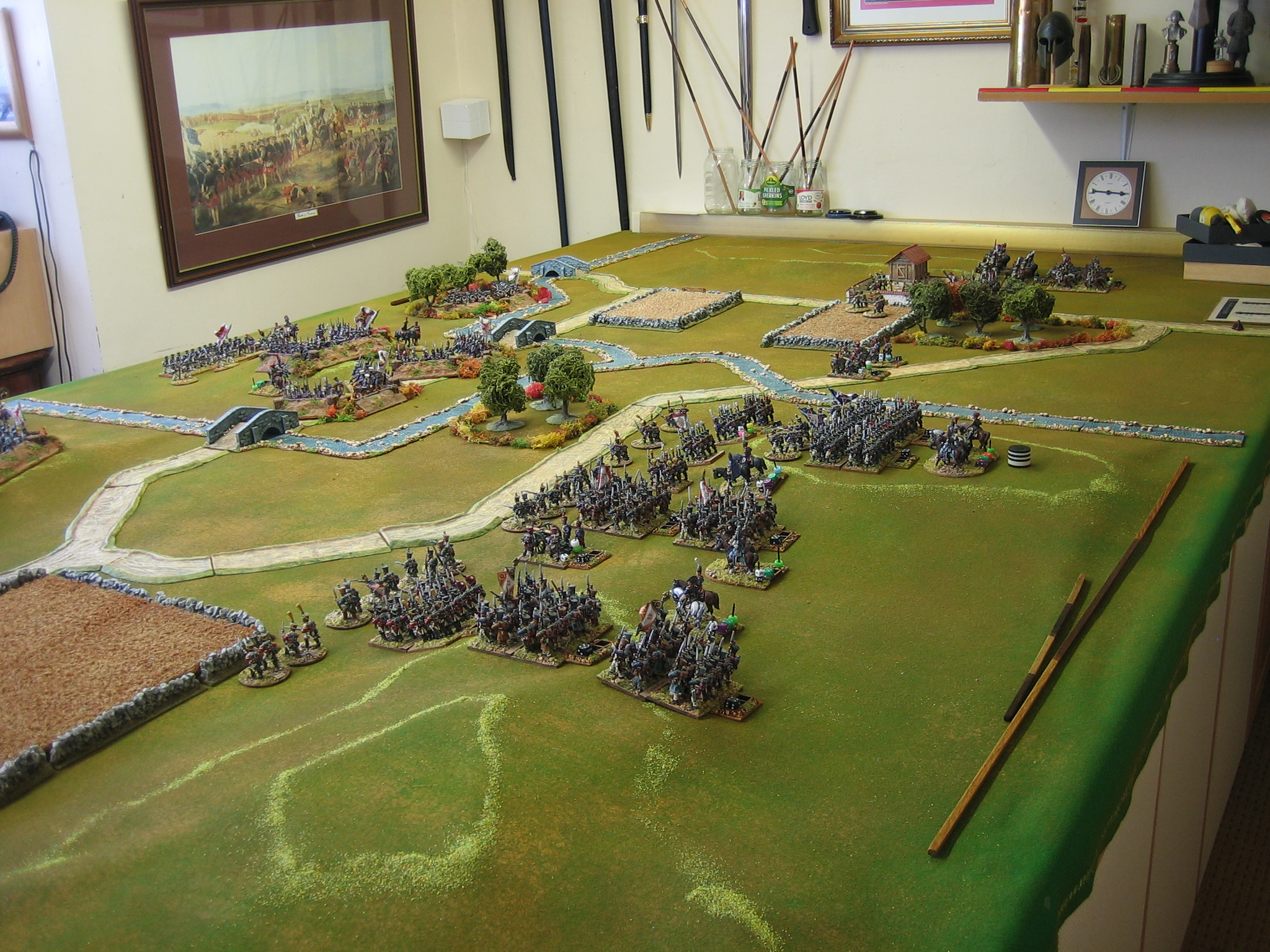
Because of the way the game ended last week (with insufficient time to do a new set of campaign map moves) it was agreed that I would pre-set a terrain for the next battle: Not knowing who would fight on it or where, this seemed fair enough - the exact terrain effect definitions could be sorted out after discovering which type of terrain (open, mountain, or wooded/cultivated) would be appropriate for the battle - I set up something that could cover all of the bases.

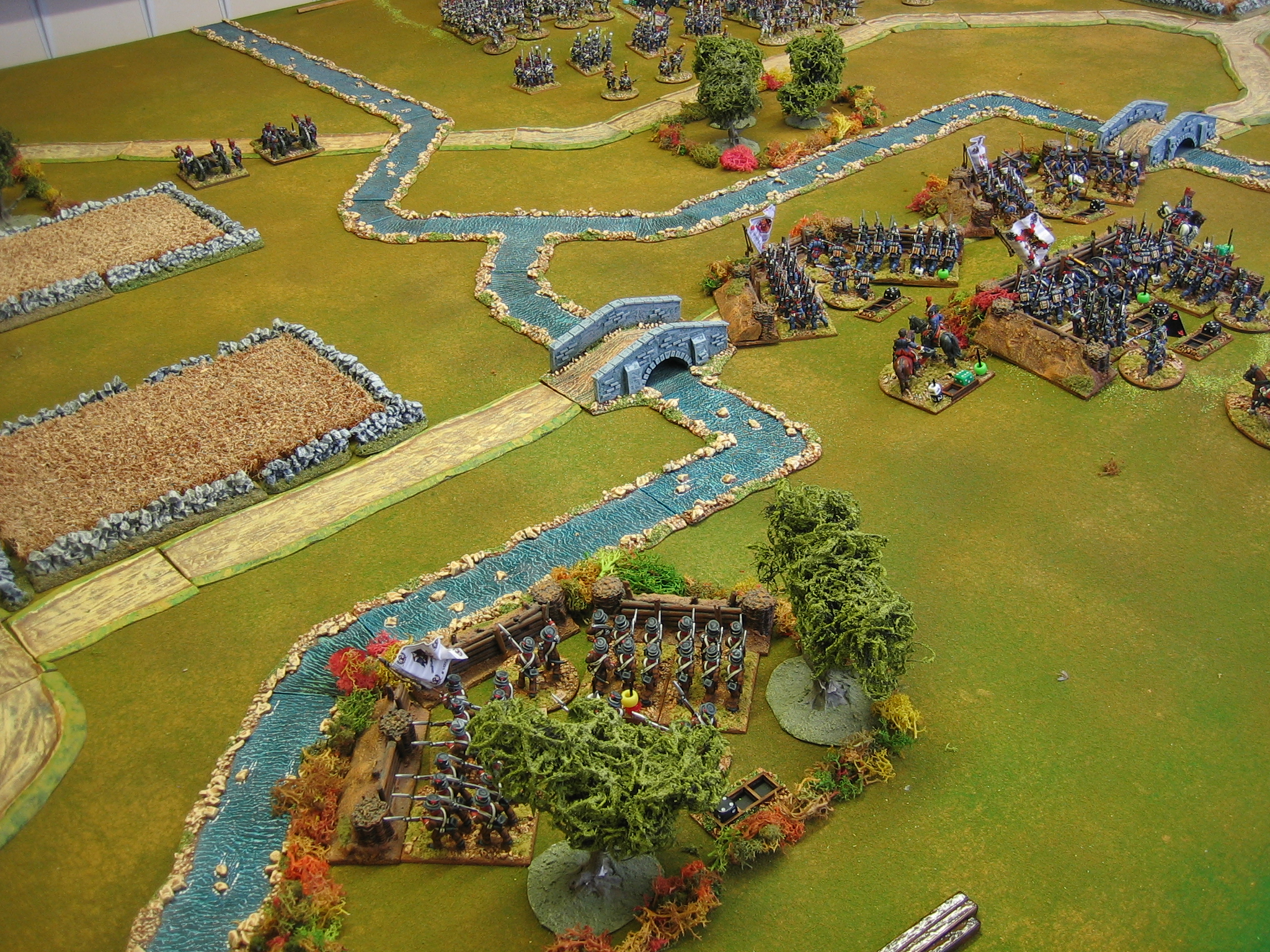
We spent the next hour or so working out the exact OOBs and Peter's fortifications (which he gets for defending in a siege assault game), then we deployed - Spanish first. With perhaps an hour of the evening still to go we decided to call the session over so people could get an early night. We are set for a full evening of table-gaming next week. This shot shows the Spanish deployment looking from the right, with a redoubt on high ground holding that flank of the position.

On the Spanish left Cazadores hold a Fleche in a wood.
The strongly held centre. Two fleches supported by a redoubt on high ground immediately behind.
The French deployed for the assault on Terragona. A strong left and centre with a possible flanking force in position on the extreme right.

Two batteries cited for maximum field of fire and within range of all the defences of the Spanish centre and left wing.
The French right - a mixed force of infantry and cavalry.

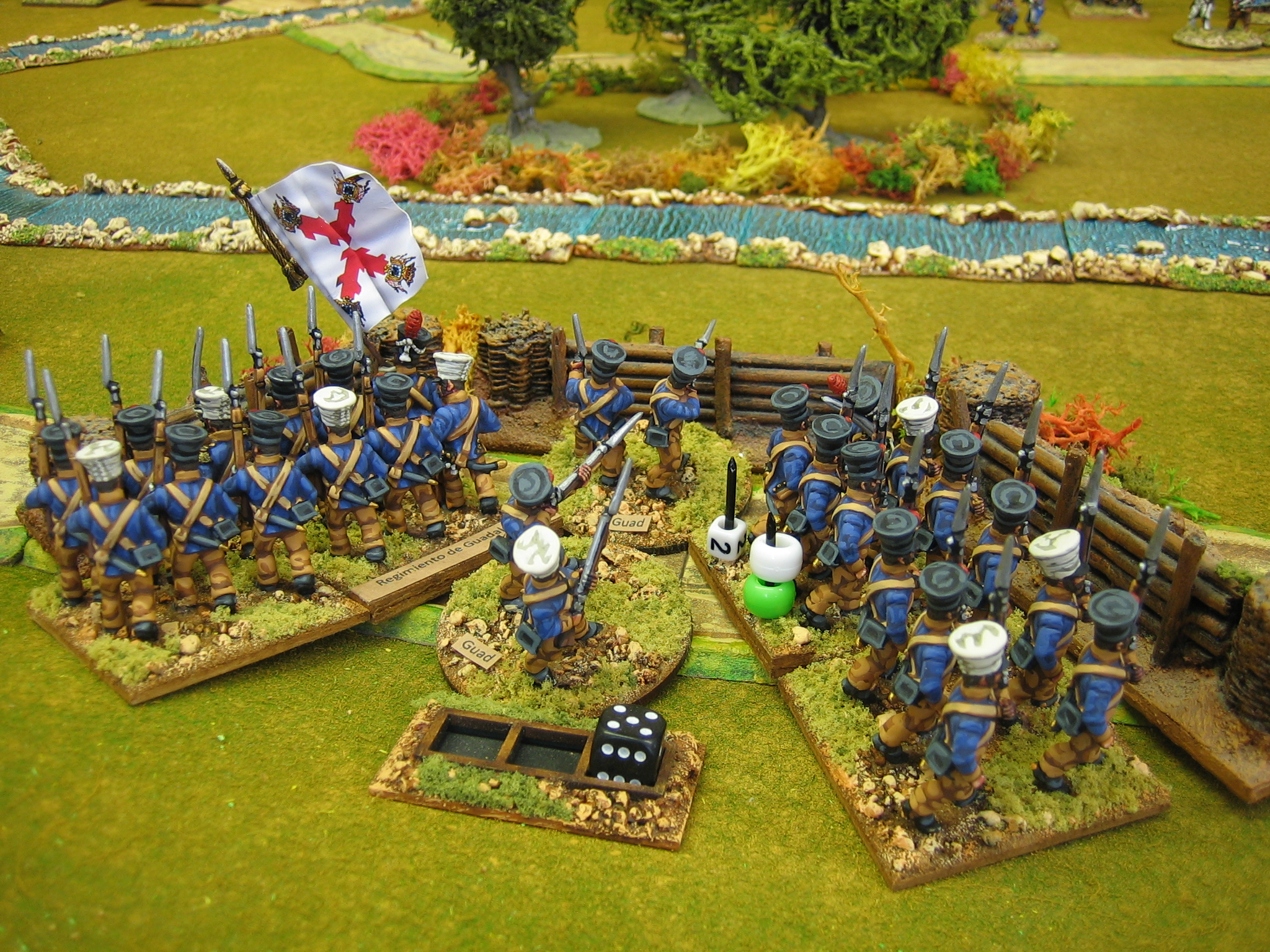
Two previously unseen units will take part in this action. These boys are Regiemento de Guadalajara. The ones in covered shako are all head swaps. The heads are from mistakenly ordered Nassau infantry. The buff facings, accoutrements and pantaloons, with bell topped shakos, are described for the grenadier companies sent to Cadiz, and I assume the rest of the regiment were similarly uniformed.

Secondly, I give you the Voluntarios de Navarra. I have these wearing the so called 'English Uniform'. They were wearing something similar late in the war (possibly with red lapels?); the grenadiers may have carried swords very similar to those carried by their French counterparts, mine don't. However, as the last infantry unit in the Napoleonic lead pile, these are close enough. 

Which leads me on to announce that stage two of my Peninsular War project is finished! It has taken me years, far longer than anticipated. It is my biggest collection to date: There are 2,683 men plus guns, horses, limbers, etc. (it beats my SYW collection by 43 figures). I'm not sure there is going to be a stage three - I have other plans.

Finally, the fortifications are not as Peter left them: I admit to having tweaked them in his absence. I don't really have rules for field fortifications (usually making them up as required) and, having thought on it overnight, decided to classify and rule on some set types. In the diagrams below, the brown lines show the shape of each type of stylised fortification I will allow in the campaign. The defending units stand below/inside them, and the shaded area shows the arc of fire that the fortification shape provides: N.B. Range is measured from the centre of the nearest face. NC stands for no change. SK stands for integral skirmishers (SK provide some limited fire potential and give an Up 1 versus a firepower morale challenge - the SK are placed within the fortification) and are included to give defences a bit of an upgrade within the general format of the game without adding lots of new rules (in a similar manner, they are always out and never withdraw when troops enter town sections).


Tuesday, 25 July 2023

Mid War Spanish Additions (cont. 17) - Sagunto Dragoons

This is the second to last cavalry unit for my Spanish (next and last, Coraceros). When it came to painting this unit I was really torn and I didn't go with what I wanted to do most: I went for what was probably more useful.

I wanted to do a heavy cavalry unit in blue coats (red facings) and bicornes and I have a flag for Del Rey but, that glorious unit is unrepresentative of the shambolic Spanish cavalry - if only they had not been so good. I also had a flag for the Sagunto Dragoons and that, strange as it seems, was the decider.

So here they are, the Sagunto Dragoons, or should that be the Dragones de Sagunto.

Figures by Front Rank and the flag is by Adolfo Ramos. Painting is by me, in Humbrol enamels. 
I think they look great in their resplendent, glowing, yellow coats with green lapels (and cuffs, under gloves).
Note the bugler. As with all Spanish dragoons in yellow coats, it's the yellow and  red (turnbacks) of the basic coat that get reversed - no green to be seen.

"No green to be seen" does that make me a wargame poet? Answers elsewhere, please.

I might do Del Rey as an addition at some point - a few additions are pencilled in for this army.

Next up: Regimiento Guadalajara. Not finished yet.


Sunday, 23 July 2023

Mid War Spanish Additions (cont. 16) - Voluntarios de Jaen 1811 & Voluntarios de Asturias 1811

I've added two units of infantry Cazadores to the army. These bring the compliment of light infantry to five units: Out of a total of twenty two units (when the last two are painted), including two Guerrilla bands, I think that should be more than enough. 

All figures are Front Rank. Flags are by Adolfo Ramos. Round bases are by Warbases, others are home cut from sheet MDF. All were painted a few weeks ago by yours truly using Humbrol enamels (mostly). Basing is a sand and grit mix; washed with diluted burnt umber ink, then dry brushed with two shades of beige household emulsion paint; the flock is Woodland Scenics coarse turf- a mix of 'yellow grass' and 'burnt grass'.

Voluntarios de Jaen 1811. Uniform details are from Osprey's Spanish Army of the Napoleonic Wars vol.3. There is no information on headgear. Given that the uniform is brown, I assume it was produced in Spain - so I've gone for round hats.

The number of skirmish stands is a visual game aid: They indicate the base skirmish factor. I nicked it from Lasalle by S. Mustafa. 


The brown and yellow coats look good as a combination and the white belts add nicely to the ensemble. The white gaiters are something I added on a whim. The Spanish wore gaiters in various colours (black, white, grey, light blue and dark blue). I couldn't find information on this unit's gaiter colour so I let rip - it's the men in top hats and spats.
Voluntarios de Asturias 1811. Again, uniform details from Osprey's Spanish Army of the Napoleonic Wars vol.3.... 
....and yet again, I don't have information on what headgear this unit wore. Given the recruitment area I can only guess that the uniform was produced in Britain: Probably a shako, then.
I decided on black accoutrements for this unit: Mostly because I probably haven't done enough of it in this colour.

Next up, another unit of Spanish dragoons (finished some time ago). That leaves just three units left to do. I can see the pub from 'ere! 

I've also finished the work on the campaign, the players seem up for it, so they might all see some action very soon.