THE BATTLE OF BIR EL GUBI 19th November 1941

On the second day of Operation Crusader, the offensive to relieve Tobruk, British 22nd Armoured Brigade was ordered to shift Italian Ariete Armoured Division from Bir El Gubi and secure the southern flank of 7th Armoured Division for operations around Sidi Rezeg and Tobruk.
22nd Armoured Brigade comprised three newly operational regiments equipped with new A15 Crusader tanks (168 of them). It was supported by three batteries of assorted artillery and a single company of King's Royal Rifle Corps infantry; 11th Hussars provided reconnaissance. Morale among the tank men, unlike proficiency, was sky high.
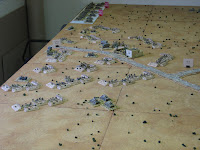
Facing the British tanks, 8th Bersaglieri Regiment of Ariete Division, well supported by anti-tank and field guns (including 90mm AA and truck mounted 102mm naval guns), were dug dug in around Bir El Gubi. In the rear, of 8th Bersaglieri, the M13/40 tanks of 132nd Tank Regiment stood ready to counter-attack. Here was the cream of the Italian army in North Africa.
At 11am, and without any artillery bombardment, the tanks of 22nd Armoured Brigade attacked. It was described as "the nearest thing to a cavalry charge by tanks yet seen during this war" - it was a 'Balaclava' moment. But, with insufficient artillery or infantry support and despite initially breaking into the Italian position, the attack was driven off with very heavy losses. British 'all tank theory' had been proved wrong - though the lesson would not be realized, or acted upon, for some time to come.
Orders of Battle for a Company Level Game (scaled at 1:5-ish).
SCENARIO NOTES
Rules
I will be using a very slimmed down, less complex and faster play version of Piquet (but it is still Piquet) for this battle. If you wish to use these notes for another rule set you will probably need to amend the arrival times slightly, and come up with a different way for the Italians to place minefields; otherwise the scenario should be easily adaptable.
The Battlefield
When setting up the terrain for this battle I used three primary sources. The maps in The Sidi Rezeg Battles 1941 by Agar-Hamilton and Turner, Benghazi Handicap by Chadwick, and Google Earth. The position of Bir El Gubi, for those wishing to find it on Google Earth, is 31 degrees 32' 14" N 24 degrees 01' 48" E. The trench lines are still clearly visible, and the battlefield is unchanged.
The ground is virtually flat, and seems to have provided good going for all vehicles. The only natural feature of any note is Wadi esc Sciaaba which runs north - south to the west of Gubi. There are two 'villages' in the area, Bir Belchofas and Bir El Gubi; Bir el Gubi is described in Brazen Chariots by Robert Crisp as "a little white-washed house surrounded by a low parapet". I have added two roads, one of which is the Trigh El Abd, but the word 'road' is, like the word 'village', an overstatement - they were desert tracks which served only as a means not to get lost. Although the terrain is reasonably accurate I have scaled it for feel rather than actual ground scale - as the battle area is flat this should make next to no difference.
Initial Deployments
At the start of the game 8th Bersaglieri Regiment and all associated artillery start the game
dug-in in two concentric arcs facing SE, with the front line beyond Bir El Gubi. The front line should be infantry, the reserve line should be a gun line. One company of M13/40s should be deployed just outside and in front of the defences. The remainder of 132nd Tank Regiment, along with the Corps artillery (105mm), are initially deployed off-table.


22nd Armoured Brigade starts the game with two tank regiments and 11th Hussars deployed on table. 2nd Royal Gloucestershire Hussars (Horse in one source) deploys to the west of Trigh El Abd facing Bir El Gubi; 4th County of London Yeomanry are to 2nd RGH's left (they are looking for the right flank of the Italians); 11th Hussars are to the right of 2nd RGH heading north east of Gubi (to find the left flank of the Italians); everything else is initially deployed off-table
Arrivals


The British have one Stratagem 1 card (activating 3rd County of London Yeomanry) and one Stratagem 2 card (activating the brigade's 'support group') in their sequence deck. Both cards activate arrivals from the start of turn 2. Once turned, the arriving units may move onto the table at full rate on the appearance of a relevant Move card. 3rd CLY appear on the far right of the British base line (looking to find the left flank of the Italians). The support group arrives, on the British base line, anywhere behind the advance of 2nd RGH and 4th CLY. Discard the Stratagem cards after use.

The Italians have one Statagem 1 card (activating both battalions of 132nd Tank Regiment, but on different turns) in their sequence deck. The card activates the two remaining companies of the 1st battalion (the other was deployed on table at the start of the game) from the start of turn 3. The card activates the 2nd battalion from the start of turn 5. Once turned, the arriving units may move onto the table at full rate on the appearance of a relevant Move card. Both battalions arrive on the base line at the extreme left of the Italian line - poor old 3rd CLY! Discard the Stratagem card after its final use.
Minefields

The Italians have four minefields. These can be placed by the Italian player during the game on the appearance of
Special 1 and
Special 2 cards. There is one of the former and two of the latter in the Italian sequence deck. On the appearance of a Special 1 card the Italian player may place one minefield. On the appearance of a Special 2 card the Italian player may place one or two minefields. When a
Special card is used it is discarded. Minefields may not be placed under units, otherwise there is no restriction on placement. Italian troops can pass through minefields at half speed without risk. Any other movement through a minefield automatically enforces a D10 Vs D6 fire strike, and if any hits are caused an automatic morale challenge.
Notes:
I have chosen to do minefields this way for two reasons. First, there is no need for mapping (and any resulting argument). Second, I was struck by the accounts of British tanks 'running into minefields'.
The Italian player must remember that he does not have sufficient cards to place all minefields individually.
Primary Sources
The Sidi Rezeg Battles 1941 - Agar Hamilton and Turner
Crusader - R. Humble
Iron Hulls, Iron Hearts - I. Walker
Benghazi Handicap - F. Chadwick
Google Earth
Figures, etc.
From the collections of Mark D. and yours truly. BTW, the shell case at the end of the table is a 2pdr from 1941.


