Thursday, 17 March 2011

Ager Sanguinis Punic Wars - update

Good news!

Following a conversation with Brent Oman of Piquet Inc. and Andrew Hubback of Miniature Wargames I have an announcement to make regarding Ager Sanguinis Punic Wars. The rules will now be published, in full, in colour, as an advertisement free centrefold pull out in Miniature Wargames (issue to be decided).

I would like to thank Brent for giving his permission to publish. Ager Sanguinis is largely based around classic Piquet & Field of Battle mechanics and his permission settles any copyright issues.

I would like to thank Andrew for committing to such a large, one off, and very 'usable', publication; Ager Sanguinis Punic Wars is a rule book not an article; it will take up considerable magazine space - a bumper issue, me thinks. Those who have the bumper issue with Ager Sanguinis Crusades in it will be familiar with the excellent job Andrew made of it (if you have a copy hold onto it, this edition has completely sold out).

Peter J. and I are still play-testing the finer points of ASPW. One of the hardest things to get right has been triplex acies formation but, we think we've completely cracked it now. Those familiar with the period will know what an essential aspect of Middle Republican Roman warfare this is. In fact, getting the Roman side of the game right has proved the most difficult thing to do full stop but, again, we think we are about there.

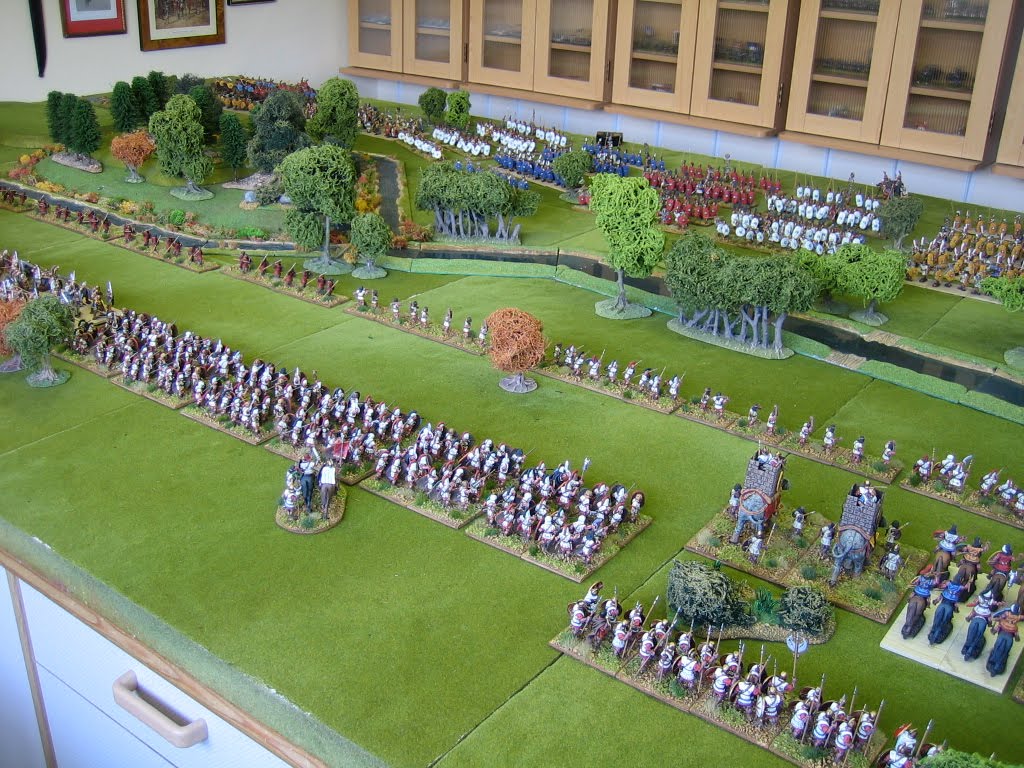
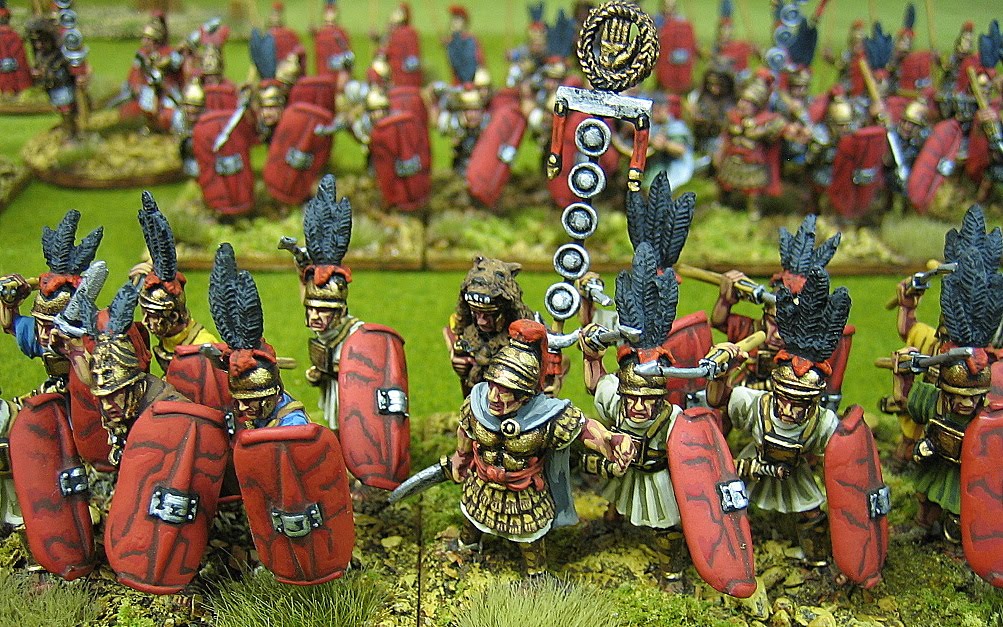
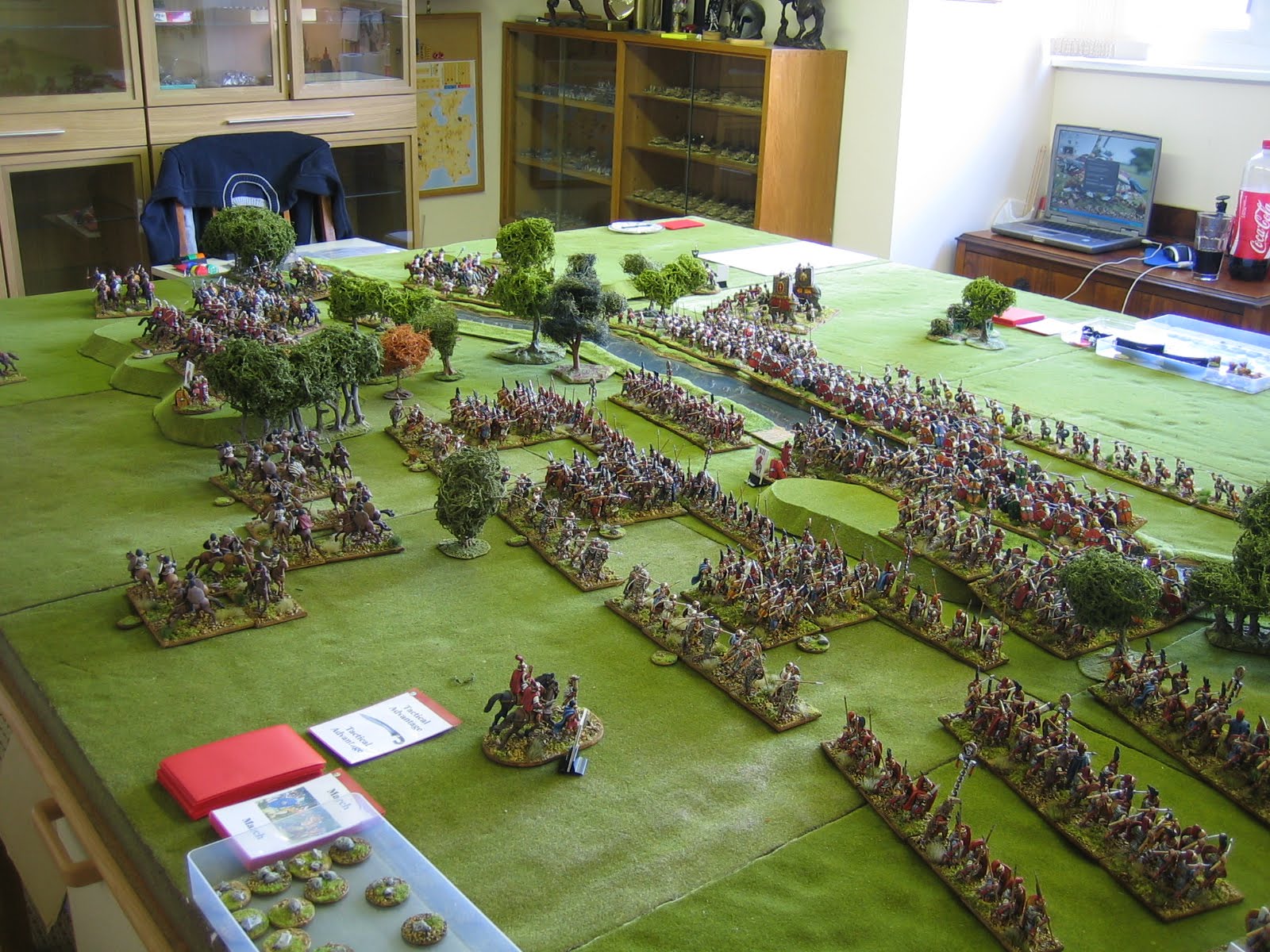
Here are some more shots of the current play-test game.


In the centre the battle continues to be hard fought. Here velites turn to cover the rear of the Roman line from marauding Numidians, and Roman cavalry on the left attempt to halt the press of Carthaginians with flank charges.


The Carthaginians were winning the infantry battle, they thought they have it in the bag and were about to turn the Roman infantry flank, when the Roman Stratagem card was turned - Hidden Ditch. This is a card from the army characterisation deck - a new addition to Ager Sanguinis - sneaky huh!

The characterisation deck adds lots of flavour to the standard (and expanded) sequence decks and sorts out army morale points. It features 'stratagems' including reinforcements, heroic speeches, hidden ditches, secret paths,etc. It also features replacement sequence cards, such as 'Aggressive, melee Up 1', wild cards, etc. These give an army some 'soul' and make a pick-up game feel like a scenario.


The Carthaginians decide to up the stakes by trying to outflank from their left (this side of the battle was quiet except for some desultory skirmishing) with Libyan phalanx marching in column through the woods to force the Roman cavalry away and open the door. Pressure was also brought in support of the main attack across the river - the Gauls stopped mooning from the woods, pulled up their baggy trousers, and charged!
We will continue this game next week.
I'll let you know when Ager Sanguinis Punic Wars is finished and when Miniature Wargames will publish.

Thursday, 10 March 2011

Ager Sanguinis Punic Wars - playtesting continues

This battle was set up to test virtually all of the mechanisms in Ager Sanguinis Punic Wars at once. Peter and I agreed to fight the battle in a friendly rather than competitive manner (though winning will count!) over two or three sessions so that everything is done 'correctly'. We think the rules are almost done, we are now fine tuning them, and the game has to stop from time to time so we can discuss outcomes.


As can be expected in a battle involving a river crossing the game had a cagey start. Skirmishing erupted along the entire battlefront. The Carthaginians got the better of it. Then the Carthaginians made their first move of consequence. The Gallic masses swept over the wooded hill (Carthaginian left centre) and though the Romans countered by sending in their own Gallic allies, again it was the Carthaginians who prevailed. Their Gauls swept down the forward slope and taunted the Romans from the trees.


In the centre it was the Romans who moved first. Sending their legionaries forward they were counter charged by veteran Iberian foot as they reached the far bank. The shock was too much for the Roman hastati and they recoiled back to their own side of the river with some heavy losses. Indeed, it was only the flexibility of the Roman triplex acies which stemmed a collapse - Roman principes being hastily rushed forward to defend their own river bank.


On the Carthaginian right, the Gallic, Iberian and Numidian cavalry moved to outflank the greatly outnumbered Roman cavalry (odds of 9:4).


On the Carthaginian left the cavalry wings of both sides advanced, but both were reticent to force the issue.

Friday, 4 March 2011

Get 'em out for the Lads


The Ager Sanguinis Punic Wars rules are almost done, so it's time to do a play-test involving armies of the size for which they were designed. This game has everything I've painted so far.
I still have some basing to finish before the game on Wednesday, but it's time I did it anyway.

Here are some shots of initial deployments.


Monday, 28 February 2011

Filler shots

I'm in the process of formatting Ager Sanguinis Punic Wars. There are always a few gaps that need filling - to get the relevant rules onto whole pages (rather than split overleaf) for easy reference - so I took these shots. They might not be the ones I settle on for the final version, but I thought you might like to see them.


On Wednesday evening Peter J. and I will put the rules through their paces. I think we are almost there.

Thursday, 17 February 2011

Ager Sanguinis Goes Punic


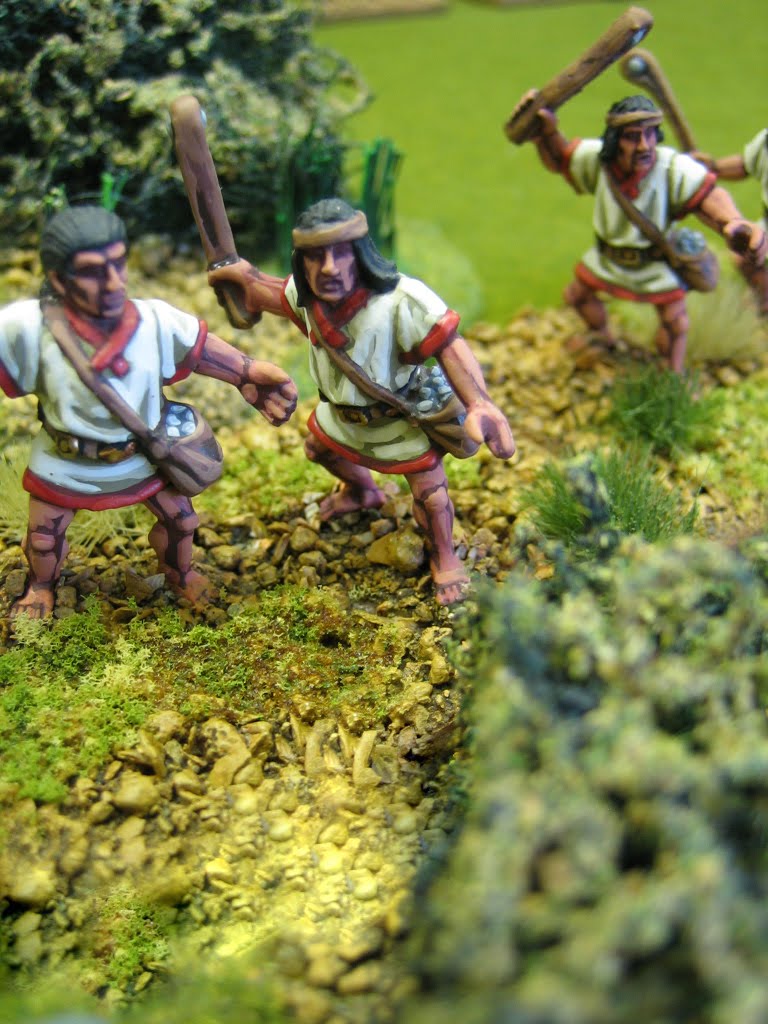
Last night Peter J. and I played a small Punic Wars game. Primarily it was to see how Ager Sanguinis rules could be modified for the Punic Wars. To make life interesting I set up a scenario where the Romans had to come straight off the line of march and break through the Carthaginians in hilly and wooded terrain. Deployment was 'free' and both sides deployed the bulk of their forces on the same side of the table; with the game played long ways (giving only a 6 foot wide table to begin with), and limiting terrain, this led to everything piling up in a small area of ground - a slogging match.


As for the rules - we used the AS quick play sheet and made everything else up as we went along - they worked well for a first outing. Most troops, formations and weapons have now been classified and their position in the tables decided. I've got to say that Piquet's Field of Battle by Brent Oman (on which AS is largely based) is such a strong, mechanically sound rule set that tweaks are easily made to 'stick' without unbalancing the basic mechanisms.