Showing posts with label 2nd Punic War Campaign 2014. Show all posts

Thursday, 26 June 2014

"Carthaginians, tharzands of em!"


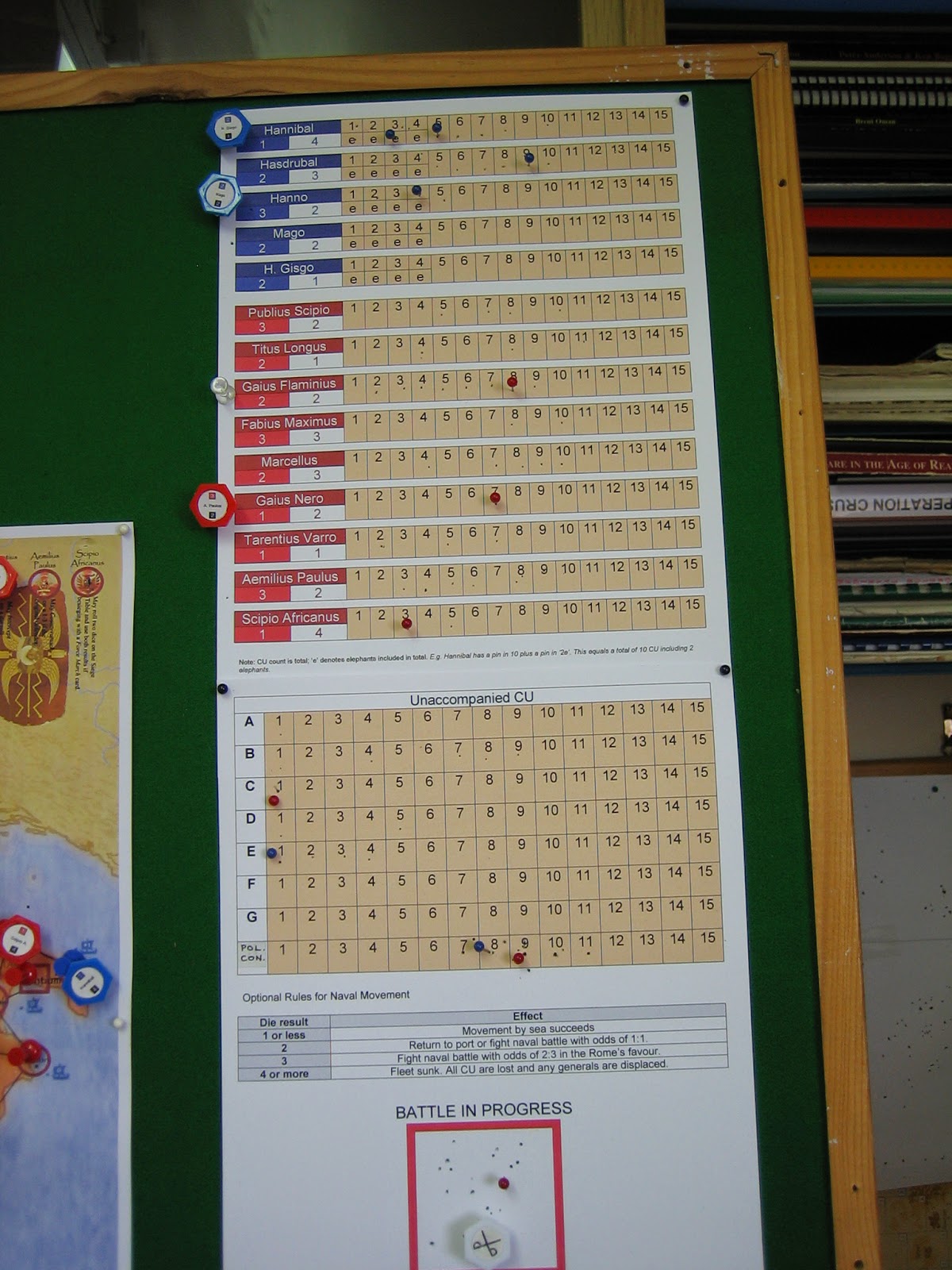
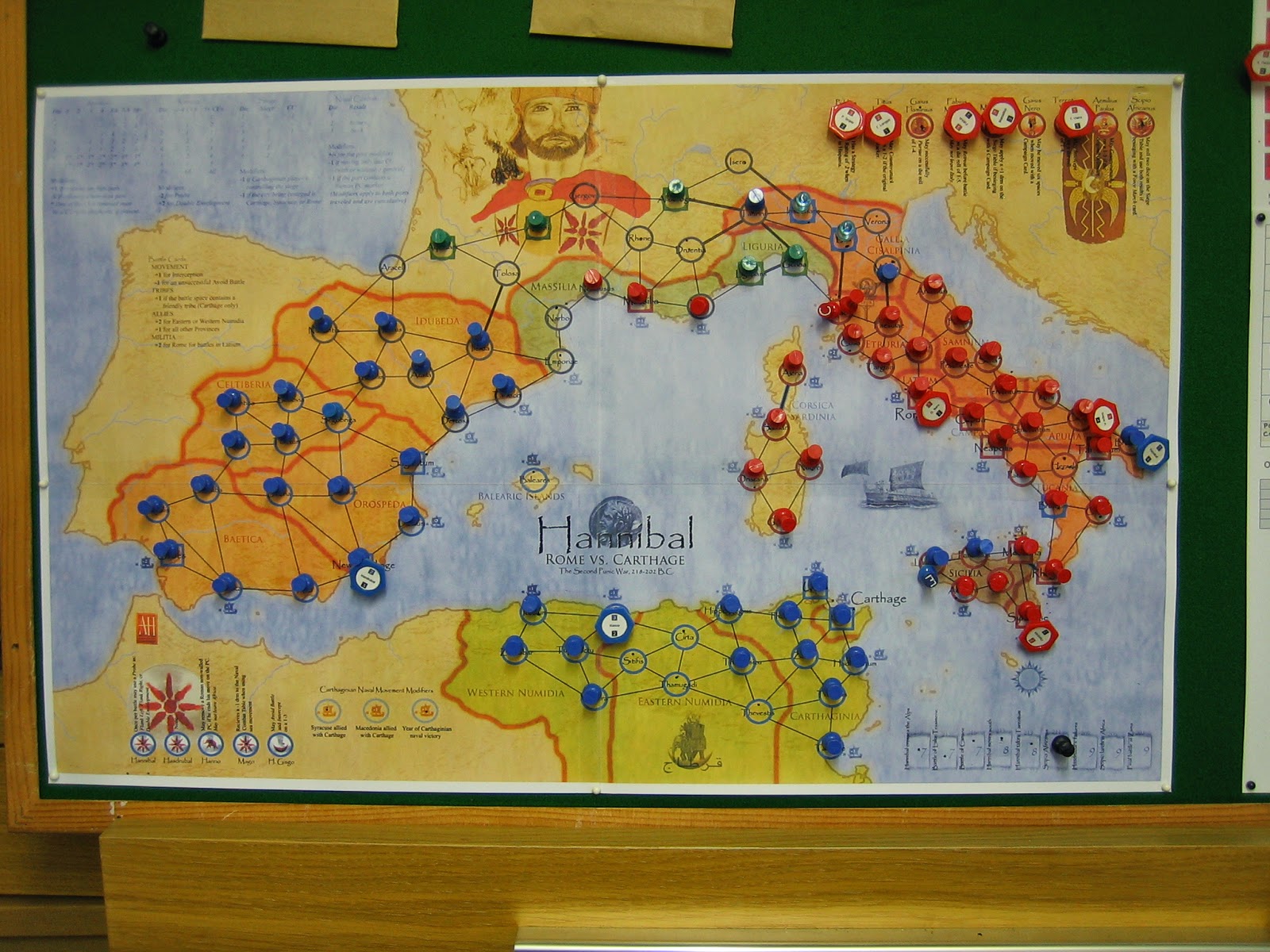
The situation at the start of turn seven - 207 BC to 209 BC. Nero and Longus are the elected consuls. Flaminius and Scipio Africanus are pro-consuls. 

Carthage: Card 57: Hannibal marches over the Alps to Araceli in Gallis Transalpinia. Hannibal's passage is not without cost - he loses 1 CU in the mountains (25% attrition).

Rome: Card 3: Event - Western Numidia Revolts.

Carthage: Card 23: Carthage regains political control over three areas in W. Numidia.

Rome: Card 48: Event - Recruit Auxilliaries. Longus recruits 2 CU.

Carthage: Card 39: Minor Campaign Card - Hannibal and Hasdrubal march to link at Iberus in Northern Hispania.

Rome: Card 24: Scipio sails to Africa. He lands at Carthage. His siege does not go according to plan and he loses 1 CU.

Carthage: Card 33: Major Campaign card. Hasdrubal marches south to New Carthage. Hannibal, the thought of his ignominious reversals gnawing at him, marches to Gergovia in Gallia Transalpinia with 8 CU - is a new invasion on the cards. Hanno marches to confront Scipio at Carthage.


The Situation at the Battle of Carthage. One rectified mistake (not shown here) is that Hannibal has restored his elephant points - elephant points do not count as they do in the board game, they just allow Hannibal to field some elephant units in miniatures battles; elephant units can always be fielded by Carthage in Spain or Africa.

Scipio is massively outnumbered - 11 : 4. The matter of Victory banner allocation has, I think, been resolved. Each side will get 6 banners plus 1 banner for every five units. This gives, for this battle, Scipio 9 and Hanno 14. On reaching zero, that side loses the battle.

Will the terrain come to Scipio's aid? 


The Carthaginian lines - absolutely packed. I offered Peter the option not to field all of his units (within reason) but to take the victory banners attributable to his army size. He refused the offer, asking if if he could keep those not fielded as off table reserves. I said no, so he fielded everything. In retrospect, having thought about it, I should have allowed him to field a balanced force as off table reserves .They could have been 'table sectored' off table and been brought on using inspired leadership cards. As it was, the numbers of Carthaginians worked against them - Cannae fashion.


Rome deployed second, largely neglecting their left table sector. The chips are used as a simple visual aid: Green for light troops,  Blue for medium troops, red for heavy troops. 'Stones' markers on chips show 'blocks' lost (see pics below).

I am currently thinking about a few changes to the make up of the Roman army. I don't like Hastati units being classed as auxillia (I think they should be medium infantry), and I'd like some form of triplex acies rule. If I can come up with something simple for the latter it should go some way to balance the loss of the former, very / over useful, status. This might lead to a re-evaluation of all unit abilities. I did this for hex-less games and it worked well.


Carthage advanced against the Roman left.
Their attack seemed to be developing nicely.
Rome moved to shore up their left against the attack and, for a while, the battle here hung in the balance.
The concerted Carthaginian attack by elephants, light troops and shrieking tribesmen was easily beaten off by the inspired leadership (two leaders were employed by Rome in this sector) and some even better dice rolling - yet again Carthage rolled the proverbial 'bag of the brown stuff'.
At the end of the first nights play the balance of power is shifting towards Rome. Both sides have 6 victory banners left each.
The positions at the end of play. Here on the Roman right the battle has been an enormous skirmish.
In the centre, the skirmish has come to hand strokes - especially around the woods - and the Romans, in terms of 'blocks' killed have come out on top; several Carthaginian units have two or three block (out of four) losses.


The Position on the Roman left has stabilised. The Romans were definitely the winners here but I think the Carthaginians could still turn the tables here.

The battle will be concluded next week.

Saturday, 21 June 2014

Scipio Vs Hannibal: Round 2 - On Squexes

 
 The campaign position following our battle of Cannae.

Rome: Card 58: Nero marches to Cannae to transfer troops to Scipio before retiring to Ami.

Carthage: Card 37: Minor Campaign Card: Hannibal marches to Tarrentum. Hasdrubal attempts to sail from Spain to Tarrentum but is forced back to port by the Roman navy.

Rome: Card 27: Scipio attacks Hannibal at Tarrentum.
  
 This battle was set up differently than the others of this campaign. Last week I decided to squex (more of later) the much underused green side of my TSS tiles so that we could play out battles using 'classic' Command and Colors. 
 The Result was an unexpected victory for Hannibal. The victory was due to two things. The first was, as per classic Commands and Colors, both sides were playing to achieve an equal number of victory banners. The second was, being unused to playing the board game as the board game was written, Rome deployed the wrong tactics and didn't cycle through his abundant reserves thus saving the first units into combat from destruction. It's hard to say which reason was the more important, but by the time Rome's fresh units came into the fight both sides were down to just a couple of victory banners and victory became a lottery that Carthage won; I think there is always a temptation with Command and Colors to try and kill something with every card rather than building a proper attack and using reserves properly. As it was, both sides escaped the encounter with minor losses - but Rome was aggrieved.

Carthage: Card 63: Following the battle Hannibal decided to try and make a run for it and prepared to sail for Africa, Carthage, and comparative safety, but the Roman Naval blockade was too close and tight: He failed to sail.

Rome: Card 30: Scipio attacked again. The weather was against him (Carthage plays Card 41, Bad Weather, as an event which limited Scipio to two spaces movement) and Hannibal managed to evade out of reach.

Carthage: Card 61: Hannibal force marched north, moving so fast that he caught Nero at orgy in Ami (Nero is displaced), to Ariminum.

Rome: Card 55: Event, Messenger Intercepted - Rome took one of Carthage's strategy cards.

Carthage: Hannibal moved into Cisalpinia. Hannibal stopped at Insubrians, Gisgo continued on to Taurini.

Rome: Card 46: Event, Allied Auxiliaries - Scipio recruited 2 CU.

Carthage: Card 21: Carthage re-established political control over two areas in Eastern Numidia.

Rome: Card 4: Event, Celtiberia Revolts!

Rome: Card 44:  Event, Allied Auxiliaries - 2 CU recruited in Rome.

Rome: Card 45:  Event, Allied Auxiliaries - 2 CU recruited in Rome.

 
 The situation at the end of the turn. We will start turn 7 next week (just three turns to go).


This will be the next battlefield. I set up the battlefield in between battles to save time. As umpire, I have no idea which generals or forces will be at the battle so it's quite fair. Then, as a double proof of fairness, at the start of each battle each player:

  • Rolls a D6 adding his battle command rating - winner chooses which side. 
  • Rolls a D6 adding his battle command rating - loser deploys first.
As you can see, this table has been squexed with squexes for squex movement. This offset square pattern is not so visually appealing as hexes but, squares are soooo much easier to draw than hexes. I first came across squexes in the ancient naval rules Diekplus by Newbury Rules back in the early 80s. Squexes have always held a curious appeal for me. I frequently use them, especially for campaign maps, because I find they are easier to put information in than true hexes (though they are more frequently Squextangles in this latter case). They are an interesting tool for Piquet 'Theatre of War' Campaigns.

Isle of Fob Map from an Imagi- Crusades campaign based on ideas in Theatre of War by Piquet

Saturday, 14 June 2014

Cannae or Can'tae

Following his defeat, as he marched by Rome, Hannibal looked vulnerable to being crushed. Things did not pan out as I expected.

Rome: Card 12: Political control of Pisae and Croton.

Carthage: Card 14: Event, Ligurian Recruits - Hannibal adds 2 combat units (CU).

Rome: Card 16: Marcellus (pro-consul) moves with 4 CU to Syracuse and a siege is successfully begun.

Carthage: Card 19: Event, Pro-consul Dissmissed - Marcellus is relieved of his command.

Rome: Card 64: Flaminius moves to Syracuse with 4 CU and the siege is successfully continued.

Carthage: Card 35: Event, Diplomacy - Political control is negotiated over Brundisium in Apulia.

Rome: Card 5: Syracuse lamely submits and Flaminius enters in triumph - back in Rome Marcellus 'The Besieger' plots his personal revenge; Flaminius must have been behind his dismissal.

Carthage: Card 50: Event, Adriatic Pirates - Hasdrubal sails for Brundisium onboard a fleet of fast pirate ships with 3 CU. Because of the straits he lands out of reach of Flaminius.

Rome: Card 51: Event, Epidemic - Hasdrubal's army falls victim to sickness but casualties are minimal (no effect on CU).

Carthage: Card 6: Hannibal marches south to Terventum.

Rome: Card 53: Political control take of Falerii.

Carthage: Card 2: Hannibal marches to join his brother in Brundisium.

Rome: Card 11: Political control take of Nice.

Carthage: Card 40: Minor Campaign card, Hanno moves to Saldae and prevents Roman control. Hasdrubal boards his ships again (without CU) and sets sail for Spain. The Romans are waiting for him and his fleet is dispersed (Hasdrubal is displaced).

Rome: Card 42: Political control take of Nemausses in Massilia.

END OF TURN: Rome had the worst hand of strategy cards I've ever seen. Her temporary advantage was lost.

TURN 6: 211 BC - 210 BC

Flaminius is made pro-consul.
Scipio Africanus is made pro-consul and marches to Cannae with 5 CU.
Paulus and Nero are elected as consuls (placed in Rome).

At the start of turn 6 the strategic position is as follows.


Carthage: Card 7: Hannibal marches to Cannae to do battle with Scipio.

Hannibal has 7 CU plus 1 CU for allies in Italy.

Scipio has 5 CU plus 3 CUs for allies in Italy and a 'Brown Card'. (We have decided that strategy cards with a brown banner can always be used as an extra CU in battle - they can, of course, be used as something else if a suitable argument can be made). 

As battles go, this one was not the most exciting. Also Peter could only play on the first night (on which the all campaign moves above were made) and I had to finish it off for him in a short session on the following night. The resulting campaign consequences were also negligable (both sides lost 2 CU). The report is a shot one.


 Initial deployments. Note that Hannibal, having been reinforced from Spain, has elephants again.
 Light troops clash as the Romans rush forwards.
 Elephants advance onto the flank of the legions. Elephants were used well, for once, in this battle and caused much damage.
 The infantry clash was fairly equal for much of the time as each side traded victory banners almost 1 for 1.
Then the luck went all one way. The Romans dispatched unit after unit without significant loss to themselves. The surprising thing about the Roman victory was the number of units which were only one 'block' away from being destroyed - of the 12 or so remaining Roman units more than half had only one block remaining.

Hannibal retreated back to Brundisium.

Next week we will all be back to the continue the campaign.

Thursday, 29 May 2014

Varras - Saviour of Rome

So, after a break of a couple of months, this week sees the restart of our 2nd Punic War campaign.

I'm afraid, as with most ancient history, some has been lost over time and it is now hard to piece together the occurances in the latter half of 215 BC. What we do know is the army under Flaminius was  soundly beaten in Africa and nothing worth the name ever made it back to Italy. At the end of 215 BC things were looking bleak for Rome.


Here is the situation at the end of turn four - 215 BC. This is how we left the campaign two months ago.


Here is the situation following campaign reinforcements and new consular elections that we carried out last night. 

The new consuls for turn five - 214 BC & 213 BC are Varras and Flaminius, the latter having obviously told a tale worthy of Homer on his return to the metropolis. 

The very first move of turn five, by Carthage, brought about a battle. Hannibal decided to march north (using card number 32) in an attempt to reach Cisaplinia and his Gallic allies before Flaminius and pro-consul Marcellus could bring their superior numbers to bear in the south. Taking the most direct route he attempted to slip past Rome's garrison under Varras. Undaunted by Hannibal's awesome reputation Varras intercepted him with every man he could muster.

Varras' force comprised 5CU and 2 Allied CU plus 2 CU from the garrison of Rome (use in Latium only). It would be represented by a consular army plus an extra 'triplex acies': 24 units total. Varras was a poor commander and was assigned a 5 card Commands and Colors hand (he should have been given 4 cards).

Hannibal's force comprised 6 CU and an allied CU: 20 very mixed units total. Hannibal was assigned an 8 card Commands and Colors hand (he should have been given 7 cards). Carthage won side of table roll and the roll to deploy second.

The Battle of Rome

Both sides deployed conventionally with cavalry wings and infantry centres.


 Rome pushed her legions forward to be met by advancing Carthaginian skirmish lines.
 Fearing an outflanking movement by Numidian cavalry one legion peels off to hold them.
 After a short period of desultory skirmishing things move speedily..
To a resounding crunch!

The Romans become outflanked by Hannibals Bruttian and Italian mercenaries. 

But it is too late.
 The melee is over very quickly. 

Except for the gallant efforts of some Spanish and Italian infantry (foreground) which kill a Roman general and almost carve through an entire triplex acies, the result is decidedly in favour of the Romans.

It will teach Hannibal not to rely too heavily on the French (Gauls).
 Hannibal plays his two card trick (Hannibal is allowed to play two cards one after the other at one point in the game - because he's a genius) and uses it to launch his cavalry in a desperate bid to turn the tables.
 On the right they are successful.
 On the left less so.
 The Romans rush velites to prop up their left flank before becoming enveloped.
 But the Carthaginians burst through. 
 Hannibal is wounded and carried from the field. The Carthaginian army begins to melt away.
Things are close. The Romans need one more victory banner. Carthage needs three.

Carthage gains two banners in the penultimate turn. Rome and Varras seal Hannibals fate in the last.

Varras, favoured by the Gods (extremely good early C&C cards), is the Saviour of Rome.

 
Here is the situation after the battle. Hannibal is alive, though just. Varras has been severely denuded.

A belting battle to kick things off. The campaign will continue next week.


Thursday, 6 March 2014

The Battle of Heraclea - Rome strikes back

Paulus marches his army out of camp and offers battle to the Carthaginians (deploys first). Hanno accepts the challenge.

The initial deployments. Rome masses its legions in the centre and details its velites to the flanks in support of its cavalry. Carthage sets its Bruttians in the hills, its African, Spanish infantry and elephants in the centre and a strong cavalry wing on the right (foreground). The Romans begin the battle here, taking the settlement and launching a series of cavalry charges. Honours are about even but the Romans remain in possession.


 The Roman legions advance in the face of the elephants. 
 The elephant attack is poorly timed (Romans battle first) and they cause as much damage to their own side as the enemy. Here an officer rides up and down the line inspiring his men against the beasts - moments later he is flattened under the dead body of one of them (C&C: double helmets!).

Carthage will lose both of its generals in the battle.
 Carthage spreads the attack over to the hill country.....
.....and sends a sneaky attack around the rear of the advancing Romans, cutting their line of retreat (this road exit is worth 2 victory flags to the owner).
 The Romans finally lose the village (2 victory flags). They have to send troops to recapture the village and the road exit.
 The Carthaginians are pulling the battle back but at heavy cost: They consolidate their right wing.
 The Roman counter-attack in the hill country. They beat the Bruttians easily. Rome is gaining ground and the battle begins to swing in favour of the Romans. They capture the Carthaginian hill (worth 1 victory flag) they need three flags to win.
And here, in one card, they are - one for the unit of surrounded, hapless Spaniards; two for the road exit (far distance) recaptured by a unit of triarii.
Following the battle, judged to be long fought (attrition on the 7-9 column) and a normal victory (no adjustment on the retreat table) Paulus takes 1 CU loss. Hanno is wiped out after rolling very badly.