Showing posts with label Napoleonic Peninsular War Project. Show all posts

Tuesday, 5 July 2022

Last of the French

EDIT: Sorry about the photographs - I had to use a different camera to the one I normally use.

When I ordered my Peninsular Spanish army in October last year I added a several nice to haves for my British and French armies. 

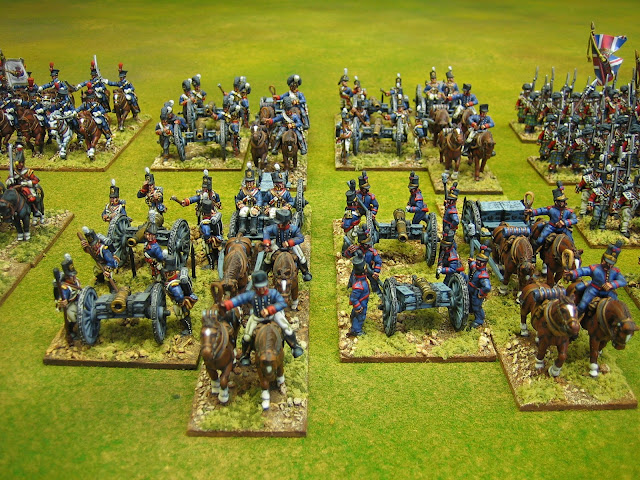
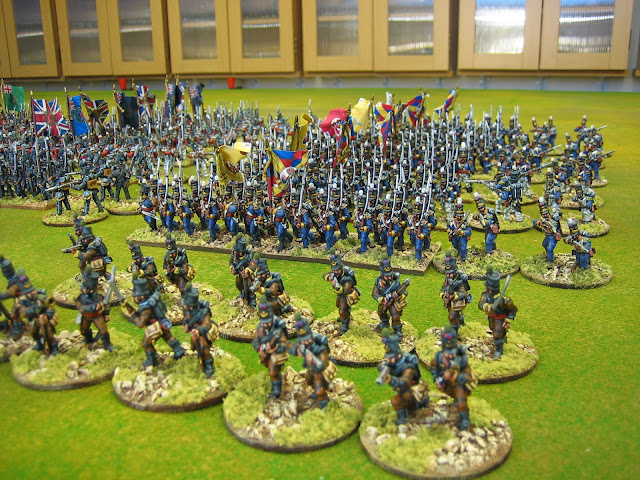
The British were all finished earlier this year and I posted a 'Parade of the British' at that point. Then I decided, rather than start the Spanish, I would finish the nice to haves for the French. I actually got these done some time ago but I've simply not had the time to blog post any progress for one reason or another. However, as late additions to an army I mistakenly said was finished, and posted about here in my 'Parade of the French', there are these beauties; if I'm not mistaken these extra bits bring the French army man count to 998.

Unless otherwise stated, all figures are by Front Rank. All are painted in enamels by yours truly. Flags are by GMB. Round bases are by War Bases, others are home cut.

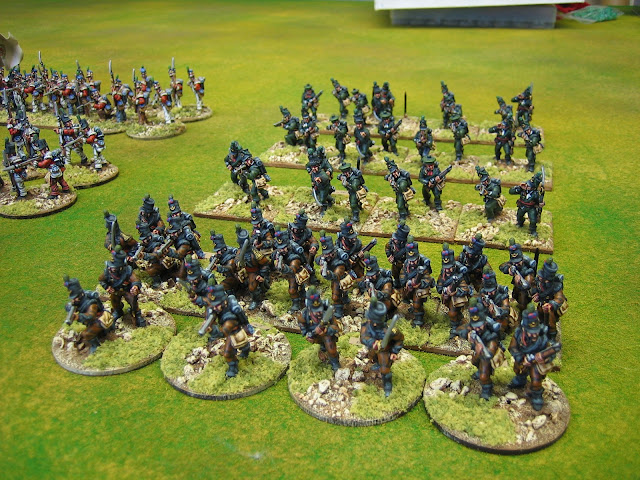
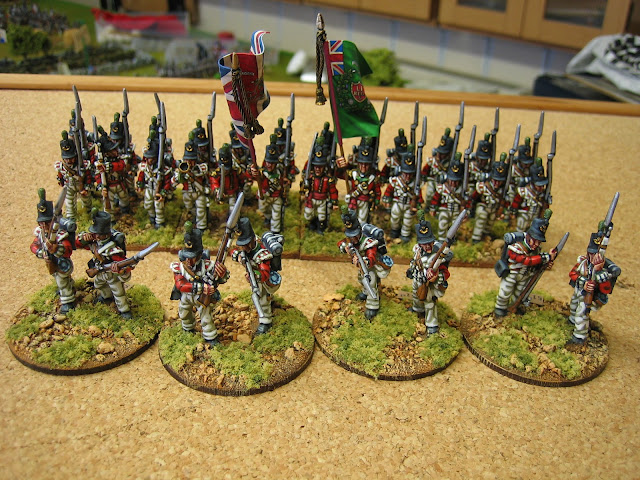
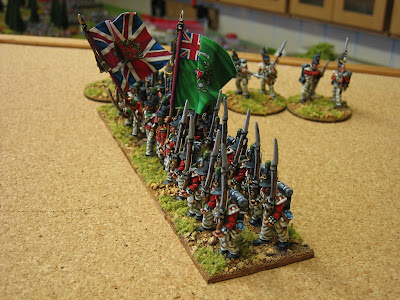
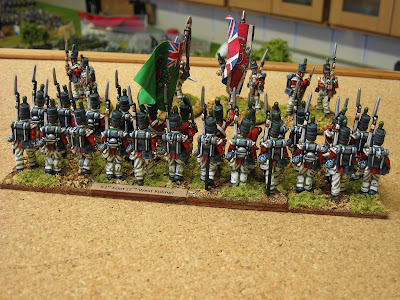
First up, two units of Legere. These are actually the 25th Legere in a bogus uniform - whip me!
The reason for choosing the 25th was a desire to have white over green plumes for the chasseurs, which I've always thought rather fetching. However, I also wanted to have voltigeurs in colpacks (which in turn led to having bearskins for the carrabiniers). Unfortunately, I couldn't find any Legere serving in the Peninsular that wore colpacks so I decided to combine my desires - and hence my 25th are in a partly bogus uniform. Apart from head gear (the plumes are right) they are correctly dressed.


I realise this decision will have the purer minded of you physically coughing up blood but, in the end they are my figures and I can do with them as I wish - their heretical nature will, like most victims of the Spanish inquisition, be forgotten with time. 

Bogusness aside, I think they look great! I just love the colpacks!
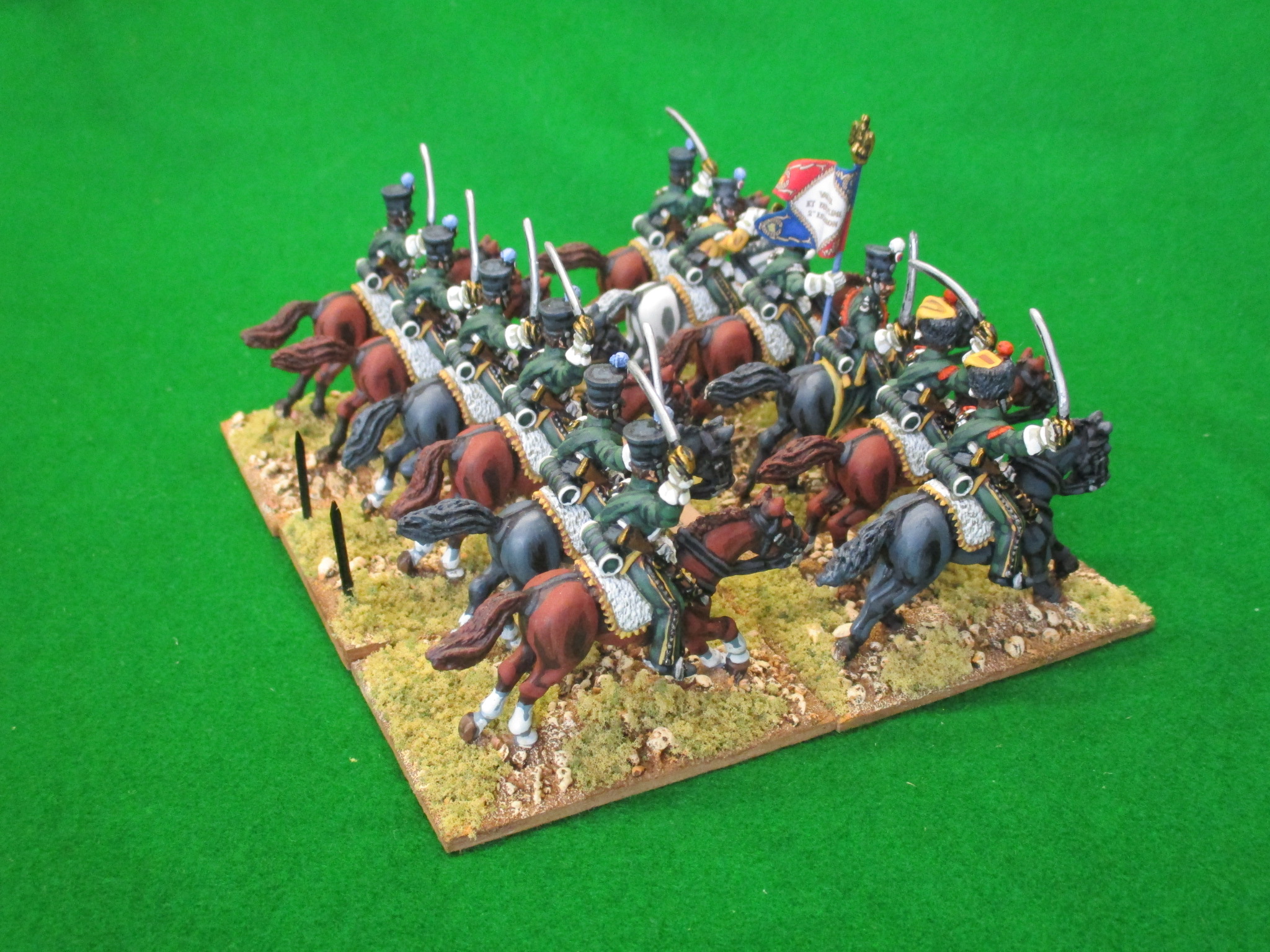
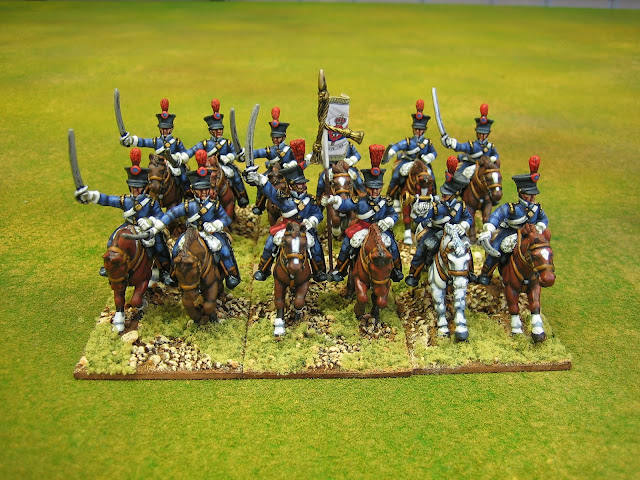
More historical, the 5th Chasseurs a Cheval. This unit brings the Chasseur regiment count to three.
It's another unit with yellow trim. Yellow is really doing it for me at the moment.
As with all of my French cavalry I've painted most of them as one company (blue pompoms in this case) because it makes painting easier and 'the lines cleaner': French cavalry pompoms confuse the heck out of me.
This pic shows the unit in line, with its name plate and coloured bead pins (for ID numbers and quality markers, etc.). I always use beads for this kind of thing because it renders roster sheets superfluous (which saves a lot of set up time): Everything is in front of you; you can call a unit by its proper name during play (even if you don't know it by sight), and you never need to look it up on a list to discover its qualities (which saves time in play). 


A second 'Corps' commander stand: I think the hussar officer is a one piece 'special' by Foundry (?), kindly donated by Jason W. The dice boxes are for holding army morale dice (one black showing multiples of six, one white showing digits of 1 - 6 to give a range of 0 - 42; and one orange showing the commanders 1 - 6 personal transferable morale points), and the pin is for holding his quality bead (red poor, green average, blue skilled).
I would have liked to add a foot figure but didn't have anything suitable. However, not to mind, as a second 'Corps' commander he probably won't get out much.

Next up, a post on my newly painted Spanish. These currently number four units of infantry, three guns (one HA), two limbers (one HA) and a commander. I'm very much looking forward to showing you these as there are several converted figures amongst them. 


Friday, 14 January 2022

Roll Call: My Anglo-Portuguese Army for the Peninsular

As I mentioned in my previous post, since half way through this lot, painting has often seemed more like a chore than a pastime. However, there is always the feeling of satisfaction following the completion of an arduous task and that's pretty much how I feel now. 

"Praise be.... There are no more Brits in the lead pile!"

Enough said.

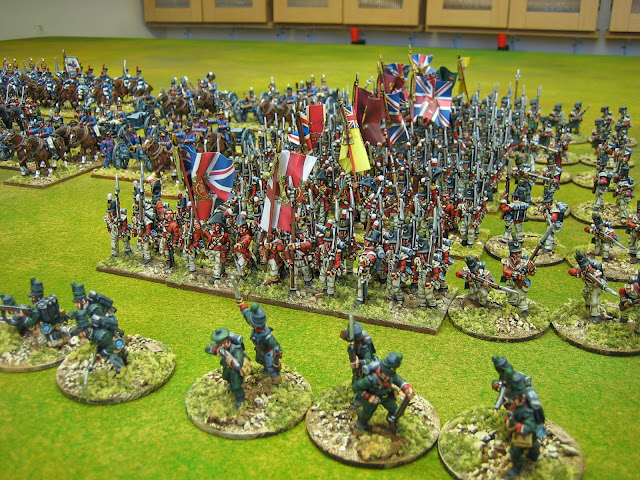
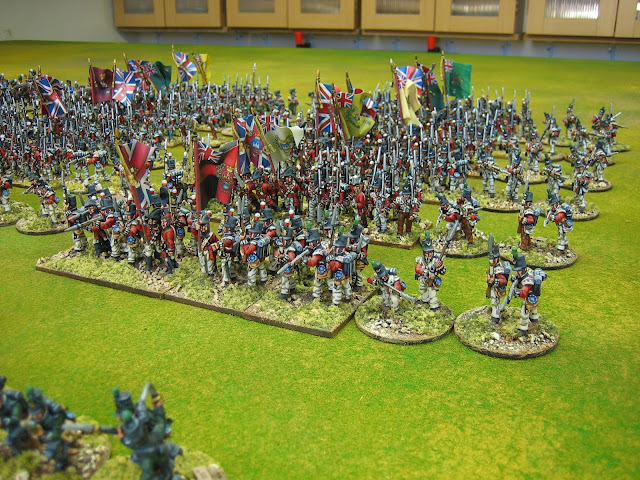
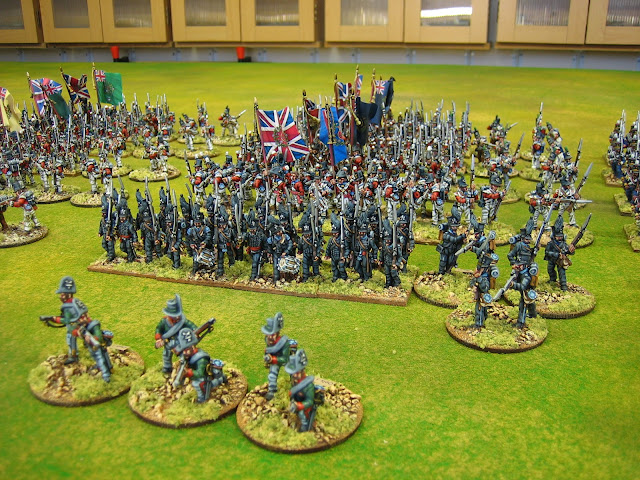
This army comprises twenty eight units of 'formed infantry'; three skirmish units of Riflemen; eight units of cavalry; eight guns and crew, plus four limbers; twenty three extra skirmish stands; ten command stands.

All, except six KGL Light Infantry figures (Warlord) are FRONT RANK MINIATURES.

All were painted by myself using enamels. 

Flags are a pretty even split between GMB Designs and Flags for the Lads. Both are excellent quality; GMB are printed on slightly thicker, shinier paper.

Bases are home cut 2mm MDF (square or officer stands), or War Bases (round for skirmishers). Basing is ink washed and dry brushed sand and grit finished off with foliage by Woodland Scenics (coarse turf: a burnt grass + yellow grass mix). Infantry / cavalry frontage is 45mm per stand.

The British infantry elements were the hardest to settle on because of the 'special troops' required for 1st, 7th and Light Divisions. Consequently, there are rather more special units, such as Highlanders, Guards and Brunswick Oels, than I would have chosen to do otherwise. Indeed, these three divisions grew the army well above the numbers I originally planned and in response the French army grew to match it - a definite case of mission creep.

At first glance the OOB seems incomplete. However, that is because I'm scaling my divisions (my basic command groups) at one unit to a thousand men and, more often than not, this means I need less units than were actually present in the divisions to make the divisions up. Furthermore, table space means collecting more would be practically pointless - I could never physically fit them on my table in any meaningful way.

A classic example of my incomplete OOB is having no 42nd (Black Watch) Highlanders for 1st Division. 1st division usually mustered about 7,500 men which works out at seven or eight units. Looking at the unit composition of 1st Division I decided it should comprise two Guard units, two Highland units (dropping one), one Highland Light unit, two KGL units (dropping two), and possibly one other British line unit (dropping one or two). 

Gentlemen of the League (especially the former and serving officers of the Black Watch), please note that the renowned 42nd were dropped simply because I had flags for the Camerons and the Gordons and no flags for the 42nd - sorry, guys. 

BTW, to the readers who kindly volunteered a donation of their spare flags to this project, thank you again.

The number of Portuguese Line units also seems a little low but, at one unit to one thousand men, there are enough Portuguese Line to furnish three Anglo-Portuguese divisions.

Outside of the afore mentioned divisions, the units I chose to paint had more to do with the flags I had than any specific OOB: They all fought in the Peninsular, and that's enough for me.

With the infantry figures I have, I can field five infantry divisions: 1st Division, Light Division and three other divisions, possibly including 7th Division (The Mongrels) all at the same time. Not bad, at all, and certainly enough for a big game.

A note on skirmishers: The number of skirmish figures attached to a unit does not represent proportionally accurate numbers. The number of stands (each two figures) equates to the unit's basic 'in game' skirmishing factor: A line unit has a skirmish factor of 2, so it gets two stands (four figures) even though this is proportionally too high for the number of figures in the unit; I could have halved the stands, or based less figures individually, but it didn't look as good. The British also have numerous independent skirmish stands that are used to bolster a division's overall skirmish factor - representing attached Rifle coys, Cacadores and such. 

The composition of the cavalry (one unit equates to 500 troopers) is a total fudge because the variation in a cavalry division was quite extreme from one year to the next and I wasn't prepared to cater beyond eight units in this department. However, given that I only use a light or heavy cavalry type classification (with quality adjustments), and one unit can easily substitute for another within that confine, I decided to go for a 50 / 50 split. It remains to be seen if I'm right on this.

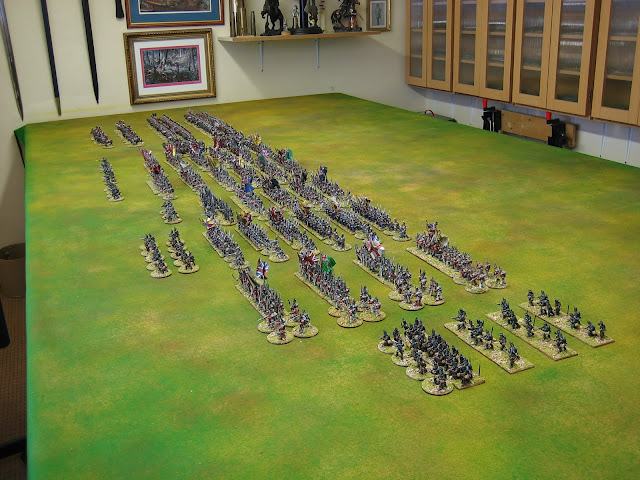
It all makes sense, kind of, to me at least, and here is my 'army'. 

We start with command: Ten command stands plus an engineer.

Two army commanders in Wellington and Beresford; plus an Officer of Engineers (an Officer of Engineers is often useful for scenarios).

Eight division / brigade / command group officer stands including two most definitely for the cavalry. 

Before you all jump down my throat, I know Picton didn't wear the top hat and civilian coat in the Peninsular but, he wouldn't look like Jack Hawkins without it.

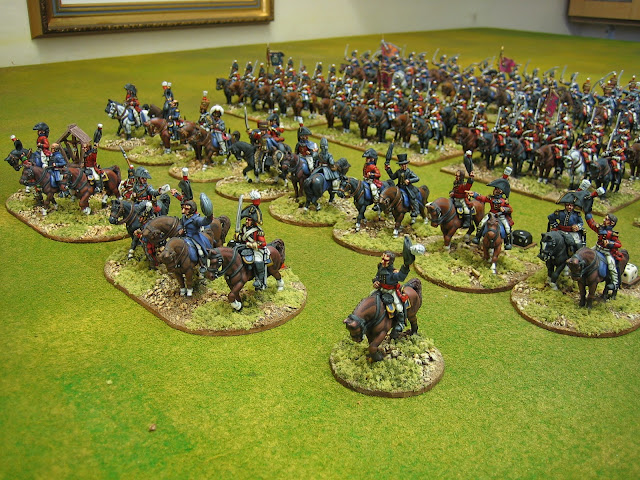
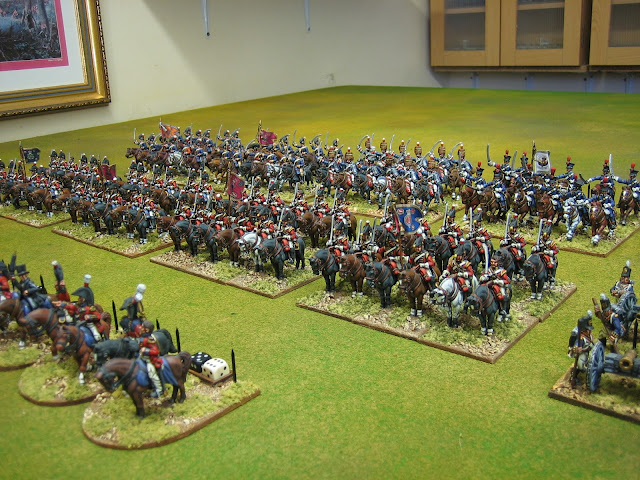
The Cavalry: Eight units, each 12 figures strong.

  • 1st and 3rd Dragoons; 1st and 2nd Dragoons KGL.
  • 13th and 14th Light Dragoons.
  • 10th Hussars
  • 10th Portuguese cavalry
Should I have had one less heavy unit and one more light?

The Artillery: Eight guns and four limbers. Each gun has 4 crew figures.

  • Four guns (British Foot Artillery) plus two limbers.
  • Two guns, (British Horse Artillery) plus one limber.
  • Two guns, (Portuguese Artillery) plus one limber.
The Portuguese limber is not available from Front Rank as pictured here. It is a simple conversion - British crew with outer buttons removed, shoulder wings added, sword and sword belt added, and a Portuguese artillery crew head swap. More pics and info here.

The Infantry: Six units each of 24 figures plus 4 skirmishers: 

  • 53rd Foot (Shropshire).
  • 88th Foot (Connaught Rangers).
  • 3rd Foot Guards (Scots Guards).
  • 1st Battalion Coldstream Guards.
  • 79th Foot (Cameron Highlanders).
  • 92nd Foot (Gordon Highlanders).
The Guards, two units, are for 1st Division but could double as other units if the flag position is swapped around. The Union flag is not the King's colour in these units - it's the crimson one.

The Infantry: Six units, each 24 figures plus 4 skirmishers:

  • 50th Foot (West Kent).
  • 27th Foot (The Inniskillings).
  • 5th Foot (Northumberland).
  • 9th Foot (East Norfolk).
  • 11th Foot (Devonshire).
  • 24th Foot (Warwickshire).
The Infantry: Five units, each 24 figures plus 4 skirmishers  (Note: the Brunswick Oels have 6 skirmishers).

  • Brunswick Oels (7th Division).
  • Chasseurs Britannique (7th Division, but can double as something else).
  • 1st Battalion KGL 
  • 2nd Battalion KGL.
  • 97th Foot (Queen's Germans, and with almost identical flags, can easily double as a third KGL unit).
The Infantry: Six Portuguese units, each 24 figures plus 4 skirmishers:

  • 8th; 9th; 12th; 13th; 16th; 21st.
Note the Cacadore skirmisher stands in the foreground. Cacadore units were invariably small, at around 400 actives, so they never quite hit the mark to be fielded as full units. I have chosen to make them additional division assets to be added to the divisional skirmish screens. They are painted as the 6th and the 8th Cacadores. The exception is in Light Division were I field one full unit to represent the multiple units therein (see below).

The Infantry: Four light infantry units each of 24 figures plus 8 skirmishers:

  • 52nd Foot (Oxfordshire) Light Infantry.
  • 51st Foot (2nd West Riding) Light Infantry.
  • 43rd Foot (Monmouthshire) Light Infantry.
  • 71st Foot Highland Light Infantry.
52nd and 43rd are for the Light Division, 71st is for 1st Division and 51st is for 7th Division. 

The Infantry: One unit of 24 figures plus 8 skirmishers; 3 units of 9 Riflemen (Skirmish order):

  • 3rd Cacadores
  • 95th Rifles (skirmish units) x3
All four of these units are for the Light Division.


Finally, extra skirmishers for deployment to the divisional skirmish musters, each stand 2 figures (pictured above, out in front, on round bases):

  • 6th Cacadores (5 stands).
  • 8th Cacadores (5 stands).
  • 95th Rifles (4 stands).
  • 60th Rifles (3 stands).
  • KGL Light Infantry (3 stands).
  • Oels Jagers (3 stands).
Totals: Men 1040; Horses 145; Guns 8; Limbers 4; Ammunition carts 2.

So, am I short? Possibly. If I were to add, and I have no intention to do so, I'd add another unit of cavalry - either light dragoons or Portuguese - and a couple of units of Portuguese line infantry. But, and here's the rub, I don't want to paint any more of them. Nor do I have the storage capacity anyway - see below.

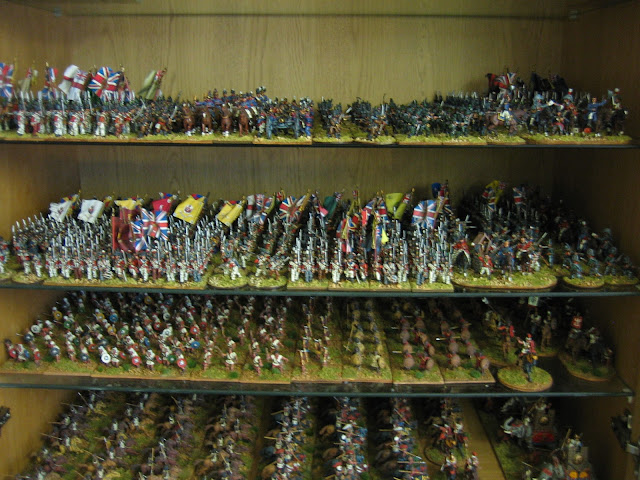
Now, there is one more part to this tale of woe: Don't let me get away without confessing a sin. It's a simple sin and, I think, one not often spoken of but shared by many: When conceiving and planning a collection I have more than history, or even a good game, in mind. In my view, there is no point collecting what you can't possibly store. Consequently, I do buy figures by the yard - there, I've said it.

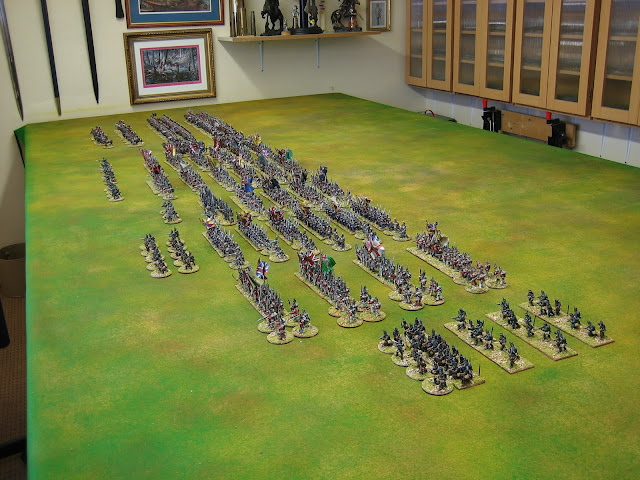
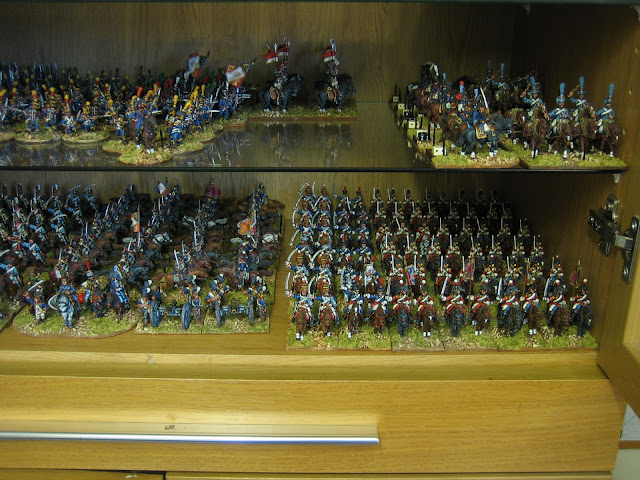
The two pictures above shows just how much that this is the case: Crammed in they are, crammed into a strictly allotted space. 

You will note two large spaces on the first French shelf above the cavalry (there's another completely full French shelf above that). I'm going to fill those spaces next, with two units of Legere, a unit of Chasseurs a Cheval and a second army command stand. That will completely finish the French.

Then I'll start the Spanish. It never ends....

Thursday, 13 January 2022

The Anglo Portuguese are finished!

I have already given myself a pat on the head for finally getting this long overdue painting done, so please don't feel a need to congratulate me. Frankly, after the half way point I've found this Napoleonic project to be a painting chore rather than a painting pleasure and I'm happier than a pig in the proverbial to finally see the back of the Anglo-Portuguese lead pile.

That said, I did save an easy unit for last. Not a bad policy, IMHO. 

I give you, the Portuguese 10th cavalry. 

Figures are by Front Rank. 

Painted by myself in enamels.

The flag is GMB Designs.

Bases are home cut MDF.
Unusually for Front Rank, the sword arms are a separate casting (glued on). We'll see how that works out over time but, I would much prefer them as a 'safer', more 'durable', one piece casting.

With a few spare command figures I had left over, plus a shrine to make up the 'figure count', I did this second British army command stand featuring Beresford. 

Note that I took your advice and painted the Christ figure on the cross. It works, thank you for your input.
At the back of these stands there are the dice slots for army morale (black and white), transferable divisional morale (orange) and a pin for a quality bead. 

The black and white beads give a range of 0 - 42. 

The black beads count sixes, white beads count digits - in this case the total adds up to 8. 

Black 1 = 6 + White 2 = 8, if that makes sense. 

So next up, roll call.

Let's have a parade! 


Wednesday, 29 December 2021

Last unit of Anglo-Portuguese infantry - My local regiment.

I'm getting soooo close to finishing the Anglo Portuguese for the Peninsular that I'm beginning to believe it's going to happen.

These figures represent my local regiment: Their regimental museum is in Halifax. I give you the 51st Regiment of Foot, 2nd West Riding, Light Infantry.

Actually, if I'd lived back then and joined up, I'd more likely be with the 27th (the Inniskillings) or some such but, that's another story. 

Figures are by Front Rank. 

I actually bought this unit as an afterthought last summer, tagging it onto my Spanish army order. I'm glad I did because it seems to be taking ages to sort out the sale of Front Rank to Gripping Beast - meanwhile it's not trading.
I bought them so that I have enough light infantry units to field (at my chosen divisional figure scale of 1 unit to 1000 men) 1st Division, 7th Division and the Light Division at the same time. 

The 51st served with 7th Division, the Mongrels: So named because its battalions had coats in red, blue, green, brown or black.  
Green facings, which always goes strikingly well with red. They were painted, in enamels, a few weeks before Christmas. 

I was hoping this unit would feature with the last unit of the Anglo-Portuguese army (the 10th Portuguese Cavalry) but, I've been too busy to finish them; I wanted to get this posted before New Year to register the 51st on the blog as a unit painted in 2021. 

I'll finish the Anglo Portuguese army early next year: The Portuguese cavalry are base painted, hands and faces done, etc.

So, that's it for 2021. 

Happy New Year, to all. I hope everyone has a good 2022.


Thursday, 25 November 2021

Bulking out a command stand: A roadside shrine


I'm in the process of sorting out the last batches of figures to finish the Anglo-Portuguese and French armies. 

I had always planned to do a second corps command stand for the French (because I can see two corps commanders featuring at the same time) and consequently, I've had three mounted figures and a couple of foot figures to do this in my lead pile for a long time. 

I hadn't planned anything similar for the Anglo-Portuguese but I had thought about having a Beresford command stand (I even painted him). Then I decided he was surplus to requirements and didn't rebase him when I rebased the other officers.  

However, whilst rummaging through the bag of odds and sods (left over from the project) I came across another unused British mounted officer. That would be two mounted figures, and I have an unused painted foot officer and an unpainted sergeant marching with his partisan over his shoulder: But, that is still not quite enough for a full C-in-C stand. Could I use a 'stand filler' as the extra piece I would need?

I could make a signpost as a filler, or a blasted tree trunk, or what about a roadside shrine! A shrine would not be out of place in a very Catholic Spain.

A roadside shrine could be quite big, at least as big as a figure, and it would be more eye catching than a signpost, or a tree stump. 

I'm not a great model maker, average at best, but even I could probably manage a cross in some kind of housing, perhaps on a Milliput stone plinth with a kneeling step. 

I had some bits of plastic (Perry plastic bases and Airfix bits) I could cut up to make the cross and the housing, and Milliput is always to hand, so I got to work.

Then I decided that a proper crucifix might look better - more eye catching - than a plain cross. Sculpting is something I'm not very good at at all but, the Christ figure would be tiny and being such a recognisable thing only an impression would be needed. Out came the Milliput and in a jiffy I had this little piece of treasure - it's not that good but, you immediately know what it is.

I'm not sure how I'll paint the crucifix. Perhaps as a brass Christ on a wooden cross, or perhaps all wood, or all brass. Not being all that up on early 19th Century Spanish shrines I'm open to suggestions.

BTW, the plinth isn't a solid lump of Milliput. It's actually a block of balsawood with a coat of Millitput applied to the outside. Other construction is all visible. 


Edit: I have painted it up with a carved wood crucifix (which I could always, and simply, repaint as brass) and I think it looks pretty good. 

Here is a close up of the Christ. You can see just how simple I made the construction, with rolled Milliput for arms and legs - position, more than detail, being everything.


Tuesday, 23 November 2021

Brunswick Oels Jagers for the Peninsular. Did somebody die?


The answer is, yes. If you want to know who, go to this wiki-link.

This is one of those iconic units so beloved by wargamers. I wanted one too, so when Alec sculpted these last year they went straight into my next Front Rank order. I wasn't disappointed, they are superbly designed and executed. 

The trouble with this unit, and I've painted it at least twice over the years for clients, is that it's a headache to paint: Black, black and more black; even the buttons are black; and so are the cuffs, which I'd forgotten were black.

Although I don't usually do painting tips in blog posts like this, I will for this unit - they might be useful in this case.
I've learned that I have to throw away my usual painting 'order of march' when doing this unit. 

After undercoating, I painted the whole figure with my black base paint (Humbrol 33), stem to stern. 

Then, in the following order, I: 
  1. Painted hands and faces.
  2. Painted none black equipment (canteens, packs and pack rolls, musket stocks), and hair. 
  3. Highlighted coats, lace and shako plumes.
  4. Painted blue collar and shoulder straps, which are best highlighted very light.
  5. Touched up belts, shako, shoes, and musket metal with plain black to re-establish some nice hard edges.
  6. Highlighted black belts, shoes, shako, etc. 
  7. Finished, as usual, with metals.
I think the trick to livening these boys up is to use two or more black hues using the same black base. I used two hues; two or three highlights of each hue. I paint in enamels; I've added the Humbrol numbers I used in parentheses.
  1. Blue Hue: Used for soft stuff such as clothing, plume and lace: Black (33) and sky blue (89). I added a bit of white (34) to this hue to get a third highlight, dry brushed over lace and plume to bring these details out even further. 
  2. Grey Hue: Used for hard stuff such as belts, shako and shoes: Black (33) and white (34) - only two highlights used. 
You will note that the officers have red sashes; apparently they wore red, not national colours, in the Peninsular.
All in all, they make for quite an impressive, if funerial, unit. 

They are not quite as monotone black as you might imagine and I put this down to the using sky blue in the main highlight hue - it has more life than plain black and white grey.

Bases are 2mm MDF: Square bases are home cut 45mm x 45mm. Round bases are 45mm diameter from Warbases.
Lastly, I also bought a six pack of jagers to add to my 'floating' divisional skirmish stand count. 

I will always remember these guys because, a couple of decades ago, I played in a huge Salamanca game where I commanded the odd base of these chaps. Being something of a Napoleonic noob at the time, I enquired who they were by asking "Why do I have Austrians?" I still think it was an easy mistake to make.

Though, I should have remembered who they were from my second oldest wargame book: Blandford's Uniforms of the Napoleonic Wars (received Christmas 1976; now without dust cover and looking very tatty), from which I've taken these uniform details.

The thing is, I can't find a picture of the the hat badge for this 1809 unit. These Front Rank figures came with a running horse badge, so they have that. If you know differently (I suspect they had a hunting horn) please let me know so I can edit this with proper info. 

Note that, as per Blandford, I have removed the figures' hat plumes. 

Blandford also shows the uniform without a blanket roll but, I think this is 'campaign dress' acceptable.

Officially, that is the Anglo-Portuguese project done. All of the originally planned units, plus this late addition, are now painted. However, when I ordered the Spanish hordes a few months ago, I added a couple of extra British units and three French units. Consequently, I'm ploughing on. 

Next up, 51st (2nd West Riding) Light Infantry - my local regiment, their regimental museum is in Halifax - to fight alongside the Brunswick Oels Jagers as part of 7th Division. 

Saturday, 20 November 2021

Napoleonic British hussars with a Spanish twist.


As I am making a push to finish the British I thought I'd get the difficult cavalry unit out of the way.


10th Prince of Wales Own Hussars (or are they?).  

These figures are not my favourite Front Rank figures. I think the sculpts are quite old and the detail, which is very intricate, on things like palisse button loops and lace, doesn't quite suit my painting style. 
That said, I think they've come out okay. Very red white and blue, and one for the Brexiteers.

Note the distinctive grey fur cap of the officer, and the grey fur trim on the pelisses.
The six bases are 45mm x 60mm x 2mm MDF. 

Two of the bases have a 7mm wide bar set at the back; one to hold the name plate; one to secure the two pins I use to hold command group ID and unit quality beads. 

Consequently, these stands are slightly raised at the back; this construction is the same for all my units in this collection. It has allowed me to do something special with this unit because......

..........this unit is not only usable by the British as the 10th Hussars, at a pinch, they can also be used for..........
....the Spanish Husares de Almansa regiment raised by General Whittingham (in Spanish Service) in 1810 and uniformed, it is said, in the uniform of the British 10th Hussars supplied by Britain. 

How EU friendly is that!

However, it does seem that there may have been significant differences in the uniform so a bit of imagination will be needed to make the change. 

I've seen two modern pictures of the Husares de Almansa (sources unknown) and both show the uniform of the 10th with the following differences: Black fur caps for all ranks; white fur edged pelisses.

The differences, especially in cap colour is striking but, as you know, I like a bit of fudge.

I've used a magnetic strip for the 10th Hussar's name plate whilst that for the Husares de Almansa is  stuck onto the base atop a piece of thin steel sheet. 

To increase the magnetism of the steel sheet, I've set three small earth magnets into the name bar below it. This seems to add quite a lot of magnetic pull.

I had to think hard before deciding to which name plate to make removable. In the end it came down to this: The unit will most commonly be British and stored as such, so to keep the plate in place and magnetised for most of the time (especially when in storage) that name is the removable one.

Next up, an infantry unit: The Brunswick Oels. Then just two more to go!